
vivo S12 Pro vs Xiaomi 13 Lite: A Detailed Comparison
| Phones Images | |||||
|---|---|---|---|---|---|
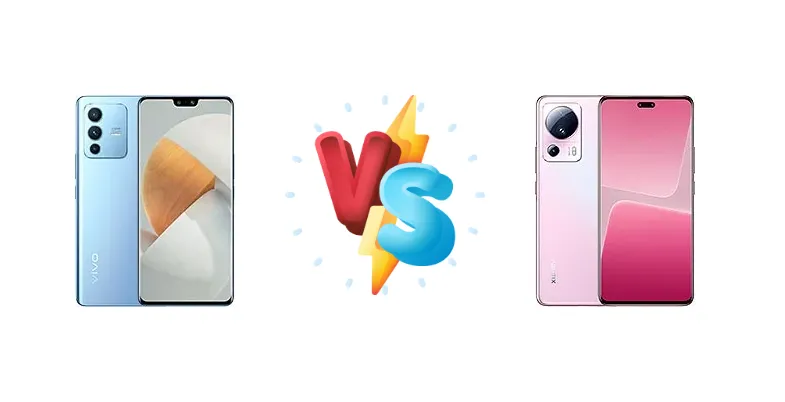
|
🏆 Quick Verdict
The Xiaomi 13 Lite edges out the vivo S12 Pro thanks to its faster charging, brighter display, and generally more modern chipset. However, the vivo S12 Pro might appeal to users prioritizing selfie camera quality and a more refined design. Ultimately, it depends on your priorities.
| PHONES | ||
|---|---|---|
| Phone Names | vivo S12 Pro | Xiaomi 13 Lite |
| Network | ||
|---|---|---|
| 2G bands | GSM 850 / 900 / 1800 / 1900 | GSM 850 / 900 / 1800 / 1900 |
| 3G bands | HSDPA 850 / 900 / 1700(AWS) / 1900 / 2100 | HSDPA 800 / 850 / 900 / 1700(AWS) / 1900 / 2100 |
| 4G bands | 1, 2, 3, 4, 5, 7, 8, 28, 34, 38, 39, 40, 41 | 1, 2, 3, 4, 5, 7, 8, 12, 13, 17, 18, 19, 20, 26, 28, 32, 38, 40, 41, 42, 66 |
| 5G bands | 1, 3, 5, 8, 28, 41, 77, 78 SA/NSA | 1, 3, 5, 7, 8, 20, 28, 38, 40, 41, 66, 77, 78 SA/NSA |
| Speed | HSPA, LTE, 5G | HSPA, LTE, 5G |
| Technology | GSM / CDMA / HSPA / CDMA2000 / LTE / 5G | GSM / HSPA / LTE / 5G |
| CDMA2000 1x | - | |
| Launch | ||
|---|---|---|
| Announced | 2021, December 22 | 2023, February 26 |
| Status | Available. Released 2021, December 30 | Available. Released 2023, March 08 |
| Body | ||
|---|---|---|
| Build | - | Glass front (Gorilla Glass 5), glass back, plastic frame |
| Dimensions | 159.5 x 73.3 x 7.4 mm (6.28 x 2.89 x 0.29 in) | 159.2 x 72.7 x 7.2 mm (6.27 x 2.86 x 0.28 in) |
| SIM | Nano-SIM + Nano-SIM | · Nano-SIM + eSIM· Nano-SIM + Nano-SIM |
| Weight | 171 g (6.03 oz) | 171 g (6.03 oz) |
| - | IP53, dust and splash resistant | |
| Display | ||
|---|---|---|
| Protection | - | Corning Gorilla Glass 5 |
| Resolution | 1080 x 2400 pixels, 20:9 ratio (~401 ppi density) | 1080 x 2400 pixels, 20:9 ratio (~402 ppi density) |
| Size | 6.56 inches, 103.9 cm2 (~88.9% screen-to-body ratio) | 6.55 inches, 103.6 cm2 (~89.5% screen-to-body ratio) |
| Type | AMOLED, 90Hz, HDR10+, 1300 nits (peak) | AMOLED, 68B colors, Dolby Vision, HDR10+, 120Hz, 500 nits (typ), 1000 nits (peak) |
| Platform | ||
|---|---|---|
| CPU | Octa-core (1x3.0 GHz Cortex-A78 & 3x2.6 GHz Cortex-A78 & 4x2.0 GHz Cortex-A55) | Octa-core (1x2.4 GHz Cortex-A710 & 3x2.36 GHz Cortex-A710 & 4x1.8 GHz Cortex-A510) |
| Chipset | Mediatek Dimensity 1200 (6 nm) | Qualcomm SM7450-AB Snapdragon 7 Gen 1 (4 nm) |
| GPU | Mali-G77 MC9 | Adreno 644 |
| OS | Android 11, OriginOS Ocean | Android 12, MIUI 14 |
| Memory | ||
|---|---|---|
| Card slot | No | No |
| Internal | 128GB 8GB RAM, 256GB 8GB RAM, 256GB 12GB RAM | 64GB 8GB RAM, 128GB 8GB RAM, 256GB 8GB RAM |
| UFS 3.1 | UFS 2.2 | |
| Main Camera | ||
|---|---|---|
| Dual | 50 MP, f/2.0, (wide), AF 8 MP, f/2.3, 105˚ (ultrawide) | - |
| Features | Dual-LED flash, HDR, panorama | Dual-LED dual-tone flash, HDR, panorama |
| Triple | 108 MP, f/1.9, 26mm (wide), 1/1.52", PDAF 8 MP, f/2.2, 120˚, 16mm (ultrawide), 1/4.0", 1.12µm 2 MP (macro) | 50 MP, f/1.8, 23mm (wide), 1/1.56", 1.0µm, PDAF 8 MP, f/2.2, 119˚ (ultrawide), 1/4.0", 1.12µm 2 MP (macro) |
| Video | 4K@30fps, 1080p@30fps, gyro-EIS | 4K@30fps, 1080p@30/60/120fps, 720p@960fps |
| Selfie camera | ||
|---|---|---|
| Dual | 50 MP, f/2.0, (wide), AF 8 MP, f/2.3, 105˚ (ultrawide) | 32 MP, f/2.4, 100˚ (ultrawide), 1/2.74", 0.8µm 8 MP, f/2.3, (depth) |
| Features | Dual-LED flash, HDR | Dual-LED flash, HDR |
| Video | 4K@30fps, 1080p@30fps | 1080p@30/60fps |
| Sound | ||
|---|---|---|
| 3.5mm jack | No | No |
| 35mm jack | No | No |
| Loudspeaker | Yes | Yes |
| 24-bit/192kHz audio | 24-bit/192kHz audio | |
| Comms | ||
|---|---|---|
| Bluetooth | 5.2, A2DP, LE, aptX HD | 5.2, A2DP, LE |
| Infrared port | - | Yes |
| NFC | Yes | Yes (market/region dependent) |
| Positioning | GPS, GLONASS, GALILEO, BDS, QZSS | GPS (L1), GLONASS (G1), BDS (B1I+B1c), GALILEO (E1), QZSS (L1) |
| Radio | No | No |
| USB | USB Type-C, OTG | USB Type-C 2.0, OTG |
| WLAN | Wi-Fi 802.11 a/b/g/n/ac/6, dual-band, Wi-Fi Direct | Wi-Fi 802.11 a/b/g/n/ac/6, dual-band |
| Features | ||
|---|---|---|
| Sensors | Fingerprint (under display, optical), accelerometer, gyro, proximity, compass | Fingerprint (under display, optical), accelerometer, gyro, proximity, compass |
| Battery | ||
|---|---|---|
| Charging | 44W wired | 67W wired, 100% in 40 min |
| Type | 4300 mAh | Li-Po 4500 mAh |
| Misc | ||
|---|---|---|
| Colors | Black, Blue, Yellow | Black, Lite Blue, Lite Pink |
| Models | V2163A | - |
| Price | About 430 EUR | About 180 EUR |
| Tests | ||
|---|---|---|
| Battery life | - | Endurance rating 93h |
| Camera | - | Photo / Video |
| Display | - | Contrast ratio: Infinite (nominal) |
| Loudspeaker | - | -28.5 LUFS (Average) |
| Performance | - | AnTuTu: 534143 (v9) GeekBench: 2936 (v5.1), 2434 (v6) GFXBench: 33fps (ES 3.1 onscreen) |
vivo S12 Pro
- Excellent selfie camera
- Stylish design
- Smooth user experience
- Good overall performance
- Slower charging
- Less bright display
- Chipset slightly less powerful than competitor
Xiaomi 13 Lite
- Faster charging (67W)
- Brighter display
- More powerful chipset
- Excellent battery life
- Design less distinctive
- Selfie camera not as strong as vivo S12 Pro
- ’Infinite’ contrast ratio is nominal
Display Comparison
The Xiaomi 13 Lite boasts a significantly brighter display (938 nits) compared to the vivo S12 Pro, making it easier to see in direct sunlight. While the vivo S12 Pro's display is perfectly adequate, the Xiaomi 13 Lite's higher brightness provides a noticeable advantage. The 'Infinite' contrast ratio mentioned for the Xiaomi 13 Lite is a nominal value and doesn't provide concrete data.
Camera Comparison
Both phones feature capable camera systems. The vivo S12 Pro is known for its excellent selfie camera, often praised for its natural skin tones and effective beautification features. The Xiaomi 13 Lite offers a versatile main camera system, potentially providing better overall image quality in various lighting conditions. Detailed camera comparisons would require extensive testing.
Performance
The Xiaomi 13 Lite's Snapdragon 7 Gen 1 chipset (4nm) generally outperforms the vivo S12 Pro's Dimensity 1200 (6nm) in benchmarks and real-world usage. Expect smoother multitasking, faster app loading times, and better gaming performance on the Xiaomi 13 Lite. The Dimensity 1200 is still capable, but the Snapdragon offers a noticeable upgrade.
Battery Life
The Xiaomi 13 Lite claims an impressive endurance rating of 93h, suggesting excellent battery life. While the vivo S12 Pro's battery life is respectable, it likely won't match the Xiaomi 13 Lite's longevity. Furthermore, the Xiaomi 13 Lite's 67W charging is significantly faster than the vivo S12 Pro's 44W charging, allowing for quicker top-ups.
Buying Guide
Who should buy the vivo S12 Pro? Users prioritizing excellent selfie camera performance, a stylish design, and a smooth user experience. Who should buy the Xiaomi 13 Lite? Those seeking faster charging, a brighter display for outdoor use, and a more powerful chipset for gaming and demanding tasks.