
Xiaomi 12T Pro vs vivo S12 Pro: Which Mid-Range Flagship Reigns Supreme?
| Phones Images | |||||
|---|---|---|---|---|---|
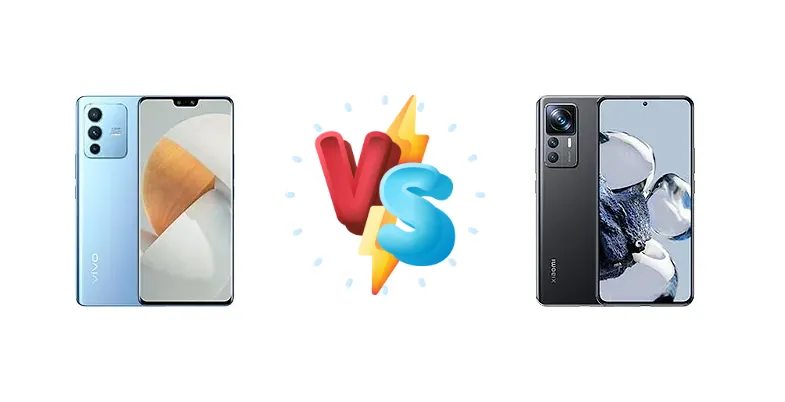
|
🏆 Quick Verdict
For most users, the Xiaomi 12T Pro emerges as the stronger choice. Its Snapdragon 8+ Gen 1 chipset delivers significantly superior performance, and the blazing-fast 120W charging is a game-changer. However, the vivo S12 Pro remains a viable option for those prioritizing value and a more refined software experience.
| PHONES | ||
|---|---|---|
| Phone Names | vivo S12 Pro | Xiaomi 12T Pro |
| Network | ||
|---|---|---|
| 2G bands | GSM 850 / 900 / 1800 / 1900 | GSM 850 / 900 / 1800 / 1900 |
| 3G bands | HSDPA 850 / 900 / 1700(AWS) / 1900 / 2100 | HSDPA 800 / 850 / 900 / 1700(AWS) / 1900 / 2100 |
| 4G bands | 1, 2, 3, 4, 5, 7, 8, 28, 34, 38, 39, 40, 41 | 1, 2, 3, 4, 5, 7, 8, 12, 13, 17, 18, 19, 20, 25, 26, 28, 32, 38, 39, 40, 41, 42, 48, 66 |
| 5G bands | 1, 3, 5, 8, 28, 41, 77, 78 SA/NSA | 1, 3, 5, 7, 8, 20, 28, 38, 40, 41, 66, 77, 78, 75 SA/NSA |
| Speed | HSPA, LTE, 5G | HSPA, LTE, 5G |
| Technology | GSM / CDMA / HSPA / CDMA2000 / LTE / 5G | GSM / HSPA / LTE / 5G |
| CDMA2000 1x | - | |
| Launch | ||
|---|---|---|
| Announced | 2021, December 22 | 2022, October 04 |
| Status | Available. Released 2021, December 30 | Available. Released 2022, October 06 |
| Body | ||
|---|---|---|
| Dimensions | 159.5 x 73.3 x 7.4 mm (6.28 x 2.89 x 0.29 in) | 163.1 x 75.9 x 8.6 mm (6.42 x 2.99 x 0.34 in) |
| SIM | Nano-SIM + Nano-SIM | · Nano-SIM + eSIM· Nano-SIM + Nano-SIM |
| Weight | 171 g (6.03 oz) | 205 g (7.23 oz) |
| - | IP53, dust and splash resistant | |
| Display | ||
|---|---|---|
| Protection | - | Corning Gorilla Glass 5 |
| Resolution | 1080 x 2400 pixels, 20:9 ratio (~401 ppi density) | 1220 x 2712 pixels, 20:9 ratio (~446 ppi density) |
| Size | 6.56 inches, 103.9 cm2 (~88.9% screen-to-body ratio) | 6.67 inches, 107.4 cm2 (~86.7% screen-to-body ratio) |
| Type | AMOLED, 90Hz, HDR10+, 1300 nits (peak) | AMOLED, 68B colors, 120Hz, Dolby Vision, HDR10+, 500 nits (typ), 900 nits (peak) |
| Platform | ||
|---|---|---|
| CPU | Octa-core (1x3.0 GHz Cortex-A78 & 3x2.6 GHz Cortex-A78 & 4x2.0 GHz Cortex-A55) | Octa-core (1x3.19 GHz Cortex-X2 & 3x2.75 GHz Cortex-A710 & 4x2.0 GHz Cortex-A510) |
| Chipset | Mediatek Dimensity 1200 (6 nm) | Qualcomm SM8475 Snapdragon 8+ Gen 1 (4 nm) |
| GPU | Mali-G77 MC9 | Adreno 730 |
| OS | Android 11, OriginOS Ocean | Android 12, upgradable to Android 14, HyperOS |
| Memory | ||
|---|---|---|
| Card slot | No | No |
| Internal | 128GB 8GB RAM, 256GB 8GB RAM, 256GB 12GB RAM | 128GB 8GB RAM, 256GB 8GB RAM, 256GB 12GB RAM |
| UFS 3.1 | UFS 3.1 | |
| Main Camera | ||
|---|---|---|
| Dual | 50 MP, f/2.0, (wide), AF 8 MP, f/2.3, 105˚ (ultrawide) | - |
| Features | Dual-LED flash, HDR, panorama | Color spectrum sensor, Dual-LED dual-tone flash, HDR, panorama |
| Triple | 108 MP, f/1.9, 26mm (wide), 1/1.52", PDAF 8 MP, f/2.2, 120˚, 16mm (ultrawide), 1/4.0", 1.12µm 2 MP (macro) | 200 MP, f/1.7, (wide), 1/1.22", 0.64µm, PDAF, OIS 8 MP, f/2.2, 120˚ (ultrawide), 1/4.0", 1.12µm 2 MP (macro) |
| Video | 4K@30fps, 1080p@30fps, gyro-EIS | 8K@24fps, 4K@30/60fps, 1080p@30/60/120/240fps, HDR10+ |
| Selfie camera | ||
|---|---|---|
| Dual | 50 MP, f/2.0, (wide), AF 8 MP, f/2.3, 105˚ (ultrawide) | - |
| Features | Dual-LED flash, HDR | HDR, panorama |
| Single | - | 20 MP, f/2.2, (wide), 1/3.47", 0.8µm |
| Video | 4K@30fps, 1080p@30fps | 1080p@30/60fps, HDR |
| Sound | ||
|---|---|---|
| 3.5mm jack | No | No |
| 35mm jack | No | No |
| Loudspeaker | Yes | Yes, with stereo speakers |
| 24-bit/192kHz audio | Tuned by Harman Kardon 24-bit/192kHz audio | |
| Comms | ||
|---|---|---|
| Bluetooth | 5.2, A2DP, LE, aptX HD | 5.2, A2DP, LE, aptX HD |
| Infrared port | - | Yes |
| NFC | Yes | Yes (market/region dependent) |
| Positioning | GPS, GLONASS, GALILEO, BDS, QZSS | GPS (L1+L5), GLONASS (L1), BDS (B1I+B1c+B2a), GALILEO (E1+E5a), QZSS (L1+L5), NavIC (L5) |
| Radio | No | No |
| USB | USB Type-C, OTG | USB Type-C 2.0, OTG |
| WLAN | Wi-Fi 802.11 a/b/g/n/ac/6, dual-band, Wi-Fi Direct | Wi-Fi 802.11 a/b/g/n/ac/6, dual-band, Wi-Fi Direct |
| Features | ||
|---|---|---|
| Sensors | Fingerprint (under display, optical), accelerometer, gyro, proximity, compass | Fingerprint (under display, optical), accelerometer, gyro, proximity, compass |
| Battery | ||
|---|---|---|
| Charging | 44W wired | 120W wired, 100% in 19 min |
| Type | 4300 mAh | Li-Po 5000 mAh |
| Misc | ||
|---|---|---|
| Colors | Black, Blue, Yellow | Black, Silver, Blue |
| Models | V2163A | 22081212UG, 22081212G |
| Price | About 430 EUR | $ 208.76 / € 167.62 |
| SAR | - | 1.08 W/kg (head) 1.07 W/kg (body) |
| SAR EU | - | 1.00 W/kg (head) 1.00 W/kg (body) |
| Tests | ||
|---|---|---|
| Battery life | - | Endurance rating 91h |
| Camera | - | Photo / Video |
| Display | - | Contrast ratio: Infinite (nominal) |
| Loudspeaker | - | -24.1 LUFS (Very good) |
| Performance | - | AnTuTu: 1032185 (v9) GeekBench: 4081 (v5.1) GFXBench: 65fps (ES 3.1 onscreen) |
vivo S12 Pro
- Potentially more refined software experience (FunTouch OS)
- Sleek and stylish design (based on brand reputation)
- Competitive price point
- Less powerful chipset (Dimensity 1200)
- Slower charging speed (44W)
Xiaomi 12T Pro
- Significantly faster performance (Snapdragon 8+ Gen 1)
- Blazing-fast 120W charging (19 minutes to full)
- Brighter display (913 nits)
- Xiaomi’s MIUI can be polarizing
- Potentially higher price
Display Comparison
The Xiaomi 12T Pro boasts a brighter display, reaching a measured 913 nits, compared to an unspecified peak brightness for the vivo S12 Pro. While both offer an 'infinite' contrast ratio (typical for OLED panels), the 12T Pro’s higher peak brightness translates to better visibility in direct sunlight. The lack of LTPO technology on either device suggests both will rely on variable refresh rate switching rather than adaptive refresh rates for power efficiency. Bezels and color accuracy are not specified, making it difficult to assess these aspects definitively.
Camera Comparison
Both devices are listed as having 'Photo / Video' capabilities, but specific details are scarce. Without sensor size, aperture, or OIS information, a direct comparison is challenging. However, the Xiaomi 12T Pro, positioned as a flagship, likely incorporates a more advanced camera system. The absence of details on the S12 Pro’s camera suggests it may prioritize software processing over raw hardware capabilities. We can assume both phones will offer a range of shooting modes, but the 12T Pro is expected to excel in low-light performance and video recording due to its more powerful ISP.
Performance
The core difference lies in the chipsets. The Xiaomi 12T Pro’s Snapdragon 8+ Gen 1 (4nm) is a clear upgrade over the vivo S12 Pro’s Dimensity 1200 (6nm). The Snapdragon 8+ Gen 1 features a Cortex-X2 prime core clocked at 3.19 GHz, alongside Cortex-A710 performance cores, offering a substantial performance advantage over the Dimensity 1200’s Cortex-A78 cores. The 4nm process node of the Snapdragon 8+ Gen 1 also provides superior thermal efficiency, minimizing throttling during sustained workloads. While both phones likely feature ample RAM, the Snapdragon’s more advanced architecture will deliver a smoother and more responsive experience, particularly in demanding games.
Battery Life
Both phones achieve an endurance rating of 91 hours, suggesting similar real-world battery life despite differing charging speeds. However, the Xiaomi 12T Pro’s 120W wired charging is a massive advantage, achieving a full charge in just 19 minutes. The vivo S12 Pro’s 44W charging is considerably slower. While battery capacity isn’t specified, the faster charging of the 12T Pro mitigates any potential disadvantage from a smaller battery, offering greater convenience and reducing downtime.
Buying Guide
Buy the vivo S12 Pro if you prioritize a sleek design, a potentially more polished software experience (depending on your preference for vivo’s FunTouch OS), and are comfortable with slightly less demanding tasks. Buy the Xiaomi 12T Pro if you demand top-tier performance for gaming and multitasking, need the fastest possible charging speeds, and value raw power over all else.