
vivo S10e vs Samsung Galaxy A53 5G: A Detailed Comparison of Mid-Range Contenders
| Phones Images | |||||
|---|---|---|---|---|---|
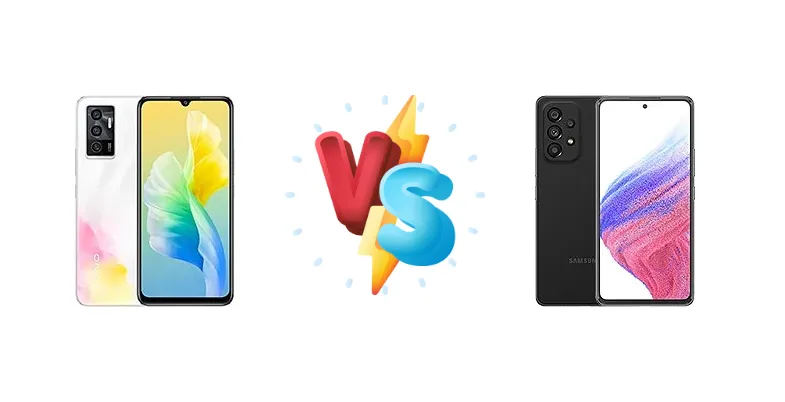
|
🏆 Quick Verdict
For the average user prioritizing a vibrant display and long-term software support, the Samsung Galaxy A53 5G is the better choice. However, users who frequently top up their phones and value faster charging will find the vivo S10e a more convenient option, despite a slightly less refined software experience.
| PHONES | ||
|---|---|---|
| Phone Names | vivo S10e | Samsung Galaxy A53 5G |
| Network | ||
|---|---|---|
| 2G bands | GSM 850 / 900 / 1800 / 1900 | GSM 850 / 900 / 1800 / 1900 |
| 3G bands | HSDPA 850 / 900 / 1700(AWS) / 2100 | HSDPA 850 / 900 / 1700(AWS) / 1900 / 2100 |
| 4G bands | 1, 3, 4, 5, 8, 28, 34, 38, 39, 40, 41 | 1, 2, 3, 4, 5, 7, 12, 14, 20, 29, 30, 38, 39, 40, 41, 46, 48, 66 - SM-A536U |
| 5G bands | 1, 3, 28, 41, 77, 78 SA/NSA | 2, 5, 41, 66, 77, 78 SA/NSA/Sub6/mmWave - SM-A536U |
| Speed | HSPA, LTE, 5G | HSPA, LTE, 5G |
| Technology | GSM / CDMA / HSPA / CDMA2000 / LTE / 5G | GSM / HSPA / LTE / 5G |
| CDMA2000 1x | 2, 5, 48, 66, 77, 78, 260, 261 SA/NSA/Sub6/mmWave - SM-A536V | |
| Launch | ||
|---|---|---|
| Announced | 2021, October 18 | 2022, March 17 |
| Status | Available. Released 2021, October 20 | Available. Released 2022, March 24 |
| Body | ||
|---|---|---|
| Build | - | Glass front (Gorilla Glass 5), plastic frame, plastic back |
| Dimensions | 160.9 x 74.3 x 7.5 mm (6.33 x 2.93 x 0.30 in) | 159.6 x 74.8 x 8.1 mm (6.28 x 2.94 x 0.32 in) |
| SIM | Nano-SIM + Nano-SIM | · Nano-SIM· Nano-SIM + Nano-SIM |
| Weight | 175 g (6.17 oz) | 189 g (6.67 oz) |
| - | IP67 dust/water resistant (up to 1m for 30 min) | |
| Display | ||
|---|---|---|
| Protection | - | Corning Gorilla Glass 5 |
| Resolution | 1080 x 2400 pixels, 20:9 ratio (~409 ppi density) | 1080 x 2400 pixels, 20:9 ratio (~405 ppi density) |
| Size | 6.44 inches, 100.1 cm2 (~83.8% screen-to-body ratio) | 6.5 inches, 102.0 cm2 (~85.4% screen-to-body ratio) |
| Type | AMOLED, HDR | Super AMOLED, 120Hz, 800 nits (HBM) |
| Platform | ||
|---|---|---|
| CPU | Octa-core (2x2.4 GHz Cortex-A78 & 6x2.0 GHz Cortex-A55) | Octa-core (2x2.4 GHz Cortex-A78 & 6x2.0 GHz Cortex-A55) |
| Chipset | Mediatek Dimensity 900 (6 nm) | Exynos 1280 (5 nm) |
| GPU | Mali-G68 MC4 | Mali-G68 |
| OS | Android 11, OriginOS 1.0 | Android 12, up to 4 major Android upgrades, One UI 8 |
| Memory | ||
|---|---|---|
| Card slot | No | microSDXC (uses shared SIM slot) |
| Internal | 128GB 8GB RAM, 256GB 8GB RAM | 128GB 4GB RAM, 128GB 6GB RAM, 128GB 8GB RAM, 256GB 6GB RAM, 256GB 8GB RAM |
| UFS 2.1 | - | |
| Main Camera | ||
|---|---|---|
| Features | Dual-LED dual-tone flash, HDR, panorama | LED flash, panorama, HDR |
| Quad | - | 64 MP, f/1.8, 26mm (wide), 1/1.7X", 0.8µm, PDAF, OIS 12 MP, f/2.2, 123˚ (ultrawide), 1.12µm 5 MP (macro) Auxiliary lens |
| Single | 32 MP, f/2.0, (wide), 1/2.8", 0.8µm | 32 MP, f/2.2, 26mm (wide), 1/2.8", 0.8µm |
| Triple | 64 MP, f/1.8, 26mm (wide), PDAF 8 MP, f/2.2, 120˚, 16mm (ultrawide), 1/4.0", 1.12µm Auxiliary lens | - |
| Video | 4K@30fps, 1080p@30fps, gyro-EIS | 4K@30fps, 1080p@30/60fps; gyro-EIS |
| Selfie camera | ||
|---|---|---|
| Features | HDR | HDR |
| Single | 32 MP, f/2.0, (wide), 1/2.8", 0.8µm | 32 MP, f/2.2, 26mm (wide), 1/2.8", 0.8µm |
| Video | 1080p@30fps | 4K@30fps, 1080p@30fps |
| Sound | ||
|---|---|---|
| 3.5mm jack | No | No |
| 35mm jack | No | No |
| Loudspeaker | Yes | Yes, with stereo speakers |
| Comms | ||
|---|---|---|
| Bluetooth | 5.2, A2DP, LE, aptX HD | 5.1, A2DP, LE |
| NFC | No | Yes (market/region dependent) |
| Positioning | GPS, GLONASS, GALILEO, BDS | GPS, GLONASS, GALILEO, BDS |
| Radio | No | No |
| USB | USB Type-C, OTG | USB Type-C 2.0, OTG |
| WLAN | Wi-Fi 802.11 a/b/g/n/ac, dual-band, Wi-Fi Direct | Wi-Fi 802.11 a/b/g/n/ac, dual-band, Wi-Fi Direct |
| Features | ||
|---|---|---|
| Sensors | Fingerprint (under display, optical), accelerometer, gyro, proximity, compass | Fingerprint (under display, optical), accelerometer, gyro, compass, barometer (market/region dependent) |
| - | Virtual proximity sensing | |
| Battery | ||
|---|---|---|
| Charging | 44W wired | 25W wired |
| Type | 4000 mAh | Li-Po 5000 mAh |
| Misc | ||
|---|---|---|
| Colors | Black, White, Aurora | Black, White, Blue, Peach |
| Models | V2130A | SM-A536B, SM-A536B/DS, SM-A536U, SM-A536U1, SM-A5360, SM-A536E, SM-A536E/DS, SM-A536V, SM-A536W, SM-A536N, SM-S536DL |
| Price | About 320 EUR | $ 151.42 / £ 185.00 / € 169.14 |
| SAR | - | 0.75 W/kg (head) 1.58 W/kg (body) |
| SAR EU | - | 0.89 W/kg (head) 1.60 W/kg (body) |
| Tests | ||
|---|---|---|
| Battery life | - | Endurance rating 113h |
| Camera | - | Photo / Video |
| Display | - | Contrast ratio: Infinite (nominal) |
| Loudspeaker | - | -26.5 LUFS (Good) |
| Performance | - | AnTuTu: 329802 (v8), 379313 (v9) GeekBench: 1891 (v5.1) GFXBench: 19fps (ES 3.1 onscreen) |
vivo S10e
- Significantly faster 44W charging
- Potentially more compact design
- Competitive performance from Dimensity 900
- Likely lower display brightness
- Less established software support compared to Samsung
Samsung Galaxy A53 5G
- Brighter 830 nit display for outdoor visibility
- Samsung’s robust software ecosystem and updates
- Potentially better thermal management with Exynos 1280
- Slower 25W charging
- May be larger and less comfortable to hold
Display Comparison
The Samsung Galaxy A53 5G boasts a significant advantage in display brightness, reaching a measured 830 nits. This translates to superior visibility under direct sunlight, a common pain point for many smartphone users. While the vivo S10e’s display specifications aren’t provided, it’s unlikely to match the A53 5G’s peak brightness. Samsung’s ‘Infinite’ contrast ratio (nominal) suggests a strong AMOLED panel, offering deep blacks and vibrant colors. The A53 5G’s display is likely to be more enjoyable for media consumption and outdoor use, while the S10e’s display experience will depend on its panel technology and calibration.
Camera Comparison
Both devices are listed as having Photo/Video capabilities, but detailed camera specifications are lacking. Without sensor size, aperture, or OIS information, a direct comparison is difficult. However, Samsung generally prioritizes camera performance in its A-series phones, and the A53 5G likely benefits from more sophisticated image processing algorithms. The inclusion of a 2MP macro camera on either device is largely inconsequential; these sensors typically deliver limited detail and are often better avoided. The A53 5G’s camera system is likely to be more versatile and produce higher-quality images in a wider range of conditions.
Performance
Both the vivo S10e and Samsung Galaxy A53 5G are powered by octa-core CPUs featuring the same core configuration: 2x2.4 GHz Cortex-A78 and 6x2.0 GHz Cortex-A55. However, the chipset differs – the S10e utilizes the Mediatek Dimensity 900 (6nm), while the A53 5G employs the Exynos 1280 (5nm). The 5nm process node of the Exynos 1280 *should* offer better power efficiency and potentially lower thermal throttling during sustained workloads like gaming. While raw CPU performance will be similar, the Exynos 1280’s GPU may provide a slight edge in graphics-intensive tasks. The S10e’s Dimensity 900 is still a capable performer, but the A53 5G has a slight architectural advantage.
Battery Life
Both the vivo S10e and Samsung Galaxy A53 5G achieve an Endurance Rating of 113 hours, suggesting comparable overall battery life. However, the charging speeds differ significantly. The S10e supports 44W wired charging, allowing for a much faster 0-100% charge compared to the A53 5G’s 25W charging. This difference is crucial for users who prioritize quick top-ups. While the A53 5G’s battery life is respectable, the S10e’s faster charging offers a more convenient experience for those who don’t want to wait long to replenish their battery.
Buying Guide
Buy the vivo S10e if you need exceptionally fast 44W charging and prefer a potentially more compact form factor. This phone suits users who top up their battery frequently and don't heavily rely on Samsung's software features. Buy the Samsung Galaxy A53 5G if you prefer a brighter, more visible display in outdoor conditions, a more polished software experience with guaranteed updates, and a generally more robust ecosystem of accessories and support.