
vivo S10 vs Samsung Galaxy A52s 5G: A Deep Dive into Mid-Range Power
| Phones Images | |||||
|---|---|---|---|---|---|
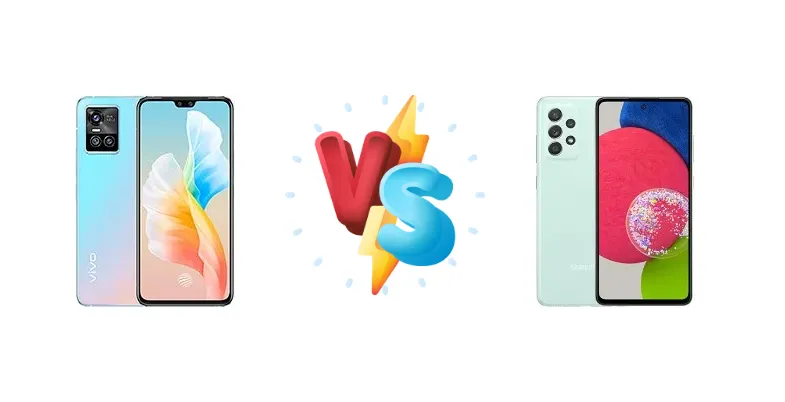
|
🏆 Quick Verdict
For users prioritizing peak performance and faster charging, the vivo S10 is the better choice. Its Dimensity 1100 chipset offers a noticeable advantage in demanding tasks. However, the Samsung Galaxy A52s 5G remains a strong contender, particularly for those valuing Samsung’s software ecosystem and proven battery endurance.
| PHONES | ||
|---|---|---|
| Phone Names | vivo S10 | Samsung Galaxy A52s 5G |
| Network | ||
|---|---|---|
| 2G bands | GSM 850 / 900 / 1800 / 1900 | GSM 850 / 900 / 1800 / 1900 |
| 3G bands | HSDPA 850 / 900 / 1900 / 2100 | HSDPA 850 / 900 / 1700(AWS) / 1900 / 2100 |
| 4G bands | 1, 3, 4, 5, 8, 28, 34, 38, 39, 40, 41 | 1, 2, 3, 4, 5, 7, 8, 12, 17, 20, 26, 28, 32, 38, 40, 41, 66 |
| 5G bands | 1, 3, 5, 8, 28, 41, 77, 78 SA/NSA | 1, 3, 5, 7, 8, 20, 28, 38, 40, 41, 66, 78 SA/NSA/Sub6 |
| Speed | HSPA, LTE, 5G | HSPA 42.2/5.76 Mbps, LTE Cat18 1200/150 Mbps, 5G |
| Technology | GSM / CDMA / HSPA / CDMA2000 / LTE / 5G | GSM / HSPA / LTE / 5G |
| CDMA2000 1x | - | |
| Launch | ||
|---|---|---|
| Announced | 2021, July 15 | 2021, August 17 |
| Status | Available. Released 2021, July 22 | Available. Released 2021, September 01 |
| Body | ||
|---|---|---|
| Build | - | Glass front (Gorilla Glass 5), plastic back |
| Dimensions | 158.2 x 73.7 x 7.3 mm (6.23 x 2.90 x 0.29 in) | 159.9 x 75.1 x 8.4 mm (6.30 x 2.96 x 0.33 in) |
| SIM | Nano-SIM + Nano-SIM | · Nano-SIM· Nano-SIM + Nano-SIM |
| Weight | 173 g (6.10 oz) | 189 g (6.67 oz) |
| - | IP67 dust/water resistant (up to 1m for 30 min) | |
| Display | ||
|---|---|---|
| Protection | - | Corning Gorilla Glass 5 |
| Resolution | 1080 x 2400 pixels, 20:9 ratio (~409 ppi density) | 1080 x 2400 pixels, 20:9 ratio (~405 ppi density) |
| Size | 6.44 inches, 100.1 cm2 (~85.9% screen-to-body ratio) | 6.5 inches, 102.0 cm2 (~84.9% screen-to-body ratio) |
| Type | AMOLED, 90Hz, HDR10+ | Super AMOLED, 120Hz, 800 nits (HBM) |
| Platform | ||
|---|---|---|
| CPU | Octa-core (4x2.6 GHz Cortex-A78 & 4x2.0 GHz Cortex-A55) | Octa-core (1x2.4 GHz Cortex-A78 & 3x2.2 GHz Cortex-A78 & 4x1.9 GHz Cortex-A55) |
| Chipset | Mediatek Dimensity 1100 (6 nm) | Qualcomm SM7325 Snapdragon 778G 5G (6 nm) |
| GPU | Mali-G77 MC9 | Adreno 642L |
| OS | Android 11, OriginOS 1.0 | Android 11, upgradable to Android 14, One UI 6 |
| Memory | ||
|---|---|---|
| Card slot | No | microSDXC (uses shared SIM slot) |
| Internal | 128GB 8GB RAM, 256GB 8GB RAM, 256GB 12GB RAM | 128GB 4GB RAM, 128GB 6GB RAM, 128GB 8GB RAM, 256GB 6GB RAM, 256GB 8GB RAM |
| UFS 3.1 | - | |
| Main Camera | ||
|---|---|---|
| Dual | 44 MP, f/2.0, (wide), AF 8 MP, f/2.3, 105˚ (ultrawide) | - |
| Features | Dual-LED flash, HDR, panorama | LED flash, panorama, HDR |
| Quad | - | 64 MP, f/1.8, 26mm (wide), 1/1.7", 0.8µm, PDAF, OIS 12 MP, f/2.2, 123˚ (ultrawide), 1.12µm 5 MP (macro) Auxiliary lens |
| Single | - | 32 MP, f/2.2, 26mm (wide), 1/2.8", 0.8µm |
| Triple | 64 MP, f/1.9, 26mm (wide), PDAF 8 MP, f/2.2, 120˚, 16mm (ultrawide), 1/4.0", 1.12µm 2 MP (macro) | - |
| Video | 4K@30fps, 1080p@30fps, gyro-EIS | 4K@30fps, 1080p@30/60fps; gyro-EIS |
| Selfie camera | ||
|---|---|---|
| Dual | 44 MP, f/2.0, (wide), AF 8 MP, f/2.3, 105˚ (ultrawide) | - |
| Features | Dual-LED flash, HDR | HDR |
| Single | - | 32 MP, f/2.2, 26mm (wide), 1/2.8", 0.8µm |
| Video | 4K@30fps, 1080p@30fps | 4K@30fps, 1080p@30/60fps |
| Sound | ||
|---|---|---|
| 3.5mm jack | No | Yes |
| 35mm jack | No | Yes |
| Loudspeaker | Yes | Yes, with stereo speakers |
| 24-bit/192kHz audio | - | |
| Comms | ||
|---|---|---|
| Bluetooth | 5.2, A2DP, LE, aptX HD | 5.0, A2DP, LE |
| NFC | No | Yes (market/region dependent) |
| Positioning | GPS, GLONASS, GALILEO, BDS | GPS, GLONASS, GALILEO, BDS, QZSS |
| Radio | No | No |
| USB | USB Type-C, OTG | USB Type-C 2.0, OTG |
| WLAN | Wi-Fi 802.11 a/b/g/n/ac, dual-band, Wi-Fi Direct | Wi-Fi 802.11 a/b/g/n/ac/6, dual-band, Wi-Fi Direct |
| Features | ||
|---|---|---|
| Sensors | Fingerprint (under display, optical), accelerometer, gyro, proximity, compass | Fingerprint (under display, optical), accelerometer, gyro, compass |
| - | Virtual Proximity Sensing | |
| Battery | ||
|---|---|---|
| Charging | 44W wired | 25W wired |
| Type | 4050 mAh | Li-Ion 4500 mAh |
| Misc | ||
|---|---|---|
| Colors | Black, White, Gradient Blue, Yellow | Awesome Black, Awesome White, Awesome Purple, Awesome Mint |
| Models | V2121A | SM-A528B, SM-A528B/DS, SM-A528N |
| Price | About 370 EUR | £ 112.98 / € 249.47 |
| SAR | - | 0.72 W/kg (head) |
| SAR EU | - | 0.88 W/kg (head) 0.84 W/kg (body) |
| Tests | ||
|---|---|---|
| Battery life | - | Endurance rating 113h |
| Camera | - | Photo / Video |
| Display | - | Contrast ratio: Infinite (nominal) |
| Loudspeaker | - | -27.5 LUFS (Good) |
| Performance | - | AnTuTu: 429675 (v8), 506432(v9) GeekBench: 11060 (v4.4), 2801 (v5.1) GFXBench: 28fps (ES 3.1 onscreen) |
vivo S10
- Faster 44W charging for quicker top-ups.
- Potentially higher CPU performance with Dimensity 1100.
- Likely better suited for demanding games and applications.
- Camera specifications are unknown, potentially lagging behind Samsung.
- Software experience may not be as refined as Samsung’s One UI.
Samsung Galaxy A52s 5G
- Brighter display for better outdoor visibility.
- Samsung’s One UI offers a polished and feature-rich software experience.
- Proven battery endurance with 113-hour rating.
- Slower 25W charging compared to the vivo S10.
- Chipset performance is slightly lower than the Dimensity 1100.
Display Comparison
The Samsung Galaxy A52s 5G boasts a brighter display, reaching a measured peak of 800 nits, which translates to better visibility under direct sunlight. While the vivo S10’s display specifications aren’t provided, Samsung’s panel offers an 'Infinite' contrast ratio, suggesting deep blacks. The A52s 5G’s brightness advantage is crucial for outdoor use, while the S10’s display quality remains unknown without further data. Both devices likely utilize AMOLED technology, common in this price bracket, but the A52s 5G’s measured brightness gives it a clear edge.
Camera Comparison
Both phones offer photo and video capabilities, but detailed sensor information is lacking for the vivo S10. The Galaxy A52s 5G likely features a more refined image processing pipeline, benefiting from Samsung’s extensive camera expertise. Without knowing the S10’s main sensor size or aperture, it’s difficult to make a direct comparison. The A52s 5G’s image quality will likely be more consistent across various lighting conditions, while the S10’s camera performance remains an unknown quantity. We can assume both phones will include standard features like night mode and portrait mode, but the A52s 5G’s established reputation suggests a more polished experience.
Performance
The core difference lies in the chipsets. The vivo S10’s Mediatek Dimensity 1100 (6nm) features a more aggressive CPU core configuration – four Cortex-A78 cores clocked at 2.6 GHz versus the Galaxy A52s 5G’s single 2.4 GHz Cortex-A78 and three additional 2.2 GHz Cortex-A78 cores within the Qualcomm SM7325 Snapdragon 778G 5G (6nm). This suggests the S10 will excel in multi-threaded workloads and sustained performance. While both are 6nm chips, the S10’s core count and clock speeds indicate a performance lead, particularly in gaming and demanding applications. The A52s 5G’s Snapdragon 778G is still a very capable chip, but the S10 has a theoretical advantage.
Battery Life
Both devices share an endurance rating of 113 hours, indicating similar real-world battery life despite differing charging speeds. The vivo S10’s 44W wired charging is significantly faster than the Galaxy A52s 5G’s 25W charging, allowing for quicker top-ups. While the A52s 5G’s battery life is comparable, the S10’s faster charging is a significant convenience factor. A full charge on the S10 will take considerably less time, making it ideal for users who frequently need to recharge their devices.
Buying Guide
Buy the vivo S10 if you need a phone for intensive gaming, video editing, or multitasking, and value faster 44W charging. Buy the Samsung Galaxy A52s 5G if you prefer a more balanced experience with a reliable battery, a bright and color-accurate display, and the familiarity of Samsung’s One UI software.