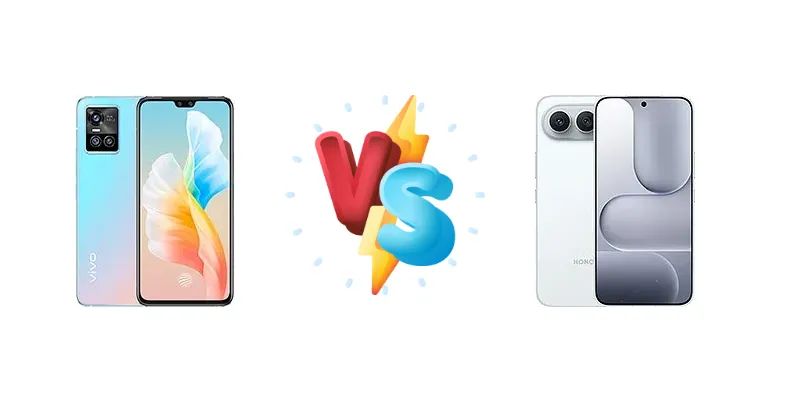
The Honor 500 and vivo S10 Pro represent distinct approaches to the mid-range smartphone market. The S10 Pro, while older, aims for a balance of features and affordability. The Honor 500, leveraging Qualcomm’s newer Snapdragon 8s Gen 4, targets users prioritizing raw processing power and future-proofing, but at what cost?
🏆 Quick Verdict
For most users, the Honor 500 is the superior choice. Its Snapdragon 8s Gen 4 chipset delivers demonstrably faster performance and improved efficiency compared to the vivo S10 Pro’s Dimensity 1100. While the S10 Pro offers 44W charging and potentially a lower price, the Honor 500’s 80W charging and overall performance advantage justify the likely price premium.
| Network |
|---|
| 2G bands | GSM 850 / 900 / 1800 / 1900 | GSM 850 / 900 / 1800 / 1900 |
| 3G bands | HSDPA 850 / 900 / 1900 / 2100 | HSDPA 800 / 850 / 900 / 1700(AWS) / 1900 / 2100 |
| 4G bands | 1, 3, 4, 5, 8, 28, 34, 38, 39, 40, 41 | LTE |
| 5G bands | 1, 3, 5, 8, 28, 41, 77, 78 SA/NSA | SA/NSA |
| Speed | HSPA, LTE, 5G | HSPA, LTE, 5G |
| Technology | GSM / CDMA / HSPA / CDMA2000 / LTE / 5G | GSM / HSPA / LTE / 5G |
| | CDMA2000 1x | - |
| Launch |
|---|
| Announced | 2021, July 15 | 2025, November 24 |
| Status | Available. Released 2021, July 22 | Available. Released 2025, November 27 |
| Body |
|---|
| Build | - | Glass front, aluminum frame |
| Dimensions | 158.2 x 73.7 x 7.3 mm (6.23 x 2.90 x 0.29 in) | 155.8 x 74.2 x 7.8 mm (6.13 x 2.92 x 0.31 in) |
| SIM | Nano-SIM + Nano-SIM | Nano-SIM + Nano-SIM |
| Weight | 173 g (6.10 oz) | 198 g (6.98 oz) |
| Display |
|---|
| Protection | - | Aluminosilicate glass |
| Resolution | 1080 x 2400 pixels, 20:9 ratio (~409 ppi density) | 1264 x 2736 pixels, 19.5:9 ratio (~460 ppi density) |
| Size | 6.44 inches, 100.1 cm2 (~85.9% screen-to-body ratio) | 6.55 inches, 105.4 cm2 (~91.2% screen-to-body ratio) |
| Type | AMOLED, 90Hz, HDR10+ | AMOLED, 1B colors, 120Hz, 3840Hz PWM, HDR Vivid, 6000 nits (peak) |
| Platform |
|---|
| CPU | Octa-core (4x2.6 GHz Cortex-A78 & 4x2.0 GHz Cortex-A55) | Octa-core (1x3.21 GHz Cortex-X4 & 3x3.0 GHz Cortex-A720 & 2x2.8 GHz Cortex-A720 & 2x2.0 GHz Cortex-A720) |
| Chipset | Mediatek Dimensity 1100 (6 nm) | Qualcomm SM8735 Snapdragon 8s Gen 4 (4 nm) |
| GPU | Mali-G77 MC9 | Adreno 825 |
| OS | Android 11, OriginOS 1.0 | Android 16, MagicOS 10 |
| Memory |
|---|
| Card slot | No | No |
| Internal | 128GB 8GB RAM, 256GB 12GB RAM | 256GB 12GB RAM, 512GB 12GB RAM, 512GB 16GB RAM |
| | UFS 3.1 | - |
| Main Camera |
|---|
| Dual | 44 MP, f/2.0, (wide), AF
8 MP, f/2.3, 105˚ (ultrawide) | 200 MP, f/1.9, (wide), 1/1.4", 0.56µm, PDAF, OIS
12 MP, f/2.2, 117˚ (ultrawide), AF |
| Features | Dual-LED flash, HDR, panorama | LED flash, HDR, panorama |
| Triple | 108 MP, f/1.9, 26mm (wide), 1/1.52", 0.7µm, PDAF
8 MP, f/2.2, 120˚, 16mm (ultrawide), 1/4.0", 1.12µm
2 MP (macro) | - |
| Video | 4K@30fps, 1080p@30fps, gyro-EIS | 4K, 1080p, gyro-EIS, OIS |
| Selfie camera |
|---|
| Dual | 44 MP, f/2.0, (wide), AF
8 MP, f/2.3, 105˚ (ultrawide) | - |
| Features | Dual-LED flash, HDR | HDR |
| Single | - | 50 MP, f/2.0, (wide) |
| Video | 4K@30fps, 1080p@30fps | 4K, 1080p, gyro-EIS |
| Sound |
|---|
| 3.5mm jack | No | - |
| 35mm jack | No | No |
| Loudspeaker | Yes | Yes, with stereo speakers |
| | 24-bit/192kHz audio | - |
| Comms |
|---|
| Bluetooth | 5.2, A2DP, LE, aptX HD | 6.0, A2DP, LE, aptX HD, aptX Adaptive, aptX Lossless, LHDC 5, Auracast, ASHA |
| Infrared port | - | Yes |
| NFC | Yes | Yes |
| Positioning | GPS, GLONASS, GALILEO, BDS | GPS (L1+L5), GLONASS (L1), BDS (B1I+B1c+B2a+B2b), GALILEO (E1+E5a+E5b), QZSS (L1+L5), NavIC (L5) |
| Radio | No | No |
| USB | USB Type-C, OTG | USB Type-C 2.0, OTG |
| WLAN | Wi-Fi 802.11 a/b/g/n/ac, dual-band, Wi-Fi Direct | Wi-Fi 802.11 a/b/g/n/ac/6/7, dual-band, Wi-Fi Direct |
| Features |
|---|
| Sensors | Fingerprint (under display, optical), accelerometer, gyro, proximity, compass | Fingerprint (under display, optical), accelerometer, gyro, proximity, compass (ultrasound) |
| Battery |
|---|
| Charging | 44W wired | 80W wired
5W reverse wired |
| Type | 4050 mAh | Si/C Li-Ion 8000 mAh |
| Misc |
|---|
| Colors | Black, White, Gradient Blue, Yellow | Black, Silver, Blue, Pink |
| Models | V2121A | MEY-AN00 |
| Price | About 500 EUR | About 330 EUR |
vivo S10 Pro
- Potentially lower price point
- Established brand reputation
- 44W fast charging is still respectable
- Older Dimensity 1100 chipset
- Less efficient 6nm process
- Slower charging compared to Honor 500
Honor 500
- Significantly faster Snapdragon 8s Gen 4
- More efficient 4nm process
- 80W wired charging with 5W reverse charging
- Likely higher price
- Honor brand may be less familiar to some
- Potential for more aggressive thermal throttling if cooling isn't optimized
Display Comparison
Neither device's display specifications are provided, so a direct comparison is limited. However, given the Honor 500's focus on a more premium experience, it's reasonable to expect a higher peak brightness and potentially a higher refresh rate. The vivo S10 Pro, likely targeting a more budget-conscious consumer, may prioritize cost savings in this area. Color accuracy will likely be similar, with both brands aiming for acceptable sRGB coverage.
Camera Comparison
Without specific camera sensor details, a detailed comparison is difficult. However, the Honor 500, positioned as a more premium device, likely features a larger main sensor and more advanced image processing algorithms. The Snapdragon 8s Gen 4’s ISP (Image Signal Processor) is also more capable than the Dimensity 1100’s, potentially resulting in better dynamic range, noise reduction, and low-light performance. We can assume both phones will include standard features like portrait mode and night mode, but the Honor 500 is expected to deliver superior image quality.
Performance
The core difference lies in the chipsets. The Honor 500’s Qualcomm Snapdragon 8s Gen 4 (4nm) is a significant upgrade over the vivo S10 Pro’s MediaTek Dimensity 1100 (6nm). The 4nm process node inherently offers better power efficiency, translating to less heat generation and sustained performance. The Snapdragon 8s Gen 4’s CPU configuration – a 1x3.21 GHz Cortex-X4 prime core alongside 3x3.0 GHz Cortex-A720 and 2x2.8 GHz Cortex-A720 cores – is architecturally superior to the Dimensity 1100’s 4x2.6 GHz Cortex-A78 and 4x2.0 GHz Cortex-A55 setup. This means faster single-core and multi-core performance for tasks like app loading, multitasking, and gaming. The Honor 500 will likely exhibit less throttling under sustained load.
Battery Life
The Honor 500’s 80W wired charging is a clear advantage over the vivo S10 Pro’s 44W charging. This translates to significantly faster charging times – potentially a full charge in under 40 minutes for the Honor 500 versus over an hour for the S10 Pro. The Honor 500 also includes 5W reverse wired charging, a feature absent on the S10 Pro. While battery capacity isn’t specified, the Snapdragon 8s Gen 4’s improved efficiency should offset any potential capacity difference, resulting in comparable or even better real-world battery life on the Honor 500.
Buying Guide
Buy the vivo S10 Pro if you prioritize a more established brand with a potentially lower price tag and are content with solid, but not leading-edge, performance for everyday tasks. Buy the Honor 500 if you demand the best possible performance in this price bracket, value faster charging, and anticipate demanding applications like gaming or video editing.
Frequently Asked Questions
❓ Will the Snapdragon 8s Gen 4 in the Honor 500 handle demanding games like Genshin Impact at high settings?
Yes, the Snapdragon 8s Gen 4 is a powerful chipset capable of running Genshin Impact and other graphically intensive games at high settings with stable frame rates. The 4nm process and improved thermal management should minimize throttling during extended gaming sessions, providing a smoother experience than the Dimensity 1100.
❓ Does the Honor 500's faster charging degrade the battery health more quickly?
While faster charging can theoretically contribute to slightly faster battery degradation over the long term, modern smartphones employ sophisticated charging algorithms to mitigate this effect. The Honor 500’s 80W charging system likely includes features like dynamic voltage regulation and temperature control to protect the battery. The convenience of faster charging generally outweighs the minimal potential impact on long-term battery health.
❓ Is the difference in performance between the Snapdragon 8s Gen 4 and Dimensity 1100 noticeable in everyday tasks like browsing and social media?
The difference won't be dramatic for basic tasks like browsing and social media. However, the Snapdragon 8s Gen 4 will feel snappier and more responsive when switching between apps, opening heavy websites, or performing multitasking. The Honor 500 will offer a more fluid and future-proof experience overall.