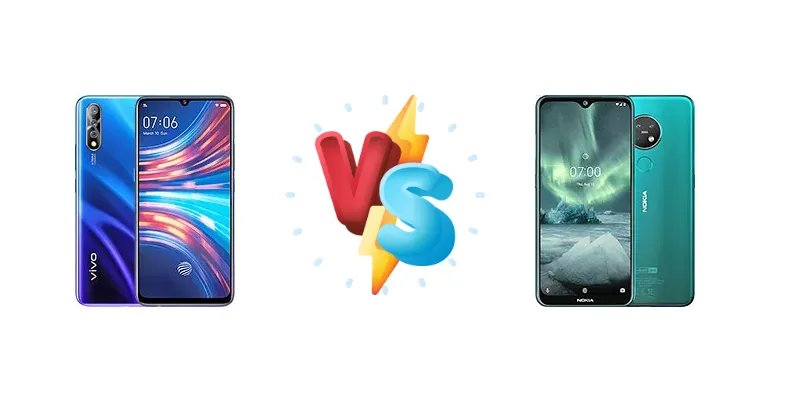
The vivo S1 and Nokia 7.2 represent compelling options in the competitive sub-₹20,000 smartphone market. While both aim to deliver a balanced experience, they take different approaches to achieving it. The vivo S1 prioritizes processing power with its Helio P65 chipset, while the Nokia 7.2 leans on Qualcomm’s Snapdragon 660 and a focus on display quality and software experience. This comparison dissects their strengths and weaknesses to determine which device best suits your needs.
🏆 Quick Verdict
For the average user prioritizing everyday performance and multitasking, the vivo S1 emerges as the better choice. Its Helio P65 chipset, coupled with RAM options up to 6GB, provides a noticeable edge in responsiveness. However, the Nokia 7.2’s superior display brightness and contrast make it a strong contender for media consumption.
| Network |
|---|
| 2G bands | GSM 850 / 900 / 1800 / 1900 | GSM 850 / 900 / 1800 / 1900 |
| 3G bands | HSDPA 850 / 900 / 2100 | HSDPA 850 / 900 / 2100 - ROW |
| 4G bands | 1, 3, 5, 7, 8, 20, 38, 40, 41 - Asia | 1, 3, 5, 7, 8, 20, 28, 38, 40, 41 - ROW |
| Speed | HSPA 42.2/5.76 Mbps, LTE (2CA) Cat6 300/150 Mbps | HSPA 42.2/5.76 Mbps, LTE (2CA) Cat6 300/50 Mbps or LTE Cat4 150/50 Mbps |
| Technology | GSM / HSPA / LTE | GSM / HSPA / LTE |
| | 1, 3, 5, 8, 34, 38, 39, 40, 41 - China | 1, 3, 5, 8, 40, 41 - IN |
| Launch |
|---|
| Announced | 2019, July 17. Released 2019, July | 2019, September 05. Released 2019, September 23 |
| Status | Discontinued | Discontinued |
| Body |
|---|
| Build | Glass front, plastic back, plastic frame | Glass front (Gorilla Glass 3), glass back (Gorilla Glass 3), plastic frame |
| Dimensions | 159.5 x 75.2 x 8.1 mm (6.28 x 2.96 x 0.32 in) | 159.9 x 75.2 x 8.3 mm (6.30 x 2.96 x 0.33 in) |
| SIM | Nano-SIM + Nano-SIM | · Nano-SIM· Nano-SIM + Nano-SIM |
| Weight | 179 g (6.31 oz) | 180 g (6.35 oz) |
| Display |
|---|
| Protection | - | Corning Gorilla Glass 3 |
| Resolution | 1080 x 2340 pixels, 19.5:9 ratio (~404 ppi density) | 1080 x 2280 pixels, 19:9 ratio (~400 ppi density) |
| Size | 6.38 inches, 99.9 cm2 (~83.3% screen-to-body ratio) | 6.3 inches, 99.1 cm2 (~82.4% screen-to-body ratio) |
| Type | Super AMOLED | IPS LCD, HDR10 |
| | Always-on display | - |
| Platform |
|---|
| CPU | Octa-core (2x2.0 GHz Cortex-A75 & 6x1.7 GHz Cortex-A55) | Octa-core (4x2.2 GHz Kryo 260 Gold & 4x1.8 GHz Kryo 260 Silver) |
| Chipset | Mediatek MT6768 Helio P65 (12 nm) | Qualcomm SDM660 Snapdragon 660 (14 nm) |
| GPU | Mali-G52 MC2 | Adreno 512 |
| OS | Android 9.0 (Pie), Funtouch 9 | Android 9.0 (Pie), upgradable to Android 11, Android One |
| Memory |
|---|
| Card slot | microSDXC (dedicated slot) | microSDXC (dedicated slot) |
| Internal | 64GB 6GB RAM, 128GB 4GB RAM, 128GB 6GB RAM, 256GB 6GB RAM | 64GB 4GB RAM, 64GB 6GB RAM, 128GB 4GB RAM, 128GB 6GB RAM |
| | eMMC 5.1 | eMMC 5.1 |
| Main Camera |
|---|
| Features | LED flash, HDR, panorama | Zeiss optics, LED flash, panorama, HDR |
| Triple | 16 MP, f/1.8, (wide), 1/2.8", 1.12µm, PDAF
8 MP, f/2.2, 13mm (ultrawide), 1/4.0", 1.12µm
Auxiliary lens | 48 MP, f/1.8, (wide), 1/2.0", 0.8µm, PDAF
8 MP, f/2.2, 13mm (ultrawide), 1/4.0", 1.12µm
Auxiliary lens |
| Video | 1080p@30fps | 4K@30fps, 1080p@30fps (gyro-EIS) |
| Selfie camera |
|---|
| Features | HDR | Zeiss optics, HDR |
| Single | 32 MP, f/2.0, 26mm (wide), 1/2.8", 0.8µm | 20 MP, f/2.0, (wide), 1/3", 0.9µm |
| Video | 1080p@30fps | 1080p@30fps |
| Sound |
|---|
| 3.5mm jack | Yes | Yes |
| 35mm jack | Yes | Yes |
| Loudspeaker | Yes | Yes |
| Comms |
|---|
| Bluetooth | 5.0, A2DP, LE | 5.0, A2DP, EDR, LE, aptX |
| NFC | No | Yes (excl. India) |
| Positioning | GPS, GLONASS, GALILEO, BDS | GPS, GLONASS, GALILEO, BDS |
| Radio | FM radio | FM radio |
| USB | microUSB 2.0, OTG | USB Type-C 2.0, OTG |
| WLAN | Wi-Fi 802.11 a/b/g/n/ac, dual-band, Wi-Fi Direct | Wi-Fi 802.11 b/g/n/ac, dual-band, Wi-Fi Direct |
| Features |
|---|
| Sensors | Fingerprint (under display, optical), accelerometer, proximity, compass | Fingerprint (rear-mounted), accelerometer, gyro, proximity, compass |
| Battery |
|---|
| Charging | 18W wired | 10W wired |
| Type | 4500 mAh, non-removable | Li-Po 3500 mAh, non-removable |
| Misc |
|---|
| Colors | Diamond Black, Skyline Blue, Cosmic Green | Cyan Green, Charcoal, Ice |
| Models | 1907, V1907, 1907_19, V1913A | TA-1193, TA-1178, TA-1196, TA-1181 |
| Price | About 230 EUR | About 240 EUR |
| SAR | - | 1.15 W/kg (head) 0.90 W/kg (body) |
| SAR EU | - | 0.99 W/kg (head) 1.44 W/kg (body) |
| Pricing |
|---|
| 128GB 4GB RAM | ₹ 17,200 | - |
| 128GB 6GB RAM | ₹ 17,200 | - |
| 64GB 6GB RAM | ₹ 17,990 | - |
| Tests |
|---|
| Audio quality | - |
Noise -93.0dB / Crosstalk -93.4dB |
| Battery life | - |
Endurance rating 69h
|
| Camera | - |
Photo / Video |
| Display | - |
Contrast ratio: 1342:1 (nominal) |
| Loudspeaker | - |
-29.6 LUFS (Average)
|
| Performance | - |
AnTuTu: 139495 (v7), 164484 (v8)
GeekBench: 5440 (v4.4), 1398 (v5.1)
GFXBench: 8.1fps (ES 3.1 onscreen) |
vivo S1
- Faster 18W charging for quicker top-ups
- Potentially better sustained performance due to the 12nm Helio P65
- Higher RAM options (up to 6GB) for smoother multitasking
- Display specifications are unknown, potentially inferior to Nokia 7.2
- Camera details are scarce, making it hard to assess image quality
Nokia 7.2
- Brighter and higher contrast display for better visibility
- Clean Android experience with guaranteed updates (typical of Nokia)
- Qualcomm ISP potentially offers better image processing
- Slower 10W charging
- Older 14nm Snapdragon 660 may throttle under sustained load
- Limited RAM options (likely 4GB or 6GB)
Display Comparison
The Nokia 7.2 boasts a significantly brighter display, reaching a measured 585 nits, compared to the vivo S1’s unspecified brightness. This, combined with a 1342:1 contrast ratio, translates to better visibility outdoors and more vibrant colors. While the vivo S1’s display specifications are not provided, the Nokia 7.2’s panel offers a superior viewing experience, particularly for multimedia consumption. The Nokia 7.2’s contrast ratio suggests a more immersive visual experience, making it better for watching videos and viewing photos.
Camera Comparison
Both phones feature a 'Photo / Video' camera setup, but detailed specifications are lacking. Without sensor size or aperture information, a direct comparison is difficult. However, the market segment suggests both will rely on software processing to enhance image quality. The Nokia 7.2, benefiting from Qualcomm’s image signal processor (ISP), may offer slightly better dynamic range and noise reduction. The absence of details on the vivo S1’s camera system makes it difficult to assess its capabilities beyond basic smartphone photography.
Performance
The vivo S1’s Mediatek Helio P65 utilizes a 12nm process and features an octa-core CPU with a mix of Cortex-A75 and A55 cores, peaking at 2.0 GHz. This configuration aims for a balance between performance and efficiency. Conversely, the Nokia 7.2’s Qualcomm Snapdragon 660, built on a 14nm process, employs Kryo 260 Gold and Silver cores, topping out at 2.2 GHz. While the Snapdragon 660’s cores have a higher clock speed, the Helio P65’s newer architecture and smaller node size potentially offer better sustained performance and thermal management. The vivo S1’s RAM options (4GB or 6GB) are crucial; the 6GB variant will provide a smoother experience than the 4GB Nokia 7.2.
Battery Life
Both the vivo S1 and Nokia 7.2 share an endurance rating of 69 hours, indicating similar battery life under typical usage. However, the vivo S1’s 18W wired charging significantly outperforms the Nokia 7.2’s 10W charging. This means the vivo S1 can be topped up much faster, reducing downtime. While both offer comparable longevity, the vivo S1’s faster charging is a practical advantage for users who need to quickly replenish their battery.
Buying Guide
Buy the vivo S1 if you need a phone that feels snappy during daily use, handles multitasking efficiently, and offers a modern design. It’s ideal for users who frequently switch between apps, browse the web, and enjoy casual gaming. Buy the Nokia 7.2 if you prioritize a vibrant and easily viewable display, appreciate a clean Android experience, and value a phone with a slightly more refined build quality. It’s best suited for users who consume a lot of video content and prefer a minimalist software approach.
Frequently Asked Questions
❓ Does the Helio P65 in the vivo S1 struggle with graphically demanding games like PUBG?
While the Helio P65 is capable of running PUBG, you may need to lower the graphics settings to achieve a consistently smooth frame rate. The Snapdragon 660 in the Nokia 7.2 offers similar gaming performance, but both phones are not designed for high-end gaming at maximum settings.
❓ How does Nokia's software update policy affect the long-term usability of the 7.2?
Nokia is known for providing timely Android updates and security patches, ensuring the 7.2 remains secure and receives new features for a longer period. This is a significant advantage over many other brands in this price range, potentially extending the phone's useful life.
❓ Is the difference in charging speed between 18W and 10W noticeable in real-world use?
Yes, the difference is substantial. The vivo S1's 18W charging can significantly reduce charging time, allowing you to quickly top up your battery when needed. The Nokia 7.2's 10W charging is considerably slower, requiring more patience to reach a full charge.