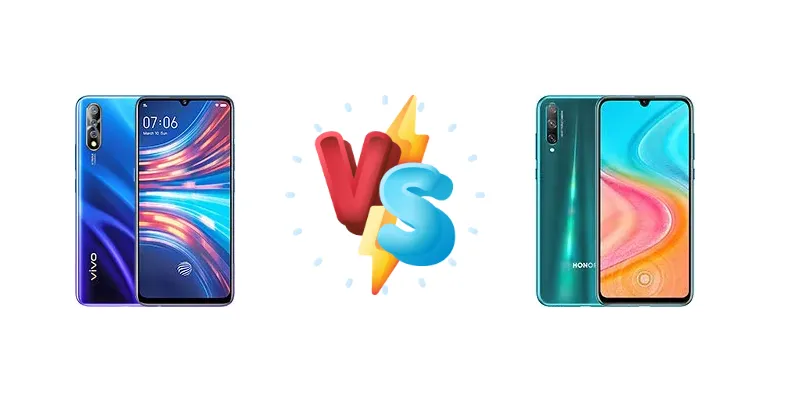
The vivo S1 and Honor 20 Lite (China) represent compelling options in the competitive budget smartphone segment. Both devices aim to deliver a balanced experience, but they achieve this through different approaches to chipset selection and feature prioritization. This comparison dissects their key specifications to determine which phone offers the most value for everyday users.
🏆 Quick Verdict
For the average user prioritizing sustained performance and a slightly faster charging experience, the Honor 20 Lite (China) emerges as the better choice. Its Kirin 710F, with its Cortex-A73 cores, offers a noticeable edge in CPU-intensive tasks compared to the vivo S1's Helio P65.
| Network |
|---|
| 2G bands | GSM 850 / 900 / 1800 / 1900 | GSM 900 / 1800 / 1900 |
| 3G bands | HSDPA 850 / 900 / 2100 | HSDPA 850 / 900 / 1900 / 2100 |
| 4G bands | 1, 3, 5, 7, 8, 20, 38, 40, 41 - Asia | 1, 3, 5, 8, 38, 39, 40, 41 |
| Speed | HSPA 42.2/5.76 Mbps, LTE (2CA) Cat6 300/150 Mbps | HSPA, LTE |
| Technology | GSM / HSPA / LTE | GSM / CDMA / HSPA / LTE |
| | 1, 3, 5, 8, 34, 38, 39, 40, 41 - China | CDMA 800 & TD-SCDMA |
| Launch |
|---|
| Announced | 2019, July 17. Released 2019, July | 2019, October. Released 2019, October |
| Status | Discontinued | Discontinued |
| Body |
|---|
| Build | Glass front, plastic back, plastic frame | - |
| Dimensions | 159.5 x 75.2 x 8.1 mm (6.28 x 2.96 x 0.32 in) | 157.2 x 73.2 x 7.7 mm (6.19 x 2.88 x 0.30 in) |
| SIM | Nano-SIM + Nano-SIM | Nano-SIM + Nano-SIM |
| Weight | 179 g (6.31 oz) | 171.5 g (6.07 oz) |
| Display |
|---|
| Resolution | 1080 x 2340 pixels, 19.5:9 ratio (~404 ppi density) | 1080 x 2400 pixels, 20:9 ratio (~418 ppi density) |
| Size | 6.38 inches, 99.9 cm2 (~83.3% screen-to-body ratio) | 6.3 inches, 95.8 cm2 (~83.3% screen-to-body ratio) |
| Type | Super AMOLED | AMOLED, 600 nits (typ) |
| | Always-on display | - |
| Platform |
|---|
| CPU | Octa-core (2x2.0 GHz Cortex-A75 & 6x1.7 GHz Cortex-A55) | Octa-core (4x2.2 GHz Cortex-A73 & 4x1.7 GHz Cortex-A53) |
| Chipset | Mediatek MT6768 Helio P65 (12 nm) | Kirin 710F (12 nm) |
| GPU | Mali-G52 MC2 | Mali-G51 MP4 |
| OS | Android 9.0 (Pie), Funtouch 9 | Android 9.0 (Pie), EMUI 9.1 |
| Memory |
|---|
| Card slot | microSDXC (dedicated slot) | microSDXC (uses shared SIM slot) |
| Internal | 64GB 6GB RAM, 128GB 4GB RAM, 128GB 6GB RAM, 256GB 6GB RAM | 64GB 4GB RAM, 64GB 6GB RAM, 128GB 6GB RAM, 128GB 8GB RAM |
| | eMMC 5.1 | - |
| Main Camera |
|---|
| Features | LED flash, HDR, panorama | LED flash, HDR, panorama |
| Triple | 16 MP, f/1.8, (wide), 1/2.8", 1.12µm, PDAF
8 MP, f/2.2, 13mm (ultrawide), 1/4.0", 1.12µm
Auxiliary lens | 48 MP, f/1.8, 28mm (wide), 1/2.0", 0.8µm, PDAF
8 MP, f/2.4, 13mm (ultrawide)
Auxiliary lens |
| Video | 1080p@30fps | 1080p@30fps |
| Selfie camera |
|---|
| Features | HDR | HDR |
| Single | 32 MP, f/2.0, 26mm (wide), 1/2.8", 0.8µm | 16 MP, f/2.0, 26mm (wide), 1/3.06", 1.0µm |
| Video | 1080p@30fps | 1080p@30fps |
| Sound |
|---|
| 3.5mm jack | Yes | Yes |
| 35mm jack | Yes | Yes |
| Loudspeaker | Yes | Yes |
| Comms |
|---|
| Bluetooth | 5.0, A2DP, LE | 5.0, A2DP, LE |
| NFC | No | No |
| Positioning | GPS, GLONASS, GALILEO, BDS | GPS, GLONASS, BDS |
| Radio | FM radio | FM radio |
| USB | microUSB 2.0, OTG | USB Type-C 2.0, OTG |
| WLAN | Wi-Fi 802.11 a/b/g/n/ac, dual-band, Wi-Fi Direct | Wi-Fi 802.11 a/b/g/n/ac, dual-band, Wi-Fi Direct |
| Features |
|---|
| Sensors | Fingerprint (under display, optical), accelerometer, proximity, compass | Fingerprint (under display, optical), accelerometer, proximity, compass |
| Battery |
|---|
| Charging | 18W wired | 20W wired |
| Type | 4500 mAh, non-removable | Li-Po 4000 mAh, non-removable |
| Misc |
|---|
| Colors | Diamond Black, Skyline Blue, Cosmic Green | Black, Green, Blue/Pink |
| Models | 1907, V1907, 1907_19, V1913A | LRA-AL00, LRA-TL00 |
| Price | About 230 EUR | About 220 EUR |
| Pricing |
|---|
| 128GB 4GB RAM | ₹ 17,200 | - |
| 128GB 6GB RAM | ₹ 17,200 | - |
| 64GB 6GB RAM | ₹ 17,990 | - |
vivo S1
- Wider range of RAM/storage options (4GB/6GB RAM, 64GB/128GB storage)
- Potentially slightly better battery life during light usage due to the Helio P65's efficiency
- Competitive pricing within the budget segment
- Helio P65 chipset offers less CPU performance than the Kirin 710F
- Slower 18W charging compared to the Honor 20 Lite
Honor 20 lite (China)
- Kirin 710F chipset provides a more responsive user experience
- Faster 20W wired charging for quicker top-ups
- Cortex-A73 cores offer better single-core performance
- Limited RAM/storage configurations compared to the vivo S1
- May experience slightly shorter battery life during intensive tasks
Display Comparison
Neither device boasts a standout display. Both utilize 12nm chipsets, suggesting a focus on cost optimization rather than premium display features. While specific panel technologies aren't provided, the absence of details like refresh rates or HDR support indicates standard LCD panels. The real-world impact will be similar viewing experiences, with color accuracy and brightness likely being average for this price bracket.
Camera Comparison
Without detailed camera specifications beyond the presence of cameras, a direct comparison is difficult. However, the market segment suggests both phones will rely on software processing to enhance image quality. The absence of information regarding sensor size or optical image stabilization (OIS) implies both will likely feature standard sensors. Users shouldn't expect flagship-level camera performance, but adequate results for social media and casual photography are probable. The 2MP macro cameras often found in this price range are unlikely to provide significant benefit.
Performance
The core difference lies in the chipsets. The Honor 20 Lite’s Kirin 710F utilizes four Cortex-A73 cores clocked at 2.2 GHz, offering a significant architectural advantage over the vivo S1’s Helio P65. The P65 employs two Cortex-A75 cores at 2.0 GHz. While both are octa-core designs, the A73 cores in the Kirin 710F generally deliver superior single-core performance, translating to snappier app launches and smoother multitasking. The P65’s strength lies in its efficiency, potentially offering slightly better battery life during lighter usage. Both phones feature 6GB RAM options, mitigating some performance differences, but the Kirin 710F’s CPU architecture will be noticeable in demanding scenarios.
Battery Life
The Honor 20 Lite’s 20W wired charging is a clear advantage over the vivo S1’s 18W charging. This translates to faster top-ups, reducing downtime. While battery capacity isn't specified for either device, the faster charging speed of the Honor 20 Lite mitigates any potential disadvantage from a slightly smaller battery. Users who frequently find themselves needing to quickly recharge will benefit from the Honor 20 Lite’s faster charging capabilities.
Buying Guide
Buy the vivo S1 if you prioritize a wider range of RAM/storage configurations and are comfortable with a slightly less powerful processor for basic tasks. Buy the Honor 20 Lite (China) if you value a more responsive user experience, particularly when multitasking or running demanding applications, and appreciate the faster 20W charging.
Frequently Asked Questions
❓ Will the Kirin 710F in the Honor 20 Lite handle demanding games like PUBG Mobile smoothly?
The Kirin 710F is capable of running PUBG Mobile, but expect to use medium graphics settings for a consistently smooth experience. The Cortex-A73 cores provide enough processing power, but the GPU isn't a high-end performer. Frame rate stability will depend on the specific game settings and duration of play.
❓ Is the 6GB of RAM enough for multitasking on the vivo S1?
6GB of RAM is generally sufficient for multitasking on the vivo S1, allowing you to switch between several apps without significant slowdown. However, the Helio P65's CPU limitations may become apparent when running multiple resource-intensive applications simultaneously. The Honor 20 Lite's Kirin 710F will handle multitasking more efficiently.
❓ How long will it take to fully charge the Honor 20 Lite with the 20W charger?
While a precise 0-100% charging time isn't available, the 20W charger should fully charge the Honor 20 Lite in approximately 1 hour and 30 minutes to 2 hours, depending on battery capacity. This is noticeably faster than the vivo S1's 18W charging.