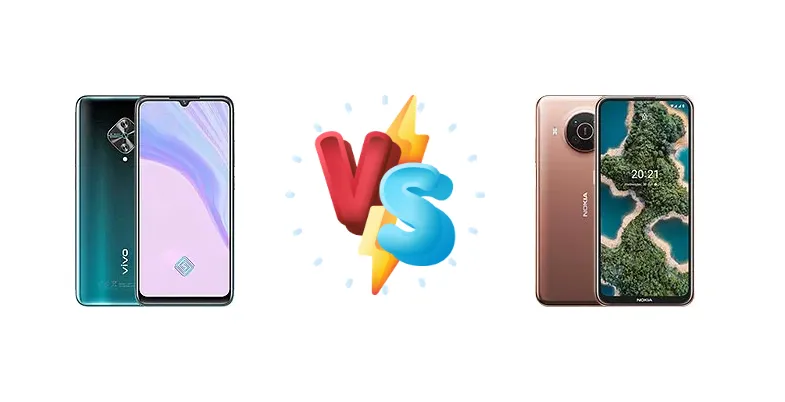
The vivo S1 Prime and Nokia X20 represent different approaches to the affordable smartphone market. The S1 Prime, leveraging the Snapdragon 665, aims for a balance of features and cost. The Nokia X20, with its Snapdragon 480 5G, prioritizes future-proofing with 5G connectivity. This comparison dissects their key differences to determine which device delivers the best value.
🏆 Quick Verdict
For the average user prioritizing future connectivity and slightly better performance, the Nokia X20 is the stronger choice. Its Snapdragon 480 5G offers a noticeable step up in processing power and 5G support, despite both phones sharing the same 18W charging. However, the S1 Prime remains a viable option for those on a tighter budget.
| Network |
|---|
| 2G bands | GSM 850 / 900 / 1800 / 1900 | GSM 850 / 900 / 1800 / 1900 |
| 3G bands | HSDPA 850 / 900 / 1700(AWS) / 1900 / 2100 | HSDPA 850 / 900 / 1700(AWS) / 1900 / 2100 |
| 4G bands | 1, 2, 3, 4, 5, 7, 8, 20, 38, 40, 41 | 1, 2, 3, 4, 5, 7, 8, 12, 20, 28, 66, 38, 39, 40, 41 |
| 5G bands | - | 1, 2, 3, 5, 7, 28, 38, 41, 66, 78 SA/NSA/Sub6 |
| Speed | HSPA 42.2/5.76 Mbps, LTE (2CA) Cat6 300/150 Mbps | HSPA, LTE, 5G |
| Technology | GSM / HSPA / LTE | GSM / HSPA / LTE / 5G |
| Launch |
|---|
| Announced | 2020, August 12. Released 2020, August 12 | 2021, April 08 |
| Status | Discontinued | Available. Released 2021, May 12 |
| Body |
|---|
| Build | Glass front, plastic back, plastic frame | - |
| Dimensions | 159.3 x 75.2 x 8.7 mm (6.27 x 2.96 x 0.34 in) | 168.9 x 79.7 x 9.1 mm (6.65 x 3.14 x 0.36 in) |
| SIM | Nano-SIM + Nano-SIM | · Nano-SIM· Nano-SIM + Nano-SIM |
| Weight | 190.2 g (6.70 oz) | 220 g (7.76 oz) |
| Display |
|---|
| Protection | - | Corning Gorilla Glass 5 |
| Resolution | 1080 x 2340 pixels, 19.5:9 ratio (~404 ppi density) | 1080 x 2400 pixels, 20:9 ratio (~395 ppi density) |
| Size | 6.38 inches, 99.9 cm2 (~83.4% screen-to-body ratio) | 6.67 inches, 107.4 cm2 (~79.8% screen-to-body ratio) |
| Type | AMOLED | IPS LCD, 450 nits (typ) |
| Platform |
|---|
| CPU | Octa-core (4x2.0 GHz Kryo 260 Gold & 4x1.8 GHz Kryo 260 Silver) | Octa-core (2x2.0 GHz Kryo 460 & 6x1.8 GHz Kryo 460) |
| Chipset | Qualcomm SDM665 Snapdragon 665 (11 nm) | Qualcomm SM4350 Snapdragon 480 5G (8 nm) |
| GPU | Adreno 610 | Adreno 619 |
| OS | Android 9.0 (Pie), Funtouch 9.2 | Android 11, upgradable to Android 14 |
| Memory |
|---|
| Card slot | microSDXC (uses shared SIM slot) | microSDXC (uses shared SIM slot) |
| Internal | 128GB 8GB RAM | 128GB 6GB RAM, 128GB 8GB RAM |
| | UFS 2.1 | - |
| Main Camera |
|---|
| Features | LED flash, HDR, panorama | Zeiss optics, LED flash, HDR, panorama |
| Quad | 48 MP, f/1.8, (wide), 1/2.0", 0.8µm, PDAF
8 MP, f/2.2, (ultrawide), 1/4.0", 1.12µm
2 MP (macro)
Auxiliary lens | 64 MP, (wide), PDAF
5 MP, (ultrawide)
2 MP (macro)
Auxiliary lens |
| Single | - | 32 MP, (wide) |
| Video | 1080p@30fps | 1080p@30/60fps |
| Selfie camera |
|---|
| Features | HDR | - |
| Single | 16 MP, f/2.0, (wide), 1/3.06" 1.0µm | 32 MP, (wide) |
| Video | 1080p@30fps | 1080p@30fps |
| Sound |
|---|
| 3.5mm jack | Yes | Yes |
| 35mm jack | Yes | Yes |
| Loudspeaker | Yes | Yes |
| Comms |
|---|
| Bluetooth | 5.0, A2DP, LE | 5.0, A2DP, LE, aptX HD |
| NFC | No | Yes |
| Positioning | GPS, GLONASS, GALILEO, BDS | GPS, GLONASS, GALILEO |
| Radio | FM radio | FM radio |
| USB | USB Type-C 2.0, OTG | USB Type-C 2.0, OTG |
| WLAN | Wi-Fi 802.11 a/b/g/n/ac, dual-band, Wi-Fi Direct | Wi-Fi 802.11 a/b/g/n/ac, dual-band, Wi-Fi Direct |
| Features |
|---|
| Sensors | Fingerprint (under display, optical), accelerometer, gyro, proximity, compass | Fingerprint (side-mounted), accelerometer, gyro, proximity |
| Battery |
|---|
| Charging | 18W wired | 18W wired |
| Type | 4500 mAh | Li-Po 4470 mAh |
| Misc |
|---|
| Colors | Nebula Blue, Jade Black | Midnight Sun, Nordic Blue |
| Models | V1937 | TA-1341, TA-1344 |
| Price | About 240 EUR | About 130 EUR |
| SAR | - | 1.04 W/kg (head) 0.62 W/kg (body) |
| SAR EU | - | 0.51 W/kg (head) 1.29 W/kg (body) |
vivo S1 Prime
- Potentially lower price point
- Reliable Snapdragon 665 performance for basic tasks
- May have wider availability of replacement parts
- Lacks 5G connectivity
- Older chipset architecture
- Less efficient 11nm process
Nokia X20
- 5G connectivity for faster data speeds
- More modern Snapdragon 480 chipset
- Improved ISP for better camera performance
- Potentially higher price
- May have limited software update support
- 18W charging is relatively slow
Display Comparison
Neither device's display specifications are provided, so a direct comparison is limited. However, given the market positioning, both likely utilize LCD panels. The Nokia X20, being a newer device, *may* benefit from slightly improved color accuracy and viewing angles. The S1 Prime, potentially released earlier, might have wider availability of replacement parts. Without specific data on resolution, brightness, and color gamut, it's difficult to declare a clear winner.
Camera Comparison
Without detailed camera specifications beyond the chipsets, a precise comparison is challenging. However, the Snapdragon 480 generally offers improved image signal processing (ISP) capabilities compared to the 665. This translates to better noise reduction, dynamic range, and overall image quality, particularly in low-light conditions. The Nokia X20’s ISP is likely to handle computational photography tasks more effectively. The presence of a 5G modem also allows for faster uploads of high-resolution photos and videos. It's reasonable to assume the Nokia X20 will deliver superior camera performance, even if both phones have similar sensor resolutions.
Performance
The Nokia X20’s Snapdragon 480 5G, fabricated on an 8nm process, holds a significant architectural advantage over the vivo S1 Prime’s Snapdragon 665 (11nm). The 8nm node translates to improved thermal efficiency and potentially higher sustained performance. While both CPUs feature octa-core configurations, the X20’s Kryo 460 cores offer a more modern design. The X20’s CPU configuration (2x2.0 GHz + 6x1.8 GHz) suggests a stronger focus on single-core performance, beneficial for everyday tasks, while the S1 Prime’s (4x2.0 GHz + 4x1.8 GHz) may offer slightly better multi-core performance. The Snapdragon 480 also includes an integrated 5G modem, a feature absent in the S1 Prime.
Battery Life
Both the vivo S1 Prime and Nokia X20 support 18W wired charging. This suggests similar charging speeds – approximately 2-3 hours for a full charge, assuming comparable battery capacities (which are not provided). The actual battery life will depend heavily on the battery capacity of each device and the efficiency of their respective chipsets. The Snapdragon 480’s 8nm process *should* contribute to slightly better power efficiency, potentially extending the Nokia X20’s battery life under similar usage conditions. Without knowing the mAh ratings, it's impossible to definitively declare a winner.
Buying Guide
Buy the vivo S1 Prime if you need a reliable, everyday smartphone with a focus on cost-effectiveness and don't require 5G connectivity. It's ideal for users who primarily browse, use social media, and make calls. Buy the Nokia X20 if you prioritize 5G access for faster data speeds, anticipate using more demanding apps, and value a slightly more modern chipset architecture for potential software support longevity.
Frequently Asked Questions
❓ Will the Nokia X20's 5G actually make a difference in my daily use?
The benefit of 5G depends on your location and carrier coverage. If you live in an area with robust 5G infrastructure, you'll experience significantly faster download and upload speeds, especially for streaming, gaming, and large file transfers. However, if 5G coverage is limited, the difference may be negligible.
❓ Is the Snapdragon 480 in the Nokia X20 powerful enough for modern mobile games?
The Snapdragon 480 is capable of running most popular mobile games, but you may need to lower graphics settings for more demanding titles. It's not a gaming powerhouse like flagship chipsets, but it provides a playable experience for casual and moderate gamers. The Snapdragon 665 in the S1 Prime will struggle more with graphically intensive games.
❓ How long will Nokia support the X20 with software updates?
Nokia has a commitment to providing regular software updates and security patches for its smartphones. The X20 is promised 3 years of security updates and 2 major Android OS upgrades, offering a longer software support lifespan than many competitors in this price range.