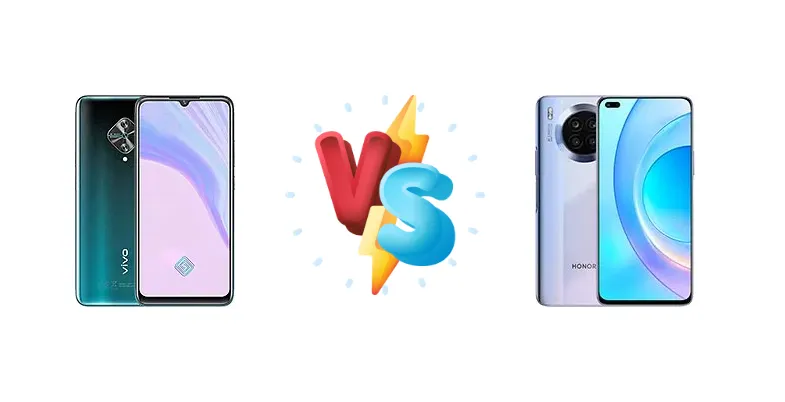
The sub-$200 smartphone market is fiercely competitive. The vivo S1 Prime and Honor 50 Lite represent compelling options, but cater to different priorities. The S1 Prime leans on Qualcomm’s Snapdragon 665 for processing, while the Honor 50 Lite aggressively targets convenience with its 66W fast charging. This comparison dissects these core differences to determine which device delivers the best overall experience.
🏆 Quick Verdict
For the average user prioritizing convenience and quick top-ups, the Honor 50 Lite is the clear winner. Its 66W charging dramatically reduces downtime. However, users who value a more established chipset and potentially better long-term software support might lean towards the vivo S1 Prime.
| Network |
|---|
| 2G bands | GSM 850 / 900 / 1800 / 1900 | GSM 850 / 900 / 1800 / 1900 |
| 3G bands | HSDPA 850 / 900 / 1700(AWS) / 1900 / 2100 | HSDPA 850 / 900 / 2100 |
| 4G bands | 1, 2, 3, 4, 5, 7, 8, 20, 38, 40, 41 | 1, 3, 5, 7, 8, 20, 28 |
| Speed | HSPA 42.2/5.76 Mbps, LTE (2CA) Cat6 300/150 Mbps | HSPA, LTE |
| Technology | GSM / HSPA / LTE | GSM / HSPA / LTE |
| Launch |
|---|
| Announced | 2020, August 12. Released 2020, August 12 | 2021, October 25 |
| Status | Discontinued | Available. Released 2021, November 17 |
| Body |
|---|
| Build | Glass front, plastic back, plastic frame | - |
| Dimensions | 159.3 x 75.2 x 8.7 mm (6.27 x 2.96 x 0.34 in) | 161.8 x 74.7 x 8.5 mm (6.37 x 2.94 x 0.33 in) |
| SIM | Nano-SIM + Nano-SIM | Nano-SIM + Nano-SIM |
| Weight | 190.2 g (6.70 oz) | 192 g (6.77 oz) |
| Display |
|---|
| Resolution | 1080 x 2340 pixels, 19.5:9 ratio (~404 ppi density) | 1080 x 2376 pixels (~391 ppi density) |
| Size | 6.38 inches, 99.9 cm2 (~83.4% screen-to-body ratio) | 6.67 inches, 108.1 cm2 (~89.5% screen-to-body ratio) |
| Type | AMOLED | IPS LCD |
| Platform |
|---|
| CPU | Octa-core (4x2.0 GHz Kryo 260 Gold & 4x1.8 GHz Kryo 260 Silver) | - |
| Chipset | Qualcomm SDM665 Snapdragon 665 (11 nm) | - |
| GPU | Adreno 610 | - |
| OS | Android 9.0 (Pie), Funtouch 9.2 | Android 11, Magic UI 4.2 |
| Memory |
|---|
| Card slot | microSDXC (uses shared SIM slot) | No |
| Internal | 128GB 8GB RAM | 128GB 6GB RAM, 128GB 8GB RAM |
| | UFS 2.1 | - |
| Main Camera |
|---|
| Features | LED flash, HDR, panorama | LED flash, Panorama, HDR |
| Quad | 48 MP, f/1.8, (wide), 1/2.0", 0.8µm, PDAF
8 MP, f/2.2, (ultrawide), 1/4.0", 1.12µm
2 MP (macro)
Auxiliary lens | 64 MP, f/1.9, 26mm (wide), 1/1.7", PDAF
8 MP, f/2.4, 120˚, 17mm (ultrawide)
2 MP (macro)
Auxiliary lens |
| Single | - | 16 MP, f/2.0, (wide) |
| Video | 1080p@30fps | 1080p@30fps |
| Selfie camera |
|---|
| Features | HDR | HDR |
| Single | 16 MP, f/2.0, (wide), 1/3.06" 1.0µm | 16 MP, f/2.0, (wide) |
| Video | 1080p@30fps | 1080p@30fps |
| Sound |
|---|
| 3.5mm jack | Yes | Yes |
| 35mm jack | Yes | Yes |
| Loudspeaker | Yes | Yes |
| Comms |
|---|
| Bluetooth | 5.0, A2DP, LE | 5.0, A2DP, LE |
| NFC | No | Yes (market/region dependent) |
| Positioning | GPS, GLONASS, GALILEO, BDS | GPS, GLONASS, GALILEO, BDS |
| Radio | FM radio | No |
| USB | USB Type-C 2.0, OTG | USB Type-C 2.0 |
| WLAN | Wi-Fi 802.11 a/b/g/n/ac, dual-band, Wi-Fi Direct | Wi-Fi 802.11 a/b/g/n/ac, dual-band, Wi-Fi Direct |
| Features |
|---|
| Sensors | Fingerprint (under display, optical), accelerometer, gyro, proximity, compass | Fingerprint (side-mounted), accelerometer, gyro, proximity, compass |
| Battery |
|---|
| Charging | 18W wired | 66W wired, 40% in 10 min |
| Type | 4500 mAh | Li-Po 4300 mAh |
| Misc |
|---|
| Colors | Nebula Blue, Jade Black | Midnight Black, Space Silver, Deep Sea Blue |
| Models | V1937 | NTN-L22, NTN-LX1, NTN-LX3 |
| Price | About 240 EUR | About 160 EUR |
vivo S1 Prime
- Established Qualcomm Snapdragon 665 chipset
- Potentially better long-term software support
- Known performance characteristics
- Slow 18W charging
- Display specifications unknown, likely basic
- Camera details are lacking
Honor 50 Lite
- Ultra-fast 66W charging (40% in 10 minutes)
- Likely more modern design
- Potentially better display technology
- Chipset details unknown, potential performance compromise
- Honor’s software update history is less consistent
- Camera quality dependent on sensor details
Display Comparison
Neither device’s display specifications are provided, so a direct comparison is limited. However, given their price points, both likely utilize LCD panels. The Honor 50 Lite, being a newer model, *may* benefit from slightly improved color accuracy or brightness. The absence of information regarding refresh rates suggests both are likely capped at 60Hz, impacting smoothness during scrolling and animations. Bezels are expected to be relatively substantial on both devices, typical for this segment.
Camera Comparison
Without detailed camera specifications, a comprehensive comparison is difficult. However, it’s reasonable to assume both phones feature multi-camera setups with a primary sensor and supporting lenses (likely depth and macro). The absence of OIS (Optical Image Stabilization) on either device suggests image stabilization will rely on software algorithms. The image processing style will likely differ; vivo often emphasizes vibrant, social media-ready images, while Honor may lean towards a more natural look. The quality of the primary sensor will be the most significant factor, and without knowing the megapixel count or sensor size, it’s impossible to declare a winner.
Performance
The vivo S1 Prime’s Qualcomm Snapdragon 665 (11nm) is the key differentiator here. Its octa-core configuration – 4x2.0 GHz Kryo 260 Gold and 4x1.8 GHz Kryo 260 Silver – offers a balanced approach to performance. While not a powerhouse, the Snapdragon 665 is a known quantity, providing adequate performance for everyday tasks and light gaming. The Honor 50 Lite’s chipset is unspecified, but given its focus on value, it likely utilizes a MediaTek Helio G-series processor. The Snapdragon 665’s 11nm process node suggests reasonable thermal efficiency, potentially leading to less throttling during sustained workloads compared to some less-efficient MediaTek alternatives. The S1 Prime will likely handle multitasking and moderately demanding apps more smoothly.
Battery Life
The Honor 50 Lite’s 66W wired charging is its standout feature. The claim of 40% charge in 10 minutes is a significant advantage, drastically reducing downtime. The vivo S1 Prime’s 18W charging is considerably slower. While battery capacity isn’t specified for either device, the Honor 50 Lite’s charging speed effectively mitigates the impact of a potentially smaller battery. Users who frequently top up their phones will greatly benefit from the Honor 50 Lite’s rapid charging capabilities. The S1 Prime will require significantly longer to reach a full charge.
Buying Guide
Buy the vivo S1 Prime if you need a phone with a Qualcomm Snapdragon processor for potentially better app compatibility and a more predictable software experience. Buy the Honor 50 Lite if you prioritize minimizing charging time and want a phone that can quickly regain power during short breaks – ideal for users constantly on the move. The Honor 50 Lite is also a better choice for those who frequently find themselves with low battery and need a rapid recharge.
Frequently Asked Questions
❓ Is the Honor 50 Lite’s 66W charging compatible with all USB-C chargers?
While the Honor 50 Lite uses USB-C, to achieve the full 66W charging speed, you’ll need to use the charger included in the box or a compatible charger that supports the Honor SuperCharge protocol. Standard USB-PD chargers will charge the phone, but at a significantly slower rate.
❓ Will the Snapdragon 665 in the vivo S1 Prime struggle with demanding games like PUBG Mobile?
The Snapdragon 665 can run PUBG Mobile, but you’ll likely need to lower the graphics settings to medium or low to maintain a stable frame rate. Don’t expect to play at the highest settings without experiencing some lag or stuttering. The Honor 50 Lite’s chipset performance is unknown, but it may offer similar or slightly lower gaming performance.
❓ How does Honor’s software update policy compare to vivo’s?
Historically, vivo has offered more consistent software updates and longer support cycles for its devices compared to Honor. Honor’s software support has improved since becoming independent, but it still lags behind vivo in terms of guaranteed updates and long-term commitment.