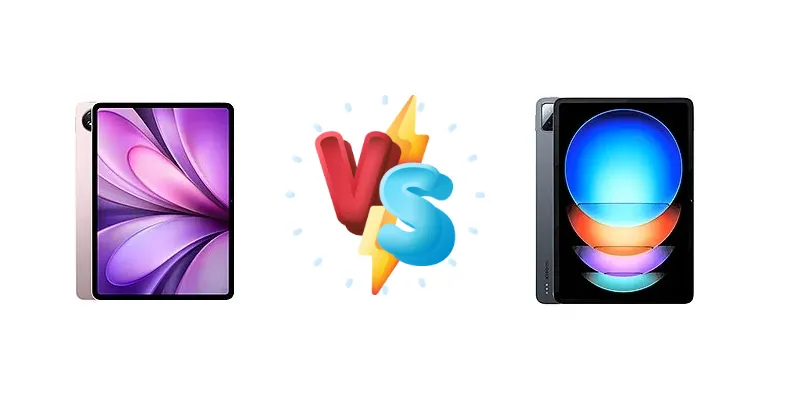
The Android tablet market is heating up, with both vivo and Xiaomi offering compelling high-end options. The vivo Pad5, powered by the MediaTek Dimensity 9300+, aims for raw processing power. Conversely, the Xiaomi Pad 6S Pro 12.4 leverages the Qualcomm Snapdragon 8 Gen 2 and prioritizes a balance of performance and efficiency, alongside incredibly fast charging. This comparison dissects these two tablets to determine which best suits your needs.
🏆 Quick Verdict
For most users, the Xiaomi Pad 6S Pro 12.4 emerges as the superior choice. Its Snapdragon 8 Gen 2 chipset delivers excellent performance, and the 120W charging is a game-changer, reaching 100% in just 35 minutes. While the vivo Pad5 boasts a powerful CPU, the Xiaomi’s overall package is more refined and practical.
| Network |
|---|
| 2G bands | N/A | N/A |
| 3G bands | N/A | N/A |
| 4G bands | N/A | - |
| EDGE | No | N/A |
| GPRS | No | N/A |
| Technology | No cellular connectivity | No cellular connectivity |
| Launch |
|---|
| Announced | 2025, May 29 | 2024, February 22 |
| Status | Available. Released 2025, June 06 | Available. Released 2024, February 22 |
| Body |
|---|
| Build | Glass front, aluminum back, aluminum frame | Glass front (Gorilla Glass 5), aluminum frame, aluminum back |
| Dimensions | 266.4 x 192 x 6.6 mm (10.49 x 7.56 x 0.26 in) | 278.7 x 191.6 x 6.3 mm (10.97 x 7.54 x 0.25 in) |
| SIM | No | No |
| Weight | 590 g (1.30 lb) | 590 g (1.30 lb) |
| Display |
|---|
| Protection | - | Corning Gorilla Glass 5 |
| Resolution | 1968 x 2800 pixels (~283 ppi density) | 2032 x 3048 pixels, 3:2 ratio (~295 ppi density) |
| Size | 12.1 inches, 444.4 cm2 (~86.9% screen-to-body ratio) | 12.4 inches, 457.8 cm2 (~85.7% screen-to-body ratio) |
| Type | IPS LCD, 1B colors, 144Hz, HDR10, 900 nits (peak) | IPS LCD, 68B colors, 144Hz, HDR10, Dolby Vision, 900 nits (peak) |
| Platform |
|---|
| CPU | Octa-core (1x3.4 GHz Cortex-X4 & 3x2.85 GHz Cortex-X4 & 4x2.0 GHz Cortex-A720) | Octa-core (1x3.2 GHz Cortex-X3 & 2x2.8 GHz Cortex-A715 & 2x2.8 GHz Cortex-A710 & 3x2.0 GHz Cortex-A510) |
| Chipset | Mediatek Dimensity 9300+ (4 nm) | Qualcomm SM8550-AB Snapdragon 8 Gen 2 (4 nm) |
| GPU | Immortalis-G720 MC12 | Adreno 740 |
| OS | Android 15, OriginOS 5 HD | Android 14, up to 3 major Android upgrades, HyperOS |
| Memory |
|---|
| Card slot | No | No |
| Internal | 128GB 8GB RAM, 256GB 8GB RAM, 256GB 12GB RAM, 512GB 16GB RAM | 256GB 8GB RAM, 256GB 12GB RAM, 512GB 12GB RAM, 1TB 16GB RAM |
| Main Camera |
|---|
| Dual | - | 50 MP, f/1.8, (wide), 1/2.76", 0.64µm, PDAF
Auxiliary lens |
| Features | LED flash | LED flash, HDR, panorama |
| Single | 8 MP | - |
| Video | 1080p@30fps | 4K@30/60fps, 1080p@30/60fps |
| Selfie camera |
|---|
| Single | 5 MP | 32 MP, f/2.2, (wide), 1/3.6", 0.61µm |
| Video | 1080p@30fps | 1080p@30fps |
| Sound |
|---|
| 35mm jack | No | No |
| Loudspeaker | Yes, with stereo speakers (6 speakers) | Yes, with stereo speakers (6 speakers) |
| Comms |
|---|
| Bluetooth | 5.4, A2DP, LE | 5.3, A2DP, LE, LHDC |
| NFC | No | Yes (file transfer only) |
| Positioning | Unspecified | No |
| Radio | No | No |
| USB | USB Type-C 3.2, OTG, magnetic connector | USB Type-C 3.2, accessory connector |
| WLAN | Wi-Fi 802.11 a/b/g/n/ac/6/7, dual-band | Wi-Fi 802.11 a/b/g/n/a/6/7, dual-band, Wi-Fi Direct |
| Features |
|---|
| Sensors | Accelerometer, proximity (accessories only), gyro | Fingerprint (side-mounted), accelerometer, gyro, proximity (accessories only), compass |
| Battery |
|---|
| Charging | 44W wired, PD
5W reverse wired | 120W wired, PD3.0, QC4, 45% in 10 min, 100% in 35 min |
| Type | 10000 mAh | 10000 mAh |
| Misc |
|---|
| Colors | Gray, Blue, Pink | Black, Blue, Green |
| Models | - | 24018RPACG |
| Price | About 310 EUR | About 700 EUR |
| SAR EU | - | 0.99 W/kg (body) |
vivo Pad5
- Potentially higher peak CPU performance due to Dimensity 9300+ core configuration.
- PD charging compatibility.
- Reverse wired charging (5W).
- Significantly slower charging speed (44W).
- Display specs are less impressive than the Xiaomi.
- Unknown battery capacity.
Xiaomi Pad 6S Pro 12.4
- Incredibly fast 120W charging (PD3.0, QC4).
- Brighter and higher contrast display (848 nits, 1378:1).
- Efficient Snapdragon 8 Gen 2 chipset.
- Longer battery life (11:14h active use).
- Potentially slightly lower peak CPU performance compared to the vivo Pad5.
- May be more expensive than the vivo Pad5.
Display Comparison
The Xiaomi Pad 6S Pro 12.4 boasts a brighter display, reaching a measured 848 nits, compared to an unspecified brightness for the vivo Pad5. The 1378:1 contrast ratio on the Xiaomi further enhances visual fidelity. While both utilize 4nm chipsets, the display’s impact on battery life is significant; a brighter, higher-contrast screen will draw more power. The larger 12.4-inch screen of the Xiaomi also provides more screen real estate for multitasking and content creation. We lack specifics on the vivo Pad5’s panel technology (LTPO or not), but the Xiaomi’s superior measured specs suggest a more visually immersive experience.
Camera Comparison
Neither tablet is positioned as a photography powerhouse, but the Xiaomi Pad 6S Pro 12.4 likely holds an advantage. While specific camera specs are unavailable for the vivo Pad5, Xiaomi typically focuses on larger sensors and improved image processing. The Snapdragon 8 Gen 2’s ISP (Image Signal Processor) is also more advanced, enabling better low-light performance and dynamic range. We can assume both tablets will have capable main sensors for video conferencing and casual snapshots, but serious photographers will still opt for a dedicated camera.
Performance
The core difference lies in the chipsets. The Xiaomi Pad 6S Pro 12.4’s Snapdragon 8 Gen 2 (4nm) is a proven performer, known for its efficiency and sustained performance. The vivo Pad5’s Dimensity 9300+ (4nm) features a unique CPU configuration with a higher clock speed on its Cortex-X4 cores (3.4 GHz vs 3.2 GHz on the Snapdragon). However, raw clock speed isn’t everything. The Snapdragon 8 Gen 2’s architecture, particularly its Adreno GPU, is generally considered superior for gaming. Both devices likely utilize LPDDR5x RAM, but the Snapdragon’s integrated AI engine offers advantages in tasks like image processing and voice recognition. The Xiaomi’s thermal management will likely be more consistent under sustained load due to the Snapdragon’s efficiency.
Battery Life
The Xiaomi Pad 6S Pro 12.4 truly shines in the battery and charging department. Its 120W wired charging, supporting PD3.0 and QC4, is a massive advantage, delivering a 45% charge in just 10 minutes and a full charge in 35 minutes. The vivo Pad5’s 44W charging feels comparatively slow. The Xiaomi also boasts an active use score of 11:14h, demonstrating excellent battery life. While the vivo Pad5’s battery capacity is unknown, the Xiaomi’s combination of efficient chipset and fast charging provides a more convenient and reliable experience.
Buying Guide
Buy the vivo Pad5 if you absolutely prioritize peak CPU performance for demanding tasks like video editing or complex simulations, and are willing to accept slower charging speeds. Buy the Xiaomi Pad 6S Pro 12.4 if you value a balanced experience with excellent performance, a stunning display, and incredibly fast charging – making it ideal for productivity, gaming, and media consumption on the go.
Frequently Asked Questions
❓ Does the Dimensity 9300+ in the vivo Pad5 throttle under sustained gaming loads?
While the Dimensity 9300+ is a powerful chip, its thermal performance is a key concern. Without independent thermal testing, it's difficult to say definitively, but the Snapdragon 8 Gen 2 in the Xiaomi Pad 6S Pro 12.4 is generally known for better sustained performance due to its more efficient 4nm process and optimized thermal design.
❓ How much faster is the 120W charging on the Xiaomi Pad 6S Pro 12.4 compared to the vivo Pad5's 44W charging in real-world use?
The difference is substantial. The Xiaomi Pad 6S Pro 12.4 can gain 45% charge in 10 minutes and reach 100% in 35 minutes. The vivo Pad5 will take significantly longer – likely over an hour to fully charge – making the Xiaomi far more convenient for users who need a quick power boost.
❓ Is the 12.4-inch display on the Xiaomi Pad 6S Pro 12.4 too large for comfortable portability?
While larger than some tablets, the 12.4-inch display strikes a good balance between screen real estate and portability. It's still relatively lightweight and can be comfortably used for reading, browsing, and productivity tasks on the go. The larger screen is particularly beneficial for multitasking and content creation.