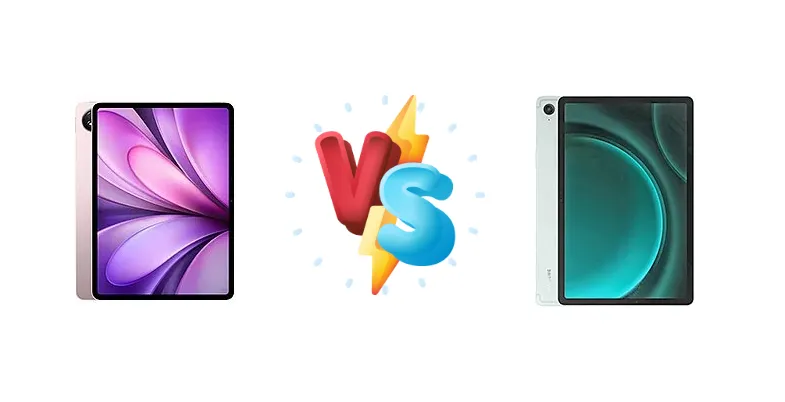
The Android tablet market is heating up, with the vivo Pad5 and Samsung Galaxy Tab S9 FE offering compelling options at different price points. The Pad5 boasts the powerful Mediatek Dimensity 9300+ chipset, while the Tab S9 FE relies on Samsung’s in-house Exynos 1380. This comparison dissects their key differences to help you determine which tablet best suits your needs.
🏆 Quick Verdict
For users prioritizing raw performance and future-proofing, the vivo Pad5 emerges as the winner thanks to its significantly more powerful Dimensity 9300+ chipset. However, the Samsung Galaxy Tab S9 FE provides a well-rounded experience with a competitive feature set and Samsung’s established ecosystem, making it a strong contender for everyday use.
| Network |
|---|
| 2G bands | N/A | GSM 850 / 900 / 1800 / 1900 |
| 3G bands | N/A | HSDPA 850 / 900 / 1700(AWS) / 1900 / 2100 |
| 4G bands | N/A | 1, 2, 3, 4, 5, 7, 8, 12, 13, 17, 20, 26, 28, 32, 38, 40, 41, 66 |
| 5G bands | - | 1, 3, 5, 7, 8, 20, 28, 38, 40, 41, 66, 77, 78 SA/NSA/Sub6 |
| EDGE | No | - |
| GPRS | No | - |
| Speed | - | HSPA, LTE, 5G - cellular model only |
| Technology | No cellular connectivity | GSM / HSPA / LTE / 5G |
| Launch |
|---|
| Announced | 2025, May 29 | 2023, October 04 |
| Status | Available. Released 2025, June 06 | Available. Released 2023, October 16 |
| Body |
|---|
| Build | Glass front, aluminum back, aluminum frame | Glass front, aluminum back, aluminum frame |
| Dimensions | 266.4 x 192 x 6.6 mm (10.49 x 7.56 x 0.26 in) | 254.3 x 165.8 x 6.5 mm (10.01 x 6.53 x 0.26 in) |
| SIM | No | Nano-SIM + eSIM (cellular model only) |
| Weight | 590 g (1.30 lb) | 523 g or 524 g (1.15 lb) |
| Display |
|---|
| Resolution | 1968 x 2800 pixels (~283 ppi density) | 1440 x 2304 pixels, 16:10 ratio (~249 ppi density) |
| Size | 12.1 inches, 444.4 cm2 (~86.9% screen-to-body ratio) | 10.9 inches, 344.5 cm2 (~81.7% screen-to-body ratio) |
| Type | IPS LCD, 1B colors, 144Hz, HDR10, 900 nits (peak) | IPS LCD, 90Hz |
| Platform |
|---|
| CPU | Octa-core (1x3.4 GHz Cortex-X4 & 3x2.85 GHz Cortex-X4 & 4x2.0 GHz Cortex-A720) | Octa-core (4x2.4 GHz Cortex-A78 & 4x2.0 GHz Cortex-A55) |
| Chipset | Mediatek Dimensity 9300+ (4 nm) | Exynos 1380 (5 nm) |
| GPU | Immortalis-G720 MC12 | Mali-G68 MP5 |
| OS | Android 15, OriginOS 5 HD | Android 13, up to 4 major Android upgrades, One UI 6 |
| Memory |
|---|
| Card slot | No | microSDXC (dedicated slot) |
| Internal | 128GB 8GB RAM, 256GB 8GB RAM, 256GB 12GB RAM, 512GB 16GB RAM | 128GB 6GB RAM, 128GB 8GB RAM, 256GB 8GB RAM |
| Main Camera |
|---|
| Features | LED flash | - |
| Single | 8 MP | 8 MP, (wide) |
| Video | 1080p@30fps | 4K@30fps, 1080p@30fps |
| Selfie camera |
|---|
| Single | 5 MP | 12 MP, (ultrawide) |
| Video | 1080p@30fps | Yes |
| Sound |
|---|
| 35mm jack | No | No |
| Loudspeaker | Yes, with stereo speakers (6 speakers) | Yes, with stereo speakers |
| Comms |
|---|
| Bluetooth | 5.4, A2DP, LE | 5.3, A2DP, LE |
| NFC | No | No |
| Positioning | Unspecified | GPS, GALILEO, GLONASS, BDS, QZSS - cellular model only |
| Radio | No | No |
| USB | USB Type-C 3.2, OTG, magnetic connector | USB Type-C 2.0, magnetic connector |
| WLAN | Wi-Fi 802.11 a/b/g/n/ac/6/7, dual-band | Wi-Fi 802.11 a/b/g/n/ac/6, dual-band, Wi-Fi Direct |
| Features |
|---|
| Sensors | Accelerometer, proximity (accessories only), gyro | Fingerprint (side-mounted), accelerometer, gyro, compass, proximity (accessories only) |
| Battery |
|---|
| Charging | 44W wired, PD
5W reverse wired | 45W wired, QC2.0 |
| Type | 10000 mAh | Li-Po 8000 mAh |
| Misc |
|---|
| Colors | Gray, Blue, Pink | Mint, Silver, Gray, Lavender |
| Models | - | SM-X510, SM-X516B |
| Price | About 310 EUR | About 300 EUR |
| SAR | - | 1.55 W/kg (body) |
| SAR EU | - | 0.59 W/kg (body) |
vivo Pad5
- Significantly more powerful Dimensity 9300+ chipset
- Potentially better thermal management due to 4nm process
- 44W fast charging with PD support
- 5W reverse wired charging
- Display specifications are unknown
- Camera performance is unconfirmed
Samsung Galaxy Tab S9 FE
- Well-rounded feature set
- Samsung ecosystem integration
- Efficient Exynos 1380 chipset
- 45W fast charging with QC2.0
- Less powerful chipset compared to the vivo Pad5
- LCD panel may lack the vibrancy of OLED alternatives
Display Comparison
While display specifications are missing for the vivo Pad5, the Samsung Galaxy Tab S9 FE is known for its LCD panel. The Exynos 1380’s integrated display engine likely supports a 60Hz refresh rate, standard for the segment. The vivo Pad5, with its higher-end chipset, *could* support a higher refresh rate, but this is unconfirmed. The 5nm Exynos 1380’s efficiency contributes to potentially better battery life during extended display use, but the lack of LTPO technology means it can’t dynamically adjust refresh rates to conserve power like some premium tablets.
Camera Comparison
Camera details are sparse for both devices. Given the market segment, neither tablet is expected to excel in photography. The Samsung Galaxy Tab S9 FE likely features a standard multi-camera setup, but image quality will be adequate for casual snapshots. The vivo Pad5’s camera capabilities are unknown, but the powerful ISP within the Dimensity 9300+ *could* offer improved image processing, even with a similar sensor. Without specific sensor details, it’s difficult to draw definitive conclusions.
Performance
The core difference lies in the chipsets. The vivo Pad5’s Mediatek Dimensity 9300+ (4nm) features a unique core configuration – 1x3.4 GHz Cortex-X4, 3x2.85 GHz Cortex-X4, and 4x2.0 GHz Cortex-A720 – designed for peak performance. This contrasts sharply with the Samsung Galaxy Tab S9 FE’s Exynos 1380 (5nm) with its 4x2.4 GHz Cortex-A78 and 4x2.0 GHz Cortex-A55 cores. The Dimensity 9300+’s Cortex-X4 cores are significantly more powerful than the A78 cores in the Exynos 1380, translating to faster app loading, smoother multitasking, and superior gaming performance. The 4nm process node of the Dimensity 9300+ also offers better thermal efficiency, potentially reducing throttling during sustained workloads. The Tab S9 FE’s 5nm Exynos 1380 prioritizes efficiency, but sacrifices raw processing power.
Battery Life
The vivo Pad5 supports 44W wired charging with PD, while the Samsung Galaxy Tab S9 FE offers 45W charging with QC2.0. While the wattage is similar, the charging protocols differ. PD is a more universal standard, potentially offering wider compatibility. The Exynos 1380’s efficiency could offset the slightly lower charging speed, resulting in comparable real-world battery life. The vivo Pad5 also offers 5W reverse wired charging, a useful feature for topping up accessories.
Buying Guide
Buy the vivo Pad5 if you need uncompromising performance for demanding tasks like video editing, gaming, or multitasking. Its Dimensity 9300+ offers a substantial advantage. Buy the Samsung Galaxy Tab S9 FE if you prefer a balanced tablet experience with a focus on ecosystem integration, reliable performance for everyday tasks, and a potentially lower price point. It’s ideal for students, casual users, and those already invested in the Samsung ecosystem.
Frequently Asked Questions
❓ Will the Exynos 1380 in the Galaxy Tab S9 FE overheat during extended gaming sessions?
The Exynos 1380 is designed for efficiency, and while it won't match the raw performance of the Dimensity 9300+, it's unlikely to overheat significantly during typical gaming. Samsung's thermal management solutions should prevent substantial throttling, but prolonged, demanding games may still result in some performance reduction.
❓ How much of a performance difference will I realistically see between the Dimensity 9300+ and the Exynos 1380 in everyday tasks?
For basic tasks like web browsing, email, and video streaming, the difference will be minimal. However, when it comes to demanding applications like video editing, graphic-intensive games, or running multiple apps simultaneously, the Dimensity 9300+ will offer a noticeably smoother and faster experience due to its superior processing power.
❓ Does the Samsung Galaxy Tab S9 FE support DeX mode for a desktop-like experience?
Yes, the Samsung Galaxy Tab S9 FE supports DeX mode, allowing you to connect it to an external monitor, keyboard, and mouse for a desktop-like experience. This is a significant advantage for productivity users who want to use their tablet as a portable workstation.
❓ Is the 44W charging on the vivo Pad5 significantly faster than the 45W charging on the Tab S9 FE?
While the wattage is similar, the difference in charging protocols (PD vs QC2.0) and the underlying battery management systems could lead to slightly faster charging on either device. However, the real-world difference in 0-100% charging time is unlikely to be substantial.