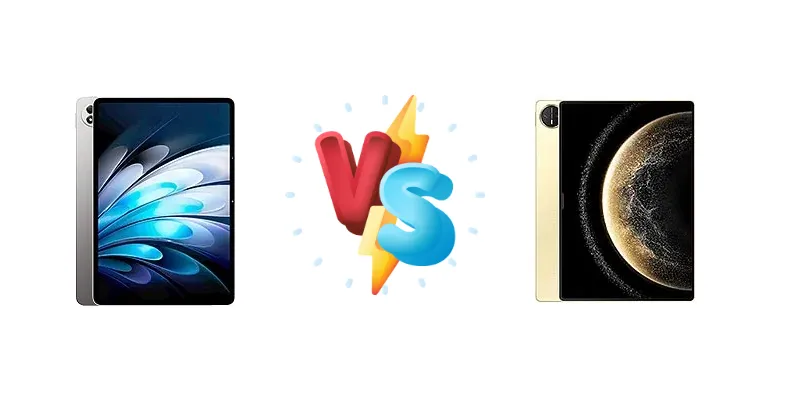
The large-screen Android tablet market is heating up, with both vivo and Huawei offering premium experiences. The vivo Pad5 Pro, powered by the cutting-edge Mediatek Dimensity 9400, aims for raw performance. Meanwhile, Huawei’s MatePad Pro 13.2 (2025) with the Kirin T92 focuses on a balanced approach, prioritizing fast charging and potentially optimized software integration. This comparison dissects the key differences to help you choose the right tablet for your needs.
🏆 Quick Verdict
For the average user prioritizing sustained performance and a potentially more open software ecosystem, the vivo Pad5 Pro with its Dimensity 9400 chipset is the better choice. However, the Huawei MatePad Pro 13.2 (2025) wins on charging speed, offering a significant advantage for users who need to quickly top up their device.
| Network |
|---|
| 2G bands | N/A | GSM 850 / 900 / 1800 / 1900 |
| 3G bands | N/A | HSDPA 850 / 900 / 1900 / 2100 |
| 4G bands | N/A | LTE |
| EDGE | No | - |
| GPRS | No | - |
| Speed | - | HSPA, LTE - cellular model only |
| Technology | No cellular connectivity | GSM / HSPA / LTE |
| Launch |
|---|
| Announced | 2025, April 21 | 2024, November 26 |
| Status | Available. Released 2025, April 25 | Available. Released 2024, December 12 |
| Body |
|---|
| Build | Glass front, aluminum back, aluminum frame | Glass front, nylon fiber back, magnesium alloy frame |
| Dimensions | 289.6 x 198.3 x 6.6 mm (11.40 x 7.81 x 0.26 in) | 289.1 x 196.1 x 5.5 mm (11.38 x 7.72 x 0.22 in) |
| SIM | No | Nano-SIM (cellular model only) |
| Weight | 578 g or 635 g (1.27 lb) | 580 g (Wi-FI) or 590 g (LTE) (1.28 lb) |
| Display |
|---|
| Resolution | 2064 x 3096 pixels, 3:2 ratio (~286 ppi density) | 2880 x 1920 pixels, 3:2 ratio (~262 ppi density) |
| Size | 13.0 inches, 503.2 cm2 (~87.6% screen-to-body ratio) | 13.2 inches, 518.8 cm2 (~91.5% screen-to-body ratio) |
| Type | IPS LCD, 1B colors, 144Hz, HDR10, 1200 nits (peak) | OLED, 1B colors, 144Hz, HDR Vivid, 1000 nits (peak) |
| Platform |
|---|
| CPU | Octa-core (1x3.63 GHz Cortex-X925 & 3x3.3 GHz Cortex-X4 & 4x2.4 GHz Cortex-A720) | Octa-core |
| Chipset | Mediatek Dimensity 9400 (3 nm) | Kirin T92 |
| GPU | Immortalis-G925 | - |
| OS | Android 15, OriginOS 5 HD | Harmony OS 4.3 |
| Memory |
|---|
| Card slot | No | No |
| Internal | 128GB 8GB RAM, 256GB 8GB RAM, 256GB 12GB RAM, 512GB 12GB RAM, 512GB 16GB RAM | 256GB 12GB RAM, 512GB 12GB RAM, 1TB 16GB RAM |
| Main Camera |
|---|
| Dual | - | 50 MP, f/1.8, (wide), PDAF
8 MP, f/2.2, (ultrawide) |
| Features | LED flash, panorama | LED flash |
| Single | 13 MP | - |
| Video | 4K, 1080p | 4K@30fps, 1080p@30fps |
| Selfie camera |
|---|
| Single | 8 MP | 16 MP, f/2.2 |
| Video | 1080p@30fps | 1080p@30fps |
| Sound |
|---|
| 35mm jack | No | No |
| Loudspeaker | Yes, with stereo speakers (8 speakers) | Yes, with stereo speakers (6 speakers) |
| Comms |
|---|
| Bluetooth | 5.4, A2DP, LE | 5.2, A2DP, LE, L2HC |
| NFC | No | No |
| Positioning | Unspecified | GPS, GALILEO, GLONASS, BDS |
| Radio | No | No |
| USB | USB Type-C 3.2, OTG, magnetic connector | USB Type-C 3.1, OTG, DisplayPort 1.2, accessory connector pins |
| WLAN | Yes | Wi-Fi 802.11 a/b/g/n/ac/6, dual-band |
| Features |
|---|
| Sensors | Accelerometer, gyro, proximity (accessories only) | Fingerprint (side-mounted), accelerometer, gyro, compass, proximity (accessories only) |
| Battery |
|---|
| Charging | 66W wired, PD
5W reverse wired | 100W wired
7.5W reverse wired |
| Type | 12050 mAh | Li-Po 10100 mAh |
| Misc |
|---|
| Colors | Gray, Blue, White, Soft pink | Black, White, Gold |
| Models | - | WEB-W00, PCE-W29 |
| Price | About 360 EUR | About 680 EUR |
vivo Pad5 Pro
- Potentially superior CPU performance with Dimensity 9400's Cortex-X925 core.
- More efficient 3nm process for better thermal management.
- Faster reverse wired charging (5W vs 7.5W).
- Slower wired charging (66W vs 100W).
- Potentially less optimized software experience compared to Huawei's ecosystem.
Huawei MatePad Pro 13.2 (2025)
- Significantly faster 100W wired charging.
- Potentially better software integration within the Huawei ecosystem.
- Larger 13.2-inch display for a more immersive experience.
- Kirin T92 chipset may offer lower peak performance compared to Dimensity 9400.
- Potentially less efficient chipset architecture.
Display Comparison
While specific display details are missing, both tablets are positioned as premium devices, suggesting high-resolution panels. The larger 13.2-inch screen of the Huawei MatePad Pro will offer a more immersive viewing experience. The Dimensity 9400’s ISP may offer superior image processing for display output. The absence of LTPO information means we can't assess adaptive refresh rate capabilities, a key feature for battery life. Bezels will likely be minimal on both, reflecting current design trends.
Camera Comparison
Given the tablet form factor, camera performance isn't a primary focus. However, the Dimensity 9400’s advanced ISP could translate to better image processing capabilities for the vivo Pad5 Pro. Without specific sensor details, it’s difficult to assess image quality. We can assume both tablets will feature capable main sensors for document scanning and video conferencing, but dedicated photography enthusiasts should look elsewhere.
Performance
The core of the comparison lies in the chipsets. The vivo Pad5 Pro’s Mediatek Dimensity 9400, built on a 3nm process, represents a significant leap in efficiency and performance. Its Cortex-X925 prime core clocked at 3.63 GHz promises exceptional single-core performance, crucial for responsive UI and app loading. The Kirin T92 in the Huawei MatePad Pro 13.2, while an octa-core processor, lacks detailed architectural information. The 3nm node of the Dimensity 9400 inherently offers better thermal efficiency, potentially leading to less throttling during sustained workloads compared to a potentially larger node process used in the Kirin T92. The Dimensity 9400’s combination of Cortex-X4 and A720 cores suggests a strong balance between performance and power efficiency.
Battery Life
The Huawei MatePad Pro 13.2 (2025) takes a clear lead in charging with its 100W wired charging capability. This will significantly reduce charging times compared to the vivo Pad5 Pro’s 66W charging. While battery capacity isn’t specified, the faster charging speed of the Huawei tablet is a substantial advantage for users who need to quickly replenish their battery. The 7.5W reverse wired charging on the Huawei is slower than the vivo’s 5W, but still useful for topping up accessories.
Buying Guide
Buy the vivo Pad5 Pro if you need uncompromising processing power for demanding tasks like video editing, gaming, or running multiple applications simultaneously. Its Dimensity 9400 chipset and likely higher RAM bandwidth will provide a smoother experience. Buy the Huawei MatePad Pro 13.2 (2025) if you prioritize rapid charging and are deeply embedded within the Huawei ecosystem, benefiting from seamless integration with other Huawei devices and services. The 100W charging is a game-changer for on-the-go professionals.
Frequently Asked Questions
❓ Will the Dimensity 9400 in the vivo Pad5 Pro experience thermal throttling during extended gaming sessions?
The Dimensity 9400’s 3nm process is designed to mitigate thermal throttling. However, sustained peak performance will inevitably generate heat. The vivo Pad5 Pro’s thermal management system will be crucial. While we lack specific details, the 3nm node gives it a significant advantage over potentially larger node processes used in the Kirin T92.
❓ How much faster is the 100W charging on the Huawei MatePad Pro 13.2 (2025) compared to the 66W charging on the vivo Pad5 Pro?
100W charging will significantly reduce charging times. While exact figures depend on battery capacity, expect a 0-100% charge to be considerably faster on the Huawei, potentially shaving off 30-60 minutes compared to the vivo Pad5 Pro. This is a major benefit for users who need a quick power boost.
❓ Does the Huawei MatePad Pro 13.2 (2025) support the full Huawei ecosystem of accessories like the M-Pencil?
Yes, the MatePad Pro series is designed to integrate seamlessly with Huawei’s ecosystem. It will fully support accessories like the M-Pencil (3rd generation) and the magnetic keyboard, offering a complete productivity experience. This is a key advantage for existing Huawei users.