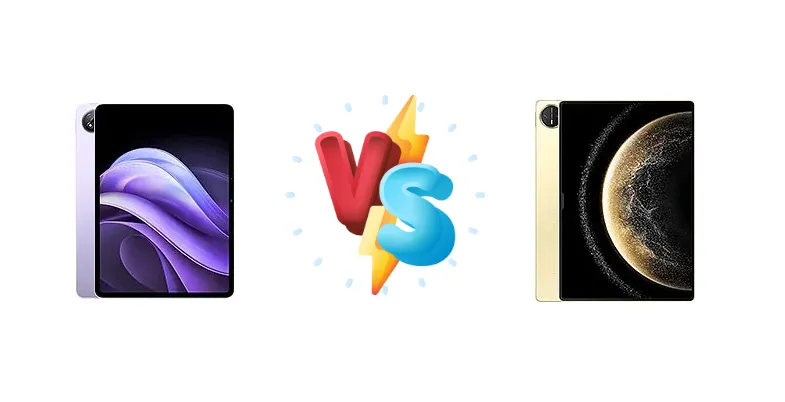
The Android tablet market is heating up, with both vivo and Huawei offering compelling large-screen experiences. The vivo Pad3, powered by Qualcomm’s Snapdragon 8s Gen 3, aims for a balance of performance and efficiency. Meanwhile, Huawei’s MatePad Pro 13.2 (2025) boasts the in-house Kirin T92 chipset and a focus on rapid charging. This comparison dissects these tablets to determine which one best suits your needs.
🏆 Quick Verdict
For the average user prioritizing sustained performance and a more established software ecosystem, the vivo Pad3 emerges as the stronger choice. The Snapdragon 8s Gen 3 offers a proven track record, and its 4nm process provides better thermal headroom. However, the Huawei MatePad Pro 13.2’s 100W charging is a significant advantage for those who demand the fastest possible top-ups.
| Network |
|---|
| 2G bands | N/A | GSM 850 / 900 / 1800 / 1900 |
| 3G bands | N/A | HSDPA 850 / 900 / 1900 / 2100 |
| 4G bands | N/A | LTE |
| EDGE | No | - |
| GPRS | No | - |
| Speed | - | HSPA, LTE - cellular model only |
| Technology | No cellular connectivity | GSM / HSPA / LTE |
| Launch |
|---|
| Announced | 2024, June 28 | 2024, November 26 |
| Status | Available. Released 2024, July 05 | Available. Released 2024, December 12 |
| Body |
|---|
| Build | Glass front, aluminum back, aluminum frame | Glass front, nylon fiber back, magnesium alloy frame |
| Dimensions | 266.4 x 192 x 6.6 mm (10.49 x 7.56 x 0.26 in) | 289.1 x 196.1 x 5.5 mm (11.38 x 7.72 x 0.22 in) |
| SIM | No | Nano-SIM (cellular model only) |
| Weight | 589.2 g (1.30 lb) | 580 g (Wi-FI) or 590 g (LTE) (1.28 lb) |
| Display |
|---|
| Resolution | 1968 x 2800 pixels (~283 ppi density) | 2880 x 1920 pixels, 3:2 ratio (~262 ppi density) |
| Size | 12.1 inches, 444.4 cm2 (~86.9% screen-to-body ratio) | 13.2 inches, 518.8 cm2 (~91.5% screen-to-body ratio) |
| Type | IPS LCD, 1B colors, 144Hz, HDR10, 600 nits (peak) | OLED, 1B colors, 144Hz, HDR Vivid, 1000 nits (peak) |
| Platform |
|---|
| CPU | Octa-core (1x3.0 GHz Cortex-X4 & 4x2.8 GHz Cortex-A720 & 3x2.0 GHz Cortex-A520) | Octa-core |
| Chipset | Qualcomm SM8635 Snapdragon 8s Gen 3 (4 nm) | Kirin T92 |
| GPU | Adreno 735 | - |
| OS | Android 14, OriginOS 4 | Harmony OS 4.3 |
| Memory |
|---|
| Card slot | No | No |
| Internal | 128GB 8GB RAM, 256GB 8GB RAM, 256GB 12GB RAM, 512GB 12GB RAM | 256GB 12GB RAM, 512GB 12GB RAM, 1TB 16GB RAM |
| Main Camera |
|---|
| Dual | - | 50 MP, f/1.8, (wide), PDAF
8 MP, f/2.2, (ultrawide) |
| Features | LED flash | LED flash |
| Single | 8 MP | - |
| Video | 1080p@30fps | 4K@30fps, 1080p@30fps |
| Selfie camera |
|---|
| Single | 5 MP | 16 MP, f/2.2 |
| Video | 1080p@30fps | 1080p@30fps |
| Sound |
|---|
| 35mm jack | No | No |
| Loudspeaker | Yes, with stereo speakers (6 speakers) | Yes, with stereo speakers (6 speakers) |
| Comms |
|---|
| Bluetooth | 5.4, A2DP, LE | 5.2, A2DP, LE, L2HC |
| NFC | No | No |
| Positioning | Unspecified | GPS, GALILEO, GLONASS, BDS |
| Radio | No | No |
| USB | USB Type-C 3.2, OTG, magnetic connector | USB Type-C 3.1, OTG, DisplayPort 1.2, accessory connector pins |
| WLAN | Wi-Fi 802.11 a/b/g/n/ac/6, dual-band | Wi-Fi 802.11 a/b/g/n/ac/6, dual-band |
| Features |
|---|
| Sensors | Accelerometer, gyro, proximity (accessories only) | Fingerprint (side-mounted), accelerometer, gyro, compass, proximity (accessories only) |
| Battery |
|---|
| Charging | 44W wired, PD
5W reverse wired | 100W wired
7.5W reverse wired |
| Type | 10000 mAh | Li-Po 10100 mAh |
| Misc |
|---|
| Colors | Gray, Blue, Purple | Black, White, Gold |
| Models | - | WEB-W00, PCE-W29 |
| Price | About 320 EUR | About 680 EUR |
vivo Pad3
- Proven Snapdragon 8s Gen 3 performance
- More efficient 4nm process for better thermals
- Likely access to a wider app ecosystem via Google Play Store
- Slower 44W charging compared to Huawei
- Software support timeline may be shorter than Huawei
Huawei MatePad Pro 13.2 (2025)
- Blazing-fast 100W wired charging
- Potentially optimized software experience with HarmonyOS
- Large 13.2-inch display for immersive viewing
- Kirin T92 chipset performance is less established
- HarmonyOS app ecosystem may be limited
Display Comparison
While specific display specs are missing, both tablets target the premium large-screen segment. The MatePad Pro 13.2 likely features a high-resolution panel to match its size, potentially utilizing Huawei’s OLED technology. The vivo Pad3’s display quality will be crucial, but without knowing its panel type or refresh rate, it’s difficult to assess. Bezels will be a key differentiator, with thinner bezels enhancing the immersive experience. Color accuracy, measured in DCI-P3 coverage, will be important for content creators.
Camera Comparison
Given the tablet form factor, camera performance isn’t a primary concern. However, the quality of the main sensor will impact video conferencing and casual photography. Without specific sensor details, it’s difficult to compare. Huawei often emphasizes computational photography, so the MatePad Pro 13.2 might offer more refined image processing. The presence of OIS (Optical Image Stabilization) on either device would be a significant advantage for video recording.
Performance
The core of the performance difference lies in the chipsets. The vivo Pad3’s Qualcomm Snapdragon 8s Gen 3 (4nm) is built on a more efficient node than what is typically used in Kirin chips. This translates to better thermal management under sustained load, reducing the likelihood of performance throttling during extended gaming sessions. The Snapdragon 8s Gen 3’s CPU configuration – a 1x3.0 GHz Cortex-X4 prime core, 4x2.8 GHz Cortex-A720 performance cores, and 3x2.0 GHz Cortex-A520 efficiency cores – provides a balanced approach to performance and power consumption. The Kirin T92’s octa-core configuration lacks detailed specifications, making a direct CPU comparison difficult, but it likely prioritizes efficiency over raw power. The vivo Pad3 will almost certainly benefit from LPDDR5x RAM, further boosting performance.
Battery Life
The Huawei MatePad Pro 13.2’s 100W wired charging is a game-changer, potentially allowing a full charge in under 40 minutes. This is a substantial advantage over the vivo Pad3’s 44W charging. While the Pad3’s charging isn’t slow, the MatePad Pro’s speed is significantly faster. The actual battery life will depend on the capacity of each tablet’s battery (not specified), but the faster charging of the Huawei device mitigates concerns about battery drain. The 5W/7.5W reverse wired charging on both devices is primarily for topping up accessories like earbuds.
Buying Guide
Buy the vivo Pad3 if you need a tablet for demanding tasks like gaming and content creation, and value a stable, well-supported Android experience. Its Snapdragon 8s Gen 3 chipset delivers robust performance. Buy the Huawei MatePad Pro 13.2 (2025) if you prioritize incredibly fast charging and are comfortable with Huawei’s HarmonyOS, potentially facing limitations in app availability compared to the Google Play Store.
Frequently Asked Questions
❓ Will the Kirin T92 chipset in the Huawei MatePad Pro 13.2 overheat during prolonged gaming sessions?
While the Kirin T92’s thermal performance is unknown, Huawei typically employs robust cooling solutions. However, the Snapdragon 8s Gen 3’s 4nm process in the vivo Pad3 offers a more inherent advantage in thermal efficiency, potentially leading to less throttling during extended gaming.
❓ Does the Huawei MatePad Pro 13.2 (2025) support Google Mobile Services (GMS) and the Google Play Store?
The Huawei MatePad Pro 13.2 (2025) runs on HarmonyOS, which does *not* natively include Google Mobile Services (GMS). While Huawei has made efforts to provide alternative app stores and workarounds, access to the full Google Play Store ecosystem is limited. Users may need to sideload apps or rely on Huawei’s AppGallery.
❓ How does the reverse wired charging functionality compare between the two tablets?
Both tablets offer reverse wired charging, but the Huawei MatePad Pro 13.2 (2025) supports 7.5W, while the vivo Pad3 supports 5W. This means the Huawei tablet can charge accessories slightly faster, but the difference is not substantial.