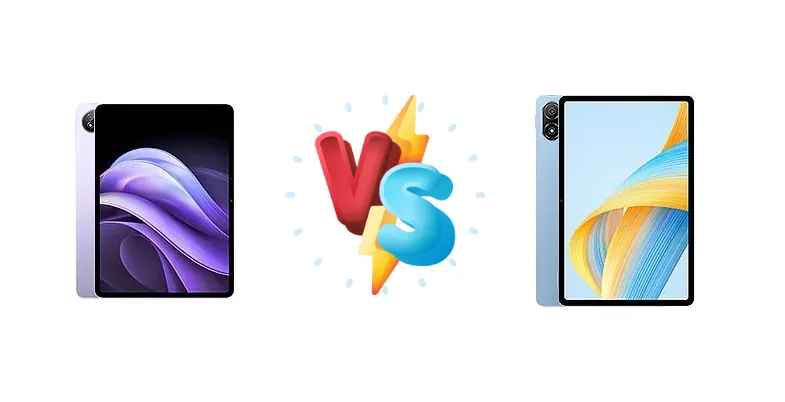
The Android tablet market is heating up, with the vivo Pad3 and Honor Pad V8 Pro offering compelling alternatives to established players. Both aim to deliver a premium experience without the flagship price tag, but they take different approaches. The vivo Pad3 leverages Qualcomm’s newer Snapdragon 8s Gen 3, while the Honor Pad V8 Pro relies on the proven MediaTek Dimensity 8100. This comparison dives deep into the specifics to determine which tablet best suits your needs.
🏆 Quick Verdict
For most users, the vivo Pad3 emerges as the better choice. Its Snapdragon 8s Gen 3 chipset, built on a more efficient 4nm process, provides a performance edge and potentially better thermal management. While the Honor Pad V8 Pro offers a solid experience, the vivo Pad3’s newer silicon gives it a future-proof advantage.
| Network |
|---|
| 2G bands | N/A | N/A |
| 3G bands | N/A | N/A |
| 4G bands | N/A | N/A |
| EDGE | No | N/A |
| GPRS | No | N/A |
| Technology | No cellular connectivity | No cellular connectivity |
| Launch |
|---|
| Announced | 2024, June 28 | 2022, December 26 |
| Status | Available. Released 2024, July 05 | Available. Released 2022, December 30 |
| Body |
|---|
| Build | Glass front, aluminum back, aluminum frame | Glass front, aluminum frame, aluminum back or eco leather back |
| Dimensions | 266.4 x 192 x 6.6 mm (10.49 x 7.56 x 0.26 in) | 277 x 179 x 6.6 mm or 7 mm |
| SIM | No | No |
| Weight | 589.2 g (1.30 lb) | 589 g or 599 g (1.30 lb) |
| | - | Honor Pencil 3 (15ms latency) |
| Display |
|---|
| Resolution | 1968 x 2800 pixels (~283 ppi density) | 2560 x 1600 pixels, 16:10 ratio (~249 ppi density) |
| Size | 12.1 inches, 444.4 cm2 (~86.9% screen-to-body ratio) | 12.1 inches, 424.5 cm2 (~85.6% screen-to-body ratio) |
| Type | IPS LCD, 1B colors, 144Hz, HDR10, 600 nits (peak) | IPS LCD, 1B colors, 144Hz, 600 nits |
| | - | IMAX enhanced |
| Platform |
|---|
| CPU | Octa-core (1x3.0 GHz Cortex-X4 & 4x2.8 GHz Cortex-A720 & 3x2.0 GHz Cortex-A520) | Octa-core (4x2.85 GHz Cortex-A78 & 4x2.0 GHz Cortex-A55) |
| Chipset | Qualcomm SM8635 Snapdragon 8s Gen 3 (4 nm) | Mediatek Dimensity 8100 (5 nm) |
| GPU | Adreno 735 | Mali-G610 MC6 |
| OS | Android 14, OriginOS 4 | Android 12, MagicOS 7 |
| Memory |
|---|
| Card slot | No | No |
| Internal | 128GB 8GB RAM, 256GB 8GB RAM, 256GB 12GB RAM, 512GB 12GB RAM | 128GB 8GB RAM, 256GB 8GB RAM, 256GB 12GB RAM |
| Main Camera |
|---|
| Features | LED flash | LED flash, HDR |
| Single | 8 MP | 13 MP, f/2.0, (wide), 1/3.0", AF |
| Video | 1080p@30fps | 4K@30fps, 1080p@30fps |
| Selfie camera |
|---|
| Single | 5 MP | 5 MP, f/2.2 |
| Video | 1080p@30fps | 1080p@30fps |
| Sound |
|---|
| 3.5mm jack | - | No |
| 35mm jack | No | No |
| Loudspeaker | Yes, with stereo speakers (6 speakers) | Yes, with stereo speakers (8 speakers) |
| | - | 24-bit/192kHz audio |
| Comms |
|---|
| Bluetooth | 5.4, A2DP, LE | 5.2, A2DP, LE |
| NFC | No | No |
| Positioning | Unspecified | GPS, GLONASS, BDS |
| Radio | No | No |
| USB | USB Type-C 3.2, OTG, magnetic connector | USB Type-C, magnetic connector |
| WLAN | Wi-Fi 802.11 a/b/g/n/ac/6, dual-band | Wi-Fi 802.11 a/b/g/n/ac/6, dual-band |
| Features |
|---|
| Sensors | Accelerometer, gyro, proximity (accessories only) | Accelerometer |
| Battery |
|---|
| Charging | 44W wired, PD
5W reverse wired | 35W wired |
| Type | 10000 mAh | Li-Po 10050 mAh |
| Misc |
|---|
| Colors | Gray, Blue, Purple | Grey, Blue, Orange |
| Models | - | ROD-W09 |
| Price | About 320 EUR | About 350 EUR |
vivo Pad3
- More powerful Snapdragon 8s Gen 3 chipset
- Faster 44W charging
- Potentially better thermal management due to 4nm process
- Price may be higher than the Honor Pad V8 Pro
- Detailed display specs are currently unknown
Honor Pad V8 Pro
- Potentially lower price point
- Proven Dimensity 8100 performance
- Solid all-around tablet experience
- Older chipset architecture
- Slower 35W charging
- Potential for more thermal throttling
Display Comparison
Unfortunately, detailed display specs like brightness and panel type are unavailable. However, considering the target market, both tablets likely employ IPS LCD panels. The key difference will likely be color calibration and viewing angles. The Honor Pad V8 Pro, given Honor’s history, may lean towards more saturated colors, while vivo might aim for greater accuracy. Bezels are a critical factor; smaller bezels contribute to a more immersive experience, and this is an area where visual inspection and user reviews will be crucial. Without specific data, it's difficult to declare a clear winner.
Camera Comparison
Camera details are sparse for both devices. Given the tablet form factor, camera quality is rarely a primary concern. However, the presence of a larger sensor and optical image stabilization (OIS) would be beneficial. Without specific sensor sizes or aperture information, it’s difficult to assess the camera capabilities. It’s reasonable to assume both tablets will offer adequate cameras for casual snapshots and video calls, but neither is likely to compete with dedicated camera phones.
Performance
The core of the difference lies in the chipsets. The vivo Pad3’s Qualcomm Snapdragon 8s Gen 3 (4nm) boasts a Cortex-X4 prime core clocked at 3.0 GHz, paired with Cortex-A720 performance cores. This architecture, combined with the 4nm fabrication process, offers superior efficiency and performance per watt compared to the Honor Pad V8 Pro’s MediaTek Dimensity 8100 (5nm). While the Dimensity 8100’s Cortex-A78 cores are capable, they are a generation older and built on a slightly less efficient node. This translates to potentially more throttling under sustained load on the Honor Pad V8 Pro. The Snapdragon 8s Gen 3 will benefit users engaged in graphically intensive gaming or demanding productivity applications.
Battery Life
The vivo Pad3 features 44W wired charging with 5W reverse wired charging, while the Honor Pad V8 Pro offers 35W wired charging. The faster charging speed of the vivo Pad3 will significantly reduce charging times, offering a more convenient experience. While battery capacity isn’t specified, the Snapdragon 8s Gen 3’s efficiency could offset a potentially smaller battery size in the vivo Pad3, resulting in comparable real-world battery life. The 5W reverse wired charging on the vivo Pad3 is a useful addition for topping up accessories like earbuds.
Buying Guide
Buy the vivo Pad3 if you prioritize raw performance for demanding tasks like gaming and video editing, and value a more modern chipset architecture for potential longevity. Buy the Honor Pad V8 Pro if you’re seeking a well-rounded tablet experience at a potentially lower price point, and your workload consists primarily of media consumption and light productivity.
Frequently Asked Questions
❓ Will the Snapdragon 8s Gen 3 in the vivo Pad3 handle demanding games like Genshin Impact at high settings?
Yes, the Snapdragon 8s Gen 3 is a capable chipset that should handle Genshin Impact and other demanding games at high settings. The 4nm process and efficient architecture will help minimize throttling, providing a smoother gaming experience compared to the Dimensity 8100.
❓ Does the Honor Pad V8 Pro get noticeably hot during extended gaming sessions?
The Dimensity 8100, while powerful, is built on a 5nm process and may experience more thermal throttling during prolonged gaming. Users should expect some heat buildup, and performance may decrease slightly over time to manage temperatures.
❓ Is the 5W reverse wired charging on the vivo Pad3 useful for charging accessories?
Yes, the 5W reverse wired charging is a convenient feature for topping up accessories like wireless earbuds or a smartwatch. While it's not a fast charging solution, it can provide a small boost when you're away from a power outlet.
❓ Which tablet is better for taking notes with a stylus?
Neither manufacturer explicitly highlights stylus support. However, both tablets likely support passive styluses. For a truly optimized stylus experience, including pressure sensitivity and palm rejection, you'd need to investigate compatible third-party styluses and their performance on each device.