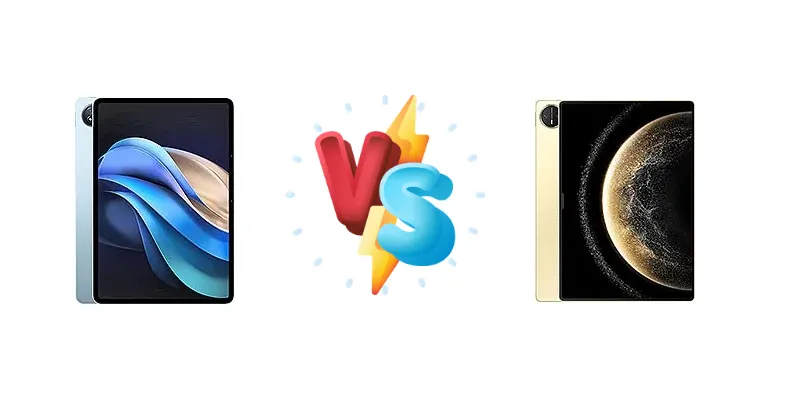
The Android tablet space is heating up, with both vivo and Huawei aiming for the premium segment. The vivo Pad3 Pro, powered by MediaTek’s flagship Dimensity 9300, challenges Huawei’s new MatePad Pro 13.2 (2025) and its in-house Kirin T92 chipset. This comparison dissects the key differences to help you determine which tablet best suits your needs, focusing on performance, charging speed, and overall user experience.
🏆 Quick Verdict
For the average user prioritizing raw processing power and a potentially more open software experience, the vivo Pad3 Pro with its Dimensity 9300 is the better choice. However, the Huawei MatePad Pro 13.2 (2025) counters with significantly faster 100W charging, a crucial advantage for those constantly on the move.
| Network |
|---|
| 2G bands | N/A | GSM 850 / 900 / 1800 / 1900 |
| 3G bands | N/A | HSDPA 850 / 900 / 1900 / 2100 |
| 4G bands | N/A | LTE |
| EDGE | No | - |
| GPRS | No | - |
| Speed | - | HSPA, LTE - cellular model only |
| Technology | No cellular connectivity | GSM / HSPA / LTE |
| Launch |
|---|
| Announced | 2024, March 26 | 2024, November 26 |
| Status | Available. Released 2024, April 03 | Available. Released 2024, December 12 |
| Body |
|---|
| Build | Glass front, aluminum back, aluminum frame | Glass front, nylon fiber back, magnesium alloy frame |
| Dimensions | 289.6 x 198.3 x 6.6 mm (11.40 x 7.81 x 0.26 in) | 289.1 x 196.1 x 5.5 mm (11.38 x 7.72 x 0.22 in) |
| SIM | No | Nano-SIM (cellular model only) |
| Weight | 679 g (1.50 lb) | 580 g (Wi-FI) or 590 g (LTE) (1.28 lb) |
| Display |
|---|
| Resolution | 2064 x 3096 pixels, 3:2 ratio (~286 ppi density) | 2880 x 1920 pixels, 3:2 ratio (~262 ppi density) |
| Size | 13.0 inches, 503.2 cm2 (~87.6% screen-to-body ratio) | 13.2 inches, 518.8 cm2 (~91.5% screen-to-body ratio) |
| Type | IPS LCD, 1B colors, 144Hz, HDR10, 900 nits (peak) | OLED, 1B colors, 144Hz, HDR Vivid, 1000 nits (peak) |
| Platform |
|---|
| CPU | Octa-core (1x3.25 GHz Cortex-X4 & 3x2.85 GHz Cortex-X4 & 4x2.0 GHz Cortex-A720) | Octa-core |
| Chipset | Mediatek Dimensity 9300 (4 nm) | Kirin T92 |
| GPU | Immortalis-G720 MC12 | - |
| OS | Android 14, OriginOS 4 | Harmony OS 4.3 |
| Memory |
|---|
| Card slot | No | No |
| Internal | 128GB 8GB RAM, 256GB 8GB RAM, 256GB 12GB RAM, 512GB 16GB RAM | 256GB 12GB RAM, 512GB 12GB RAM, 1TB 16GB RAM |
| Main Camera |
|---|
| Dual | - | 50 MP, f/1.8, (wide), PDAF
8 MP, f/2.2, (ultrawide) |
| Features | LED flash, panorama | LED flash |
| Single | 13 MP | - |
| Video | Yes | 4K@30fps, 1080p@30fps |
| Selfie camera |
|---|
| Single | 8 MP | 16 MP, f/2.2 |
| Video | 1080p@30fps | 1080p@30fps |
| Sound |
|---|
| 35mm jack | No | No |
| Loudspeaker | Yes, with stereo speakers (8 speakers) | Yes, with stereo speakers (6 speakers) |
| Comms |
|---|
| Bluetooth | 5.4, A2DP, LE | 5.2, A2DP, LE, L2HC |
| NFC | Yes | No |
| Positioning | Unspecified | GPS, GALILEO, GLONASS, BDS |
| Radio | No | No |
| USB | USB Type-C 3.2, OTG, magnetic connector | USB Type-C 3.1, OTG, DisplayPort 1.2, accessory connector pins |
| WLAN | Wi-Fi 802.11 a/b/g/n/ac/6/7, dual-band | Wi-Fi 802.11 a/b/g/n/ac/6, dual-band |
| Features |
|---|
| Sensors | Accelerometer, gyro, proximity (accessories only) | Fingerprint (side-mounted), accelerometer, gyro, compass, proximity (accessories only) |
| Battery |
|---|
| Charging | 66W wired, PD
5W reverse wired | 100W wired
7.5W reverse wired |
| Type | 11500 mAh | Li-Po 10100 mAh |
| Misc |
|---|
| Colors | Gray, Blue, Purple | Black, White, Gold |
| Models | - | WEB-W00, PCE-W29 |
| Price | About 380 EUR | About 680 EUR |
vivo Pad3 Pro
- Potentially superior CPU performance with Dimensity 9300
- More efficient 4nm manufacturing process
- Likely better GPU performance for gaming
- Slower 66W charging compared to Huawei
- Software experience may vary depending on region
Huawei MatePad Pro 13.2 (2025)
- Ultra-fast 100W wired charging
- Potentially optimized camera processing (based on Huawei's history)
- Slightly higher reverse charging wattage
- Kirin T92 chipset may lag behind Dimensity 9300 in raw performance
- Software ecosystem may be restrictive for some users
Display Comparison
While both tablets likely feature high-resolution displays (specs not provided), the core difference lies in the underlying processing power driving them. Without display specs, we can assume both will target a premium visual experience. However, the Dimensity 9300’s superior GPU could translate to smoother performance in graphically intensive applications and games displayed on either screen.
Camera Comparison
As camera specifications are absent, a direct comparison is impossible. However, given Huawei’s historical strength in mobile photography, the MatePad Pro 13.2 (2025) may prioritize image processing and camera features. The vivo Pad3 Pro will likely focus on delivering a balanced camera experience, leveraging the Dimensity 9300’s image signal processor (ISP) capabilities.
Performance
The vivo Pad3 Pro’s Mediatek Dimensity 9300, built on a 4nm process, boasts a unique CPU configuration with a 1x3.25 GHz Cortex-X4 prime core, three 2.85 GHz Cortex-X4 cores, and four 2.0 GHz Cortex-A720 cores. This contrasts with the Huawei MatePad Pro 13.2 (2025)’s Kirin T92, which has an octa-core configuration but lacks detailed core specifications. The Dimensity 9300’s architecture, particularly the inclusion of multiple Cortex-X4 cores, suggests a significant advantage in single-core and multi-core performance, crucial for demanding applications. The 4nm node also implies better thermal efficiency, potentially reducing throttling during sustained workloads.
Battery Life
The Huawei MatePad Pro 13.2 (2025) takes a clear lead in charging speed with its 100W wired charging, significantly faster than the vivo Pad3 Pro’s 66W. This translates to a much quicker 0-100% charge time, a critical advantage for users who need to rapidly replenish their battery. While battery capacity isn’t specified, the faster charging of the Huawei device effectively mitigates any potential disadvantage from a smaller battery size. The vivo Pad3 Pro offers 5W reverse wired charging, while the Huawei device offers 7.5W, providing slightly more utility for topping up smaller accessories.
Buying Guide
Buy the vivo Pad3 Pro if you need a tablet focused on demanding tasks like video editing, gaming, or running multiple applications simultaneously, benefiting from the Dimensity 9300’s advanced CPU architecture. Buy the Huawei MatePad Pro 13.2 (2025) if you prioritize minimizing downtime and require the fastest possible charging speeds, making it ideal for professionals who need a reliably powered device throughout the day.
Frequently Asked Questions
❓ Will the Dimensity 9300 in the vivo Pad3 Pro experience thermal throttling during extended gaming sessions?
The Dimensity 9300’s 4nm process and efficient core architecture are designed to minimize thermal throttling. However, sustained high loads will inevitably generate heat. The effectiveness of vivo’s cooling solution will be crucial in maintaining peak performance over extended periods. Expect better sustained performance than older generation chipsets.
❓ How does the 100W charging on the Huawei MatePad Pro 13.2 (2025) compare to typical tablet charging speeds?
100W charging is exceptionally fast for a tablet. Most tablets charge at 65W or lower. This means the Huawei MatePad Pro 13.2 (2025) can significantly reduce charging times, potentially going from 0-100% in under an hour, a substantial benefit for users who need a quickly replenished battery.
❓ Does the Kirin T92 chipset support 5G connectivity in the Huawei MatePad Pro 13.2 (2025)?
While the Kirin T92 is capable of 5G connectivity, Huawei's current situation may limit its availability depending on the region. Check the specific model number and regional specifications to confirm 5G support.