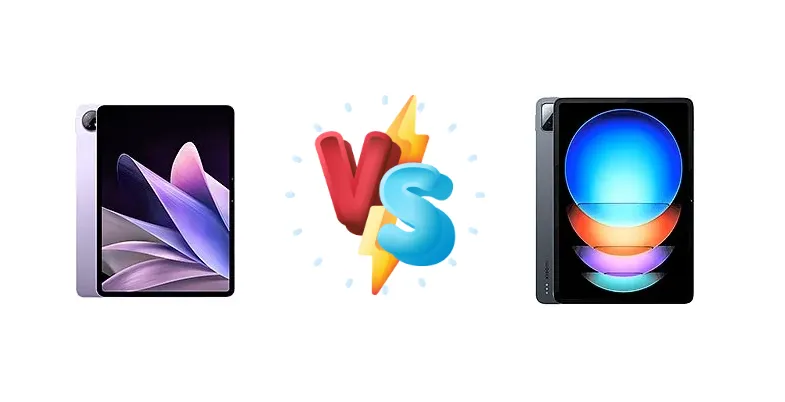
The Android tablet market is heating up, with both vivo and Xiaomi offering compelling options in the premium space. The vivo Pad2 aims to deliver flagship performance at a competitive price, while the Xiaomi Pad 6S Pro 12.4 pushes the boundaries with its blazing-fast charging and powerful Snapdragon 8 Gen 2 chipset. This comparison dives deep into the specifics to determine which tablet best suits your needs.
🏆 Quick Verdict
For most users, the Xiaomi Pad 6S Pro 12.4 is the superior choice, thanks to its significantly faster 120W charging and the raw power of the Snapdragon 8 Gen 2. However, the vivo Pad2 presents a strong value proposition, offering a capable Dimensity 9000 chipset at a potentially lower price point.
| Network |
|---|
| 2G bands | N/A | N/A |
| 3G bands | N/A | N/A |
| 4G bands | N/A | - |
| EDGE | No | N/A |
| GPRS | No | N/A |
| Technology | No cellular connectivity | No cellular connectivity |
| Launch |
|---|
| Announced | 2023, April 20 | 2024, February 22 |
| Status | Available. Released 2023, April 24 | Available. Released 2024, February 22 |
| Body |
|---|
| Build | Glass front, aluminum back, aluminum frame | Glass front (Gorilla Glass 5), aluminum frame, aluminum back |
| Dimensions | 266 x 191.6 x 6.6 mm (10.47 x 7.54 x 0.26 in) | 278.7 x 191.6 x 6.3 mm (10.97 x 7.54 x 0.25 in) |
| SIM | No | No |
| Weight | 585 g (1.29 lb) | 590 g (1.30 lb) |
| | Stylus support | - |
| Display |
|---|
| Protection | - | Corning Gorilla Glass 5 |
| Resolution | 1968 x 2800 pixels (~284 ppi density) | 2032 x 3048 pixels, 3:2 ratio (~295 ppi density) |
| Size | 12.1 inches, 441.3 cm2 (~86.6% screen-to-body ratio) | 12.4 inches, 457.8 cm2 (~85.7% screen-to-body ratio) |
| Type | IPS LCD, 1B colors, 144Hz, HDR10, 600 nits | IPS LCD, 68B colors, 144Hz, HDR10, Dolby Vision, 900 nits (peak) |
| Platform |
|---|
| CPU | Octa-core (1x3.05 GHz Cortex-X2 & 3x2.85 GHz Cortex-A710 & 4x1.80 GHz Cortex-A510) | Octa-core (1x3.2 GHz Cortex-X3 & 2x2.8 GHz Cortex-A715 & 2x2.8 GHz Cortex-A710 & 3x2.0 GHz Cortex-A510) |
| Chipset | Mediatek Dimensity 9000 (4 nm) | Qualcomm SM8550-AB Snapdragon 8 Gen 2 (4 nm) |
| GPU | Mali-G710 MC10 | Adreno 740 |
| OS | Android 13, OriginOS 3 | Android 14, up to 3 major Android upgrades, HyperOS |
| Memory |
|---|
| Card slot | No | No |
| Internal | 128GB 8GB RAM, 256GB 8GB RAM, 256GB 12GB RAM, 512GB 12GB RAM | 256GB 8GB RAM, 256GB 12GB RAM, 512GB 12GB RAM, 1TB 16GB RAM |
| | UFS 3.1 | - |
| Main Camera |
|---|
| Dual | 13 MP, f/2.2, 21mm, 112˚ (ultrawide), 1.12µm, AF
2 MP (macro) | 50 MP, f/1.8, (wide), 1/2.76", 0.64µm, PDAF
Auxiliary lens |
| Features | LED flash, panorama | LED flash, HDR, panorama |
| Video | 4K@30fps, 1080p@30fps | 4K@30/60fps, 1080p@30/60fps |
| Selfie camera |
|---|
| Single | 8 MP, f/2.0, (wide), 1/4.0", 1.12µm | 32 MP, f/2.2, (wide), 1/3.6", 0.61µm |
| Video | 1080p@30fps | 1080p@30fps |
| Sound |
|---|
| 3.5mm jack | No | - |
| 35mm jack | No | No |
| Loudspeaker | Yes, with stereo speakers (4 speakers) | Yes, with stereo speakers (6 speakers) |
| Comms |
|---|
| Bluetooth | 5.3, A2DP, LE | 5.3, A2DP, LE, LHDC |
| NFC | Yes | Yes (file transfer only) |
| Positioning | Unspecified | No |
| Radio | No | No |
| USB | USB Type-C 3.2, OTG, DisplayPort, magnetic connector | USB Type-C 3.2, accessory connector |
| WLAN | Wi-Fi 802.11 a/b/g/n/ac/6, dual-band, Wi-Fi Direct | Wi-Fi 802.11 a/b/g/n/a/6/7, dual-band, Wi-Fi Direct |
| Features |
|---|
| Sensors | Accelerometer, gyro, proximity, compass | Fingerprint (side-mounted), accelerometer, gyro, proximity (accessories only), compass |
| Battery |
|---|
| Charging | 44W wired, PD
5W reverse wired | 120W wired, PD3.0, QC4, 45% in 10 min, 100% in 35 min |
| Type | 10000 mAh | 10000 mAh |
| Misc |
|---|
| Colors | Gray, Blue, Violet | Black, Blue, Green |
| Models | - | 24018RPACG |
| Price | About 330 EUR | About 700 EUR |
| SAR EU | - | 0.99 W/kg (body) |
vivo Pad2
- Potentially more affordable price point
- Capable Dimensity 9000 chipset for everyday tasks
- 44W fast charging with PD support
- Less powerful processor than the Snapdragon 8 Gen 2
- Slower charging speed compared to the Xiaomi
- Display brightness and contrast likely inferior
Xiaomi Pad 6S Pro 12.4
- Blazing-fast 120W charging
- Superior performance with Snapdragon 8 Gen 2
- Brighter and higher contrast display
- Higher price tag
- Potentially more expensive repairs
- May run hotter under sustained load
Display Comparison
The Xiaomi Pad 6S Pro 12.4 boasts a brighter display, reaching a measured 848 nits, compared to an unspecified peak brightness for the vivo Pad2. This higher brightness translates to better visibility outdoors. While both utilize 4nm chipsets, the Xiaomi’s display also features a 1378:1 contrast ratio, suggesting deeper blacks and more vibrant colors. The larger 12.4-inch screen size of the Xiaomi Pad 6S Pro also provides more screen real estate for multitasking and content creation. We lack PWM frequency data for both, but a higher refresh rate (likely 120Hz on the Xiaomi) would be beneficial for smoother scrolling and gaming.
Camera Comparison
Neither tablet is positioned as a photography powerhouse, but the Xiaomi Pad 6S Pro 12.4 likely holds an advantage due to its expected higher-quality image signal processor (ISP) within the Snapdragon 8 Gen 2. Without specific sensor details for either device, it’s difficult to make a definitive statement. However, Xiaomi generally prioritizes camera performance in its flagship devices. The inclusion of OIS (Optical Image Stabilization) on the Xiaomi would be a significant benefit for video recording and low-light photography, a feature we cannot confirm for either device.
Performance
The Xiaomi Pad 6S Pro 12.4’s Snapdragon 8 Gen 2 (4nm) represents a significant leap in performance over the vivo Pad2’s Dimensity 9000 (4nm). The Snapdragon 8 Gen 2 features a newer Cortex-X3 core clocked at 3.2 GHz, compared to the Dimensity 9000’s Cortex-X2 at 3.05 GHz. This, coupled with the more efficient A715 cores in the Snapdragon, results in superior single-core and multi-core performance. While both utilize 4nm fabrication, the Snapdragon 8 Gen 2’s architecture offers better thermal efficiency, potentially leading to less throttling during sustained workloads. The Xiaomi’s LPDDR5x RAM further enhances performance, providing faster data access.
Battery Life
The Xiaomi Pad 6S Pro 12.4’s 120W wired charging is a game-changer, achieving 45% charge in just 10 minutes and a full charge in 35 minutes. This drastically reduces downtime compared to the vivo Pad2’s 44W charging. While the Xiaomi Pad 6S Pro 12.4 has an active use score of 11:14h, the vivo Pad2’s battery capacity is unknown. The faster charging of the Xiaomi effectively mitigates any potential disadvantage in battery capacity, making it the more convenient option for users who need to quickly top up their device.
Buying Guide
Buy the vivo Pad2 if you prioritize value and a balanced experience, needing a reliable tablet for everyday tasks, media consumption, and light gaming. You'll appreciate the responsiveness of the Dimensity 9000 without breaking the bank. Buy the Xiaomi Pad 6S Pro 12.4 if you demand the absolute best performance, need rapid charging to minimize downtime, and plan to engage in demanding tasks like video editing or graphically intensive gaming. The Snapdragon 8 Gen 2 and 120W charging are worth the premium.
Frequently Asked Questions
❓ Will the Snapdragon 8 Gen 2 in the Xiaomi Pad 6S Pro 12.4 overheat during extended gaming sessions?
While the Snapdragon 8 Gen 2 is a powerful chip, Qualcomm has made significant strides in thermal management. The 4nm process and optimized architecture contribute to better efficiency. However, prolonged, graphically intensive gaming will inevitably generate heat. Xiaomi likely incorporates a robust cooling system, but some throttling may occur to maintain stability.
❓ Does the vivo Pad2 support stylus input and keyboard accessories?
While not explicitly stated in the provided data, vivo typically offers stylus and keyboard accessories for its Pad series. Checking vivo’s official website or retailer listings is recommended to confirm compatibility and availability. The larger screen size of the Xiaomi Pad 6S Pro 12.4 may offer a more comfortable experience with these accessories.
❓ How does the 44W charging on the vivo Pad2 compare to standard tablet charging speeds?
44W is considered relatively fast charging for a tablet, exceeding the charging speeds of many older or budget-oriented models. However, it pales in comparison to the 120W charging on the Xiaomi Pad 6S Pro 12.4. Expect a full charge on the vivo Pad2 to take considerably longer – likely over 2 hours – compared to the Xiaomi’s 35-minute timeframe.