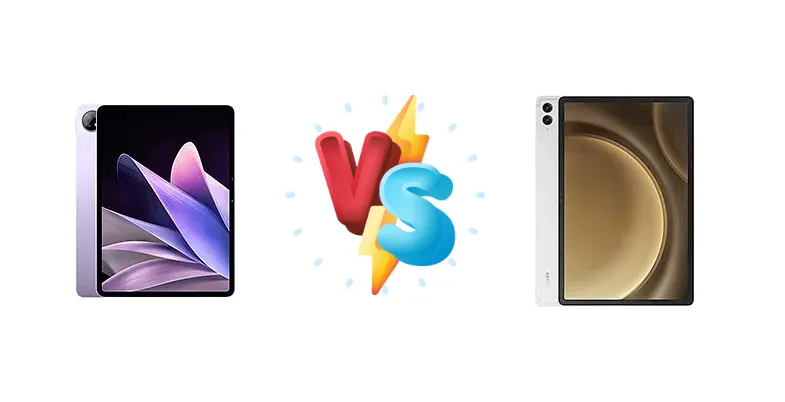
The Android tablet market is heating up, with the vivo Pad2 and Samsung Galaxy Tab S9 FE+ vying for attention. The Pad2 arrives with a flagship-level Dimensity 9000 chipset, while the S9 FE+ opts for Samsung’s in-house Exynos 1380. This comparison dissects these key differences, alongside charging capabilities and overall value, to determine which tablet best suits your needs.
🏆 Quick Verdict
For users prioritizing raw performance and potentially longer software support, the vivo Pad2 emerges as the winner. Its Dimensity 9000 chipset offers a significant advantage in demanding tasks. However, the Samsung Galaxy Tab S9 FE+ provides a compelling alternative with its established ecosystem and slightly faster charging.
| Network |
|---|
| 2G bands | N/A | GSM 850 / 900 / 1800 / 1900 |
| 3G bands | N/A | HSDPA 850 / 900 / 1700(AWS) / 1900 / 2100 |
| 4G bands | N/A | 1, 2, 3, 4, 5, 7, 8, 12, 13, 17, 20, 26, 28, 32, 38, 40, 41, 66 |
| 5G bands | - | 1, 3, 5, 7, 8, 20, 28, 38, 40, 41, 66, 77, 78 SA/NSA/Sub6 |
| EDGE | No | - |
| GPRS | No | - |
| Speed | - | HSPA, LTE, 5G - cellular model only |
| Technology | No cellular connectivity | GSM / HSPA / LTE / 5G |
| Launch |
|---|
| Announced | 2023, April 20 | 2023, October 04 |
| Status | Available. Released 2023, April 24 | Available. Released 2023, October 16 |
| Body |
|---|
| Build | Glass front, aluminum back, aluminum frame | Glass front, aluminum back, aluminum frame |
| Dimensions | 266 x 191.6 x 6.6 mm (10.47 x 7.54 x 0.26 in) | 285.4 x 185.4 x 6.5 mm (11.24 x 7.30 x 0.26 in) |
| SIM | No | Nano-SIM + eSIM (cellular model only) |
| Weight | 585 g (1.29 lb) | 627 g or 628 g (1.38 lb) |
| | Stylus support | - |
| Display |
|---|
| Resolution | 1968 x 2800 pixels (~284 ppi density) | 1600 x 2560 pixels, 16:10 ratio (~243 ppi density) |
| Size | 12.1 inches, 441.3 cm2 (~86.6% screen-to-body ratio) | 12.4 inches, 445.8 cm2 (~84.3% screen-to-body ratio) |
| Type | IPS LCD, 1B colors, 144Hz, HDR10, 600 nits | IPS LCD, 90Hz |
| Platform |
|---|
| CPU | Octa-core (1x3.05 GHz Cortex-X2 & 3x2.85 GHz Cortex-A710 & 4x1.80 GHz Cortex-A510) | Octa-core (4x2.4 GHz Cortex-A78 & 4x2.0 GHz Cortex-A55) |
| Chipset | Mediatek Dimensity 9000 (4 nm) | Exynos 1380 (5 nm) |
| GPU | Mali-G710 MC10 | Mali-G68 MP5 |
| OS | Android 13, OriginOS 3 | Android 13, up to 4 major Android upgrades, One UI 6 |
| Memory |
|---|
| Card slot | No | microSDXC (dedicated slot) |
| Internal | 128GB 8GB RAM, 256GB 8GB RAM, 256GB 12GB RAM, 512GB 12GB RAM | 128GB 6GB RAM, 128GB 8GB RAM, 256GB 8GB RAM, 256GB 12GB RAM |
| | UFS 3.1 | - |
| Main Camera |
|---|
| Dual | 13 MP, f/2.2, 21mm, 112˚ (ultrawide), 1.12µm, AF
2 MP (macro) | 8 MP, (wide)
8 MP, (ultrawide) |
| Features | LED flash, panorama | - |
| Video | 4K@30fps, 1080p@30fps | 4K@30fps, 1080p@30fps |
| Selfie camera |
|---|
| Single | 8 MP, f/2.0, (wide), 1/4.0", 1.12µm | 12 MP, (ultrawide) |
| Video | 1080p@30fps | Yes |
| Sound |
|---|
| 3.5mm jack | No | - |
| 35mm jack | No | No |
| Loudspeaker | Yes, with stereo speakers (4 speakers) | Yes, with stereo speakers |
| Comms |
|---|
| Bluetooth | 5.3, A2DP, LE | 5.3, A2DP, LE |
| NFC | Yes | No |
| Positioning | Unspecified | GPS, GALILEO, GLONASS, BDS, QZSS - cellular model only |
| Radio | No | No |
| USB | USB Type-C 3.2, OTG, DisplayPort, magnetic connector | USB Type-C 2.0, magnetic connector |
| WLAN | Wi-Fi 802.11 a/b/g/n/ac/6, dual-band, Wi-Fi Direct | Wi-Fi 802.11 a/b/g/n/ac/6, dual-band, Wi-Fi Direct |
| Features |
|---|
| Sensors | Accelerometer, gyro, proximity, compass | Fingerprint (side-mounted), accelerometer, gyro, compass, proximity (accessories only) |
| Battery |
|---|
| Charging | 44W wired, PD
5W reverse wired | 45W wired, QC2.0 |
| Type | 10000 mAh | Li-Po 10090 mAh |
| Misc |
|---|
| Colors | Gray, Blue, Violet | Mint, Silver, Gray, Lavender |
| Models | - | SM-X610, SM-X616B |
| Price | About 330 EUR | About 770 EUR |
| SAR | - | 0.77 W/kg (body) |
| SAR EU | - | 0.50 W/kg (body) |
vivo Pad2
- Superior processing power with the Dimensity 9000
- 4nm process for improved thermal efficiency
- 5W reverse wired charging for accessory top-ups
- Brand recognition is lower than Samsung
- Software update longevity is uncertain
Samsung Galaxy Tab S9 FE+
- Established Samsung ecosystem integration
- QC2.0 fast charging compatibility
- Wider availability and brand trust
- Exynos 1380 chipset offers lower peak performance
- 5nm process may not offset the architectural disadvantage
Display Comparison
Both tablets likely feature LCD panels, given their price points, but specific details like resolution and refresh rate are missing. The focus here is on processing power, not display fidelity. However, the choice of chipsets will impact the smoothness of UI animations and responsiveness, indirectly affecting the perceived display experience. Without knowing the PWM dimming rates, it's impossible to assess potential eye strain.
Camera Comparison
Given the tablet form factor, camera performance is less critical. However, the absence of detailed camera specifications suggests both tablets likely feature modest camera setups. Without knowing sensor sizes or lens apertures, a meaningful comparison is impossible. It’s safe to assume both will suffice for casual snapshots and video calls, but neither is positioned as a photography powerhouse.
Performance
The core difference lies in the chipsets. The vivo Pad2’s Mediatek Dimensity 9000, fabricated on a 4nm process, boasts a Cortex-X2 prime core clocked at 3.05 GHz, alongside three Cortex-A710 performance cores and four Cortex-A510 efficiency cores. This configuration is designed for sustained peak performance. Conversely, the Samsung Galaxy Tab S9 FE+ utilizes the Exynos 1380, built on a 5nm node, with a quad-core Cortex-A78 setup and a quad-core Cortex-A55 cluster. While the 5nm process is more efficient, the Dimensity 9000’s architectural advantages – particularly the X2 core – translate to superior single-core and multi-core performance. This means faster app loading, smoother multitasking, and a more responsive overall experience on the vivo Pad2. The Dimensity 9000’s GPU will also provide a more substantial gaming advantage.
Battery Life
Both tablets offer fast charging, with the vivo Pad2 supporting 44W wired charging with PD and the Samsung Galaxy Tab S9 FE+ offering 45W with QC2.0. The slightly higher wattage of the Samsung tablet *could* translate to marginally faster charging times, but the actual 0-100% time will depend on battery capacity (which is currently unknown). The vivo Pad2 also offers 5W reverse wired charging, a useful feature for topping up accessories.
Buying Guide
Buy the vivo Pad2 if you need a tablet capable of handling intensive multitasking, demanding games, or creative workloads. Its Dimensity 9000 provides a noticeable performance edge. Buy the Samsung Galaxy Tab S9 FE+ if you prioritize seamless integration with the Samsung ecosystem, prefer a more widely recognized brand, and value the convenience of Quick Charge 2.0 compatibility, even if it means a slight performance trade-off.
Frequently Asked Questions
❓ Will the Exynos 1380 in the Galaxy Tab S9 FE+ throttle under sustained load, like during extended gaming sessions?
The Exynos 1380, while a capable chip, is more prone to throttling than the Dimensity 9000 due to its less efficient architecture and potentially less robust thermal solution within the tablet. Expect performance to dip slightly during prolonged, demanding tasks.
❓ Does the vivo Pad2 support stylus input, and if so, is a stylus included in the box?
Stylus support for the vivo Pad2 is currently unconfirmed. While many tablets in this price range offer stylus compatibility, it's often sold as a separate accessory. Check official vivo documentation for definitive information regarding stylus support and inclusion.
❓ What kind of storage and RAM options are available for each tablet, and is there microSD card expansion?
Storage and RAM configurations are currently unknown for both devices. MicroSD card expansion is also unconfirmed, but given the trend towards sealed designs, it's unlikely to be available on either tablet.
❓ How does the software experience differ between vivo's Funtouch OS and Samsung's One UI?
Samsung's One UI is a more mature and widely recognized Android skin, offering a wealth of features and customization options. vivo's Funtouch OS has improved significantly in recent years, but may still feel less polished and offer fewer features compared to One UI. Software update frequency and longevity are also generally better with Samsung.