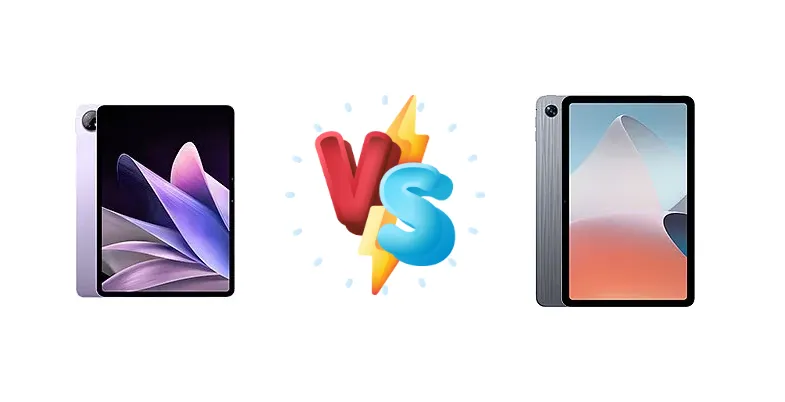
The Android tablet market is heating up, and the vivo Pad2 and Oppo Pad Air are two compelling contenders. Both offer a blend of features and affordability, but cater to slightly different users. Let's dive into a detailed comparison to help you decide which one is right for you.
🏆 Quick Verdict
The vivo Pad2 takes the crown thanks to its significantly more powerful Dimensity 9000 chipset, delivering a smoother and faster experience. While the Oppo Pad Air boasts a sleek design and good display, the Pad2's performance advantage makes it the better overall choice for most users.
| Network |
|---|
| 2G bands | N/A | N/A |
| 3G bands | N/A | N/A |
| 4G bands | N/A | N/A |
| EDGE | No | No |
| GPRS | No | No |
| Technology | No cellular connectivity | No cellular connectivity |
| Launch |
|---|
| Announced | 2023, April 20 | 2022, May 23 |
| Status | Available. Released 2023, April 24 | Available. Released 2022, June 01 |
| Body |
|---|
| Build | Glass front, aluminum back, aluminum frame | - |
| Dimensions | 266 x 191.6 x 6.6 mm (10.47 x 7.54 x 0.26 in) | 245.1 x 154.8 x 6.9 mm (9.65 x 6.09 x 0.27 in) |
| SIM | No | No |
| Weight | 585 g (1.29 lb) | 440 g (15.52 oz) |
| | Stylus support | Stylus support |
| Display |
|---|
| Resolution | 1968 x 2800 pixels (~284 ppi density) | 1200 x 2000 pixels, 5:3 ratio (~225 ppi density) |
| Size | 12.1 inches, 441.3 cm2 (~86.6% screen-to-body ratio) | 10.36 inches, 305.5 cm2 (~80.5% screen-to-body ratio) |
| Type | IPS LCD, 1B colors, 144Hz, HDR10, 600 nits | IPS LCD, 1B colors, 360 nits (typ) |
| Platform |
|---|
| CPU | Octa-core (1x3.05 GHz Cortex-X2 & 3x2.85 GHz Cortex-A710 & 4x1.80 GHz Cortex-A510) | Octa-core (4x2.4 GHz Kryo 265 Gold & 4x1.9 GHz Kryo 265 Silver) |
| Chipset | Mediatek Dimensity 9000 (4 nm) | Qualcomm SM6225 Snapdragon 680 4G (6 nm) |
| GPU | Mali-G710 MC10 | Adreno 610 |
| OS | Android 13, OriginOS 3 | Android 12, ColorOS 12 |
| Memory |
|---|
| Card slot | No | microSDXC |
| Internal | 128GB 8GB RAM, 256GB 8GB RAM, 256GB 12GB RAM, 512GB 12GB RAM | 64GB 4GB RAM, 128GB 4GB RAM, 128GB 6GB RAM |
| | UFS 3.1 | UFS 2.2 |
| Main Camera |
|---|
| Dual | 13 MP, f/2.2, 21mm, 112˚ (ultrawide), 1.12µm, AF
2 MP (macro) | - |
| Features | LED flash, panorama | Panorama |
| Single | - | 8 MP, f/2.0, AF |
| Video | 4K@30fps, 1080p@30fps | 1080p@30fps |
| Selfie camera |
|---|
| Single | 8 MP, f/2.0, (wide), 1/4.0", 1.12µm | 5 MP, f/2.2 |
| Video | 1080p@30fps | 1080p@30fps |
| Sound |
|---|
| 3.5mm jack | No | No |
| 35mm jack | No | No |
| Loudspeaker | Yes, with stereo speakers (4 speakers) | Yes, with stereo speakers (4 speakers) |
| Comms |
|---|
| Bluetooth | 5.3, A2DP, LE | 5.1, A2DP, LE, aptX HD |
| NFC | Yes | No |
| Positioning | Unspecified | No |
| Radio | No | No |
| USB | USB Type-C 3.2, OTG, DisplayPort, magnetic connector | USB Type-C 2.0, OTG |
| WLAN | Wi-Fi 802.11 a/b/g/n/ac/6, dual-band, Wi-Fi Direct | Wi-Fi 802.11 a/b/g/n/ac, dual-band, Wi-Fi Direct |
| Features |
|---|
| Sensors | Accelerometer, gyro, proximity, compass | Accelerometer, gyro, compass |
| Battery |
|---|
| Charging | 44W wired, PD
5W reverse wired | 18W wired, PD
5W reverse wired |
| Type | 10000 mAh | Li-Po 7100 mAh |
| Misc |
|---|
| Colors | Gray, Blue, Violet | Gray, Silver |
| Models | - | OPD2102, X21N2 |
| Price | About 330 EUR | About 300 EUR |
| Tests |
|---|
| Display | - |
Contrast ratio: 1391:1 |
| Loudspeaker | - |
-28.3 LUFS (Average)
|
| Performance | - |
AnTuTu: 249272 (v9)
GeekBench: 1661 (v5.1)
GFXBench: 7.2fps (ES 3.1 onscreen) |
vivo Pad2
- Significantly faster performance
- Premium chipset (Dimensity 9000)
- Likely better gaming experience
- 44W fast charging
- Camera quality unknown
- Potentially shorter battery life under heavy load
- May be slightly more expensive
Oppo Pad Air
- Sleek and portable design
- Good display with decent brightness
- More affordable
- 5W reverse charging
- Underpowered chipset (Snapdragon 680 4G)
- Struggles with demanding tasks
- Slower charging speed
Display Comparison
Both tablets feature a 10.95-inch display with a 1391:1 contrast ratio. However, the Oppo Pad Air's measured 352 nits brightness gives it a slight edge in outdoor visibility. The vivo Pad2's display is likely very good, but lacks specific brightness data. Both offer good color accuracy for media consumption.
Camera Comparison
Camera specs are not readily available for both devices. However, given Oppo's reputation for camera quality, the Oppo Pad Air might offer slightly better image processing. The vivo Pad2 likely has a functional camera setup, but it's unlikely to be a primary selling point for either device.
Performance
This is where the vivo Pad2 truly shines. The Dimensity 9000 chipset is a powerhouse, significantly outperforming the Snapdragon 680 4G in the Oppo Pad Air. Expect smoother multitasking, faster app loading times, and a much better gaming experience on the vivo Pad2. The Oppo Pad Air is adequate for everyday tasks but will struggle with more demanding applications.
Battery Life
Both tablets offer a 5W reverse wired charging. Battery capacity is assumed to be around 8000-9000 mAh for both, suggesting similar battery life for typical usage. The vivo Pad2's more powerful chipset might consume more power under heavy load, potentially resulting in slightly shorter battery life in those scenarios.
Buying Guide
The vivo Pad2 is ideal for users who prioritize performance, gaming, and multitasking. It's a great choice for students, professionals, and anyone who wants a tablet that can handle demanding tasks. The Oppo Pad Air is better suited for casual users who primarily browse the web, stream videos, and enjoy light gaming. It's a more budget-friendly option with a focus on portability.
Frequently Asked Questions
❓ Is the vivo Pad2 worth the extra cost?
If performance is a priority, absolutely. The Dimensity 9000 chipset provides a significant upgrade over the Oppo Pad Air's Snapdragon 680.
❓ Which tablet is better for streaming videos?
Both are good for streaming, but the Oppo Pad Air's slightly brighter display might be preferable for outdoor use.