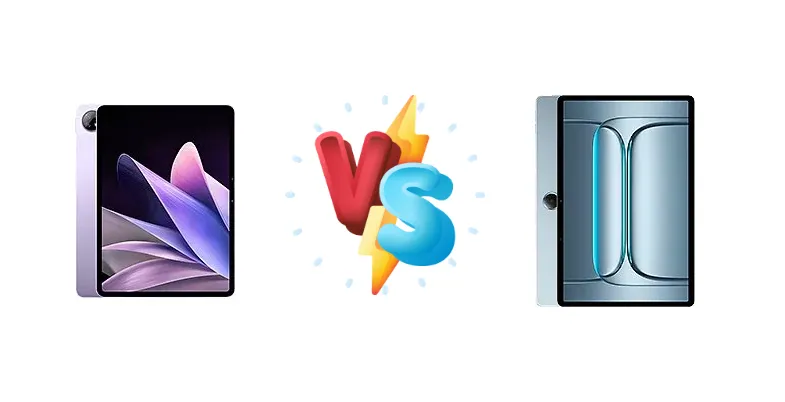
The Android tablet market is heating up, with both vivo and OnePlus offering compelling options. The vivo Pad2 aims for a premium experience with a flagship-tier chipset, while the OnePlus Pad Lite focuses on delivering essential features at a more accessible price point. This comparison dissects the key differences to determine which tablet best suits your needs.
🏆 Quick Verdict
For users prioritizing performance and future-proofing, the vivo Pad2 is the clear winner. Its Dimensity 9000 chipset provides a substantial leap in processing power over the OnePlus Pad Lite’s Helio G100. However, the OnePlus Pad Lite remains a viable option for casual users on a tighter budget.
| Network |
|---|
| 2G bands | N/A | GSM 850 / 900 / 1800 / 1900 - cellular model only |
| 3G bands | N/A | HSDPA 850 / 900 / 2100 - cellular model only |
| 4G bands | N/A | LTE - cellular model only |
| EDGE | No | - |
| GPRS | No | - |
| Speed | - | HSPA, LTE - cellular model only |
| Technology | No cellular connectivity | GSM / HSPA / LTE |
| Launch |
|---|
| Announced | 2023, April 20 | 2025, July 08 |
| Status | Available. Released 2023, April 24 | Available. Released 2025, August 14 |
| Body |
|---|
| Build | Glass front, aluminum back, aluminum frame | - |
| Dimensions | 266 x 191.6 x 6.6 mm (10.47 x 7.54 x 0.26 in) | 254.9 x 166.5 x 7.4 mm (10.04 x 6.56 x 0.29 in) |
| SIM | No | Yes - cellular model only |
| Weight | 585 g (1.29 lb) | 530 g (1.17 lb) |
| | Stylus support | - |
| Display |
|---|
| Resolution | 1968 x 2800 pixels (~284 ppi density) | 1200 x 1920 pixels, 16:10 ratio (~207 ppi density) |
| Size | 12.1 inches, 441.3 cm2 (~86.6% screen-to-body ratio) | 11.0 inches, 347.5 cm2 (~81.9% screen-to-body ratio) |
| Type | IPS LCD, 1B colors, 144Hz, HDR10, 600 nits | IPS LCD, 1B colors, 90Hz, 500 nits |
| Platform |
|---|
| CPU | Octa-core (1x3.05 GHz Cortex-X2 & 3x2.85 GHz Cortex-A710 & 4x1.80 GHz Cortex-A510) | Octa-core (2x2.2 GHz Cortex-A76 & 6x2.0 GHz Cortex-A55) |
| Chipset | Mediatek Dimensity 9000 (4 nm) | Mediatek Helio G100 (6 nm) |
| GPU | Mali-G710 MC10 | Mali-G57 MC2 |
| OS | Android 13, OriginOS 3 | Android 15, OxygenOS 15 |
| Memory |
|---|
| Card slot | No | Unspecified |
| Internal | 128GB 8GB RAM, 256GB 8GB RAM, 256GB 12GB RAM, 512GB 12GB RAM | 128GB 6GB RAM, 128GB 8GB RAM |
| | UFS 3.1 | - |
| Main Camera |
|---|
| Dual | 13 MP, f/2.2, 21mm, 112˚ (ultrawide), 1.12µm, AF
2 MP (macro) | - |
| Features | LED flash, panorama | - |
| Single | - | 5 MP |
| Video | 4K@30fps, 1080p@30fps | 1080p@30fps |
| Selfie camera |
|---|
| Single | 8 MP, f/2.0, (wide), 1/4.0", 1.12µm | 5 MP |
| Video | 1080p@30fps | 1080p@30fps |
| Sound |
|---|
| 3.5mm jack | No | - |
| 35mm jack | No | No |
| Loudspeaker | Yes, with stereo speakers (4 speakers) | Yes, with stereo speakers (4 speakers, Hi-Res audio) |
| Comms |
|---|
| Bluetooth | 5.3, A2DP, LE | 5.2, A2DP, LE, aptX HD |
| NFC | Yes | No |
| Positioning | Unspecified | GPS, (cellular model only) - unconfirmed |
| Radio | No | No |
| USB | USB Type-C 3.2, OTG, DisplayPort, magnetic connector | USB Type-C 2.0 |
| WLAN | Wi-Fi 802.11 a/b/g/n/ac/6, dual-band, Wi-Fi Direct | Wi-Fi 802.11 a/b/g/n/ac, dual-band |
| Features |
|---|
| Sensors | Accelerometer, gyro, proximity, compass | Unspecified |
| Battery |
|---|
| Charging | 44W wired, PD
5W reverse wired | 33W wired |
| Type | 10000 mAh | Li-Po 9340 mAh |
| Misc |
|---|
| Colors | Gray, Blue, Violet | Aero Blue |
| Models | - | OPD2480 |
| Price | About 330 EUR | About 200 EUR |
vivo Pad2
- Significantly faster processor (Dimensity 9000)
- Faster 44W charging with PD support
- 5W reverse wired charging for accessories
- Likely higher price point
- Potential for higher heat output under sustained load (though 4nm helps)
OnePlus Pad Lite
- More affordable price
- Decent performance for basic tasks
- Likely lighter and more portable
- Slower processor (Helio G100)
- Slower 33W charging
- Limited performance for demanding applications
Display Comparison
While both tablets likely feature LCD panels (data unavailable), the core difference lies in their processing power, impacting UI responsiveness. The absence of LTPO technology in either device suggests standard refresh rates. Bezels are likely comparable given the market segment. Color accuracy is unknown, but both brands typically aim for acceptable sRGB coverage.
Camera Comparison
Given the context data, a detailed camera comparison is limited. Both tablets likely feature basic camera setups geared towards video calls rather than photography. The absence of sensor details prevents a meaningful analysis. It's safe to assume image quality will be adequate for casual use but not competitive with smartphone cameras.
Performance
The vivo Pad2’s Mediatek Dimensity 9000, fabricated on a 4nm process, represents a significant advantage over the OnePlus Pad Lite’s 6nm Mediatek Helio G100. The Dimensity 9000’s Cortex-X2 prime core clocked at 3.05 GHz, coupled with three Cortex-A710 performance cores, delivers substantially higher single-core and multi-core performance. The Helio G100’s Cortex-A76 cores, while capable, are older architecture and operate at a lower clock speed. This translates to smoother multitasking, faster app loading times, and a more responsive user experience on the vivo Pad2, particularly for demanding applications. The Pad2 will also handle graphically intensive games with higher frame rates and settings.
Battery Life
Battery capacity is not specified, but the charging speeds reveal a key difference. The vivo Pad2’s 44W wired charging with PD support will significantly reduce charging times compared to the OnePlus Pad Lite’s 33W charging. While a larger battery on the OnePlus Pad Lite could offset this, the faster charging on the vivo Pad2 provides greater convenience. The 5W reverse wired charging on the vivo Pad2 is a useful feature for topping up accessories, absent on the OnePlus Pad Lite.
Buying Guide
Buy the vivo Pad2 if you need a tablet capable of demanding tasks like gaming, video editing, or running multiple apps simultaneously. Its superior chipset and faster charging will significantly enhance your productivity and entertainment. Buy the OnePlus Pad Lite if you prioritize affordability and primarily use your tablet for web browsing, streaming video, and light productivity tasks. It’s a solid choice for students or those seeking a secondary display without breaking the bank.
Frequently Asked Questions
❓ Will the Mediatek Helio G100 in the OnePlus Pad Lite struggle with graphically demanding games like Genshin Impact?
Yes, the Helio G100 is a mid-range chipset and will likely require significant graphical settings reductions and potentially experience frame rate drops in demanding titles like Genshin Impact. It's better suited for less intensive games.
❓ Does the vivo Pad2's Dimensity 9000 chipset generate excessive heat during prolonged gaming sessions?
While the Dimensity 9000 is a powerful chip, its fabrication on a 4nm process helps mitigate heat generation. However, sustained gaming will inevitably lead to some thermal throttling. The Pad2 likely incorporates thermal management solutions to minimize performance impact, but it's not immune to heat.
❓ Is the difference in charging speed between 33W and 44W noticeable in real-world use?
Yes, the 44W charging on the vivo Pad2 will noticeably reduce charging times. Expect a faster 0-100% charge compared to the OnePlus Pad Lite, offering greater convenience for users who frequently need to top up their tablet.