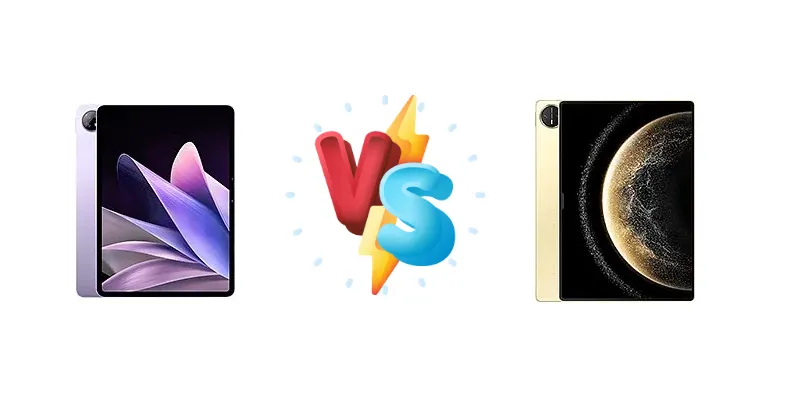
The tablet market is heating up, with both vivo and Huawei offering compelling options. The vivo Pad2, powered by the Mediatek Dimensity 9000, aims for a balance of performance and value. Meanwhile, Huawei’s MatePad Pro 13.2 (2025) enters the arena with its proprietary Kirin T92 chipset and a focus on rapid charging capabilities. This comparison dissects the key differences to determine which tablet best suits your needs.
🏆 Quick Verdict
For the average user prioritizing rapid charging and potentially optimized software integration within the Huawei ecosystem, the Huawei MatePad Pro 13.2 (2025) is the stronger choice. However, the vivo Pad2 offers a competitive performance profile at a likely more accessible price point, making it ideal for budget-conscious users.
| Network |
|---|
| 2G bands | N/A | GSM 850 / 900 / 1800 / 1900 |
| 3G bands | N/A | HSDPA 850 / 900 / 1900 / 2100 |
| 4G bands | N/A | LTE |
| EDGE | No | - |
| GPRS | No | - |
| Speed | - | HSPA, LTE - cellular model only |
| Technology | No cellular connectivity | GSM / HSPA / LTE |
| Launch |
|---|
| Announced | 2023, April 20 | 2024, November 26 |
| Status | Available. Released 2023, April 24 | Available. Released 2024, December 12 |
| Body |
|---|
| Build | Glass front, aluminum back, aluminum frame | Glass front, nylon fiber back, magnesium alloy frame |
| Dimensions | 266 x 191.6 x 6.6 mm (10.47 x 7.54 x 0.26 in) | 289.1 x 196.1 x 5.5 mm (11.38 x 7.72 x 0.22 in) |
| SIM | No | Nano-SIM (cellular model only) |
| Weight | 585 g (1.29 lb) | 580 g (Wi-FI) or 590 g (LTE) (1.28 lb) |
| | Stylus support | - |
| Display |
|---|
| Resolution | 1968 x 2800 pixels (~284 ppi density) | 2880 x 1920 pixels, 3:2 ratio (~262 ppi density) |
| Size | 12.1 inches, 441.3 cm2 (~86.6% screen-to-body ratio) | 13.2 inches, 518.8 cm2 (~91.5% screen-to-body ratio) |
| Type | IPS LCD, 1B colors, 144Hz, HDR10, 600 nits | OLED, 1B colors, 144Hz, HDR Vivid, 1000 nits (peak) |
| Platform |
|---|
| CPU | Octa-core (1x3.05 GHz Cortex-X2 & 3x2.85 GHz Cortex-A710 & 4x1.80 GHz Cortex-A510) | Octa-core |
| Chipset | Mediatek Dimensity 9000 (4 nm) | Kirin T92 |
| GPU | Mali-G710 MC10 | - |
| OS | Android 13, OriginOS 3 | Harmony OS 4.3 |
| Memory |
|---|
| Card slot | No | No |
| Internal | 128GB 8GB RAM, 256GB 8GB RAM, 256GB 12GB RAM, 512GB 12GB RAM | 256GB 12GB RAM, 512GB 12GB RAM, 1TB 16GB RAM |
| | UFS 3.1 | - |
| Main Camera |
|---|
| Dual | 13 MP, f/2.2, 21mm, 112˚ (ultrawide), 1.12µm, AF
2 MP (macro) | 50 MP, f/1.8, (wide), PDAF
8 MP, f/2.2, (ultrawide) |
| Features | LED flash, panorama | LED flash |
| Video | 4K@30fps, 1080p@30fps | 4K@30fps, 1080p@30fps |
| Selfie camera |
|---|
| Single | 8 MP, f/2.0, (wide), 1/4.0", 1.12µm | 16 MP, f/2.2 |
| Video | 1080p@30fps | 1080p@30fps |
| Sound |
|---|
| 3.5mm jack | No | - |
| 35mm jack | No | No |
| Loudspeaker | Yes, with stereo speakers (4 speakers) | Yes, with stereo speakers (6 speakers) |
| Comms |
|---|
| Bluetooth | 5.3, A2DP, LE | 5.2, A2DP, LE, L2HC |
| NFC | Yes | No |
| Positioning | Unspecified | GPS, GALILEO, GLONASS, BDS |
| Radio | No | No |
| USB | USB Type-C 3.2, OTG, DisplayPort, magnetic connector | USB Type-C 3.1, OTG, DisplayPort 1.2, accessory connector pins |
| WLAN | Wi-Fi 802.11 a/b/g/n/ac/6, dual-band, Wi-Fi Direct | Wi-Fi 802.11 a/b/g/n/ac/6, dual-band |
| Features |
|---|
| Sensors | Accelerometer, gyro, proximity, compass | Fingerprint (side-mounted), accelerometer, gyro, compass, proximity (accessories only) |
| Battery |
|---|
| Charging | 44W wired, PD
5W reverse wired | 100W wired
7.5W reverse wired |
| Type | 10000 mAh | Li-Po 10100 mAh |
| Misc |
|---|
| Colors | Gray, Blue, Violet | Black, White, Gold |
| Models | - | WEB-W00, PCE-W29 |
| Price | About 330 EUR | About 680 EUR |
vivo Pad2
- Powerful Dimensity 9000 chipset
- Likely more affordable price point
- 44W fast charging with PD support
- Slower charging compared to Huawei
- Less brand recognition in some markets
Huawei MatePad Pro 13.2 (2025)
- Ultra-fast 100W wired charging
- Potentially optimized Huawei software experience
- Larger 13.2-inch display for immersive viewing
- Kirin T92 chipset performance is less established
- Likely higher price tag
Display Comparison
While specific display details are absent, the 13.2-inch size of the Huawei MatePad Pro suggests a focus on immersive media consumption and productivity. The vivo Pad2’s display size is not specified, but its target market suggests a similar emphasis. The absence of LTPO information for either device means we can’t assess adaptive refresh rate capabilities. However, the larger screen real estate of the Huawei model will likely be preferred by users who frequently multitask or consume video content. Color accuracy and peak brightness will be crucial differentiators, but remain unknown without further data.
Camera Comparison
Given the tablet form factor, camera performance isn’t a primary concern for most users. However, the quality of the front-facing camera for video conferencing is important. Without specific sensor details, it’s difficult to assess the camera capabilities of either device. We can assume both will offer adequate cameras for basic photography and video calls, but neither is likely to compete with flagship smartphones.
Performance
The core of the performance difference lies in the chipsets. The vivo Pad2’s Mediatek Dimensity 9000 (4nm) is a proven performer, featuring an octa-core configuration with a Cortex-X2 prime core for peak performance and Cortex-A710 cores for sustained workloads. The Huawei MatePad Pro 13.2 (2025) utilizes the Kirin T92. While the Kirin T92’s core configuration is also octa-core, its architecture and manufacturing process are less widely known. The 4nm process of the Dimensity 9000 generally translates to better thermal efficiency compared to potentially older node processes used in the Kirin T92, potentially leading to less throttling during extended gaming sessions. The impact of RAM speed (likely LPDDR5x on both) will be secondary to the chipset’s inherent capabilities.
Battery Life
The Huawei MatePad Pro 13.2 (2025) boasts a significant advantage in charging speed with its 100W wired charging capability. This will dramatically reduce charging times compared to the vivo Pad2’s 44W wired charging. While battery capacity isn’t specified for either device, the faster charging of the Huawei model mitigates the impact of a potentially smaller battery. The 5W reverse wired charging on the vivo Pad2 and 7.5W on the Huawei are useful for topping up accessories, but aren’t a major selling point. The Huawei’s faster charging is a clear win for users who need to quickly replenish their battery.
Buying Guide
Buy the vivo Pad2 if you need a powerful tablet for everyday tasks, media consumption, and light gaming, and value a balance between performance and cost. You'll benefit from the Dimensity 9000's capable CPU and GPU. Buy the Huawei MatePad Pro 13.2 (2025) if you prioritize the fastest possible charging speeds, potentially benefit from Huawei’s software optimizations, and are willing to invest in a premium tablet experience.
Frequently Asked Questions
❓ How will the Kirin T92 chipset perform in demanding games compared to the Dimensity 9000?
While the Kirin T92’s gaming performance is currently unknown, the Dimensity 9000 is a well-established performer capable of handling most mobile games at high settings. The Dimensity 9000’s 4nm process also suggests better thermal management, potentially leading to more sustained performance during long gaming sessions. Without benchmarks for the Kirin T92, it’s difficult to provide a definitive comparison.
❓ Is the 100W charging on the Huawei MatePad Pro 13.2 (2025) truly faster in real-world use?
Yes, 100W charging will significantly reduce charging times compared to the vivo Pad2’s 44W charging. While the exact 0-100% time depends on battery capacity, expect the Huawei to charge much faster, potentially adding hours of use in just minutes. This is particularly beneficial for users who frequently travel or rely on their tablet throughout the day.
❓ Does the Huawei MatePad Pro 13.2 (2025) support Google Mobile Services (GMS)?
Huawei’s recent tablets have increasingly supported GMS, but it's crucial to verify the specific model and region. If GMS isn't natively supported, Huawei’s AppGallery and workarounds exist, but may not offer the same app compatibility as GMS-enabled devices.