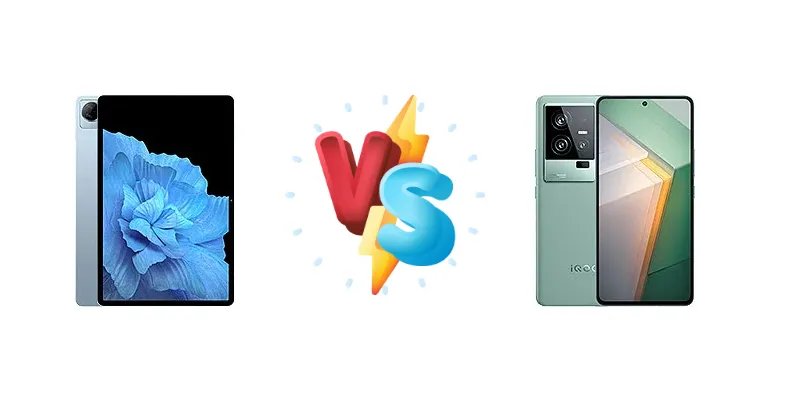
The Android landscape is brimming with options, and vivo offers compelling choices with the Pad tablet and the iQOO 11 smartphone. But which one should you choose? This comprehensive comparison dives deep into their specs, performance, and features to help you make an informed decision.
🏆 Quick Verdict
The iQOO 11 clearly takes the performance crown with its Snapdragon 8 Gen 2 and blazing-fast 120W charging. However, the vivo Pad offers a larger display for media consumption and productivity. Ultimately, it depends on whether you prioritize raw power and speed or a spacious screen.
| Network |
|---|
| 2G bands | N/A | GSM 850 / 900 / 1800 / 1900 |
| 3G bands | N/A | HSDPA 800 / 850 / 900 / 1700(AWS) / 1900 / 2100 |
| 4G bands | N/A | 1, 2, 3, 4, 5, 7, 8, 12, 17, 18, 19, 20, 26, 28, 34, 38, 39, 40, 41 - International |
| 5G bands | - | 1, 3, 5, 8, 28, 40, 41, 77, 78 SA/NSA |
| EDGE | No | - |
| GPRS | No | - |
| Speed | - | HSPA, LTE, 5G |
| Technology | No cellular connectivity | GSM / CDMA / HSPA / CDMA2000 / LTE / 5G |
| | - | 1, 2, 3, 4, 5, 7, 8, 12, 17, 18, 19, 20, 25, 26, 28, 34, 38, 39, 40, 41, 66 - China |
| Launch |
|---|
| Announced | 2022, April 11 | 2022, December 08 |
| Status | Available. Released 2022, April 15 | Available. Released 2022, December 08 |
| Body |
|---|
| Build | Glass front, aluminum back, aluminum frame | - |
| Dimensions | 253.2 x 164.7 x 6.6 mm (9.97 x 6.48 x 0.26 in) | 164.9 x 77.1 x 8.4 mm or 8.7 mm |
| SIM | No | Nano-SIM + Nano-SIM |
| Weight | 489 g (1.08 lb) | 205 g or 208 g (7.23 oz) |
| | Stylus support | - |
| Display |
|---|
| Protection | - | Corning Gorilla Glass Victus |
| Resolution | 1600 x 2560 pixels, 16:10 ratio (~274 ppi density) | 1440 x 3200 pixels, 20:9 ratio (~518 ppi density) |
| Size | 11.0 inches, 350.9 cm2 (~84.1% screen-to-body ratio) | 6.78 inches, 111.0 cm2 (~87.3% screen-to-body ratio) |
| Type | IPS LCD, 120Hz, HDR10 | LTPO4 AMOLED, 1B colors, 144Hz, HDR10+, 1800 nits (peak) |
| Platform |
|---|
| CPU | Octa-core (1x3.2 GHz Kryo 585 & 3x2.42 GHz Kryo 585 & 4x1.80 GHz Kryo 585) | Octa-core (1x3.2 GHz Cortex-X3 & 2x2.8 GHz Cortex-A715 & 2x2.8 GHz Cortex-A710 & 3x2.0 GHz Cortex-A510) |
| Chipset | Qualcomm SM8250-AC Snapdragon 870 5G (7 nm) | Qualcomm SM8550-AB Snapdragon 8 Gen 2 (4 nm) |
| GPU | Adreno 650 | Adreno 740 |
| OS | Android 12, OriginOS HD | Android 13, upgradable to Android 14, Funtouch 14 (International), OriginOS 3 (China) |
| Memory |
|---|
| Card slot | No | No |
| Internal | 128GB 8GB RAM, 256GB 8GB RAM | 128GB 8GB RAM, 256GB 8GB RAM, 256GB 12GB RAM, 256GB 16GB RAM, 512GB 16GB RAM |
| | UFS 3.1 | UFS 3.1 - 128GB
UFS 4.0 - 256/512GB |
| Main Camera |
|---|
| Dual | 13 MP, f/2.2, 112˚ (ultrawide), 1.12µm, AF
8 MP, f/2.2, 112˚ (ultrawide), 1/4.0", 1.12µm | - |
| Features | LED flash, panorama | Dual-LED flash, HDR, panorama |
| Single | 8 MP, f/2.0, (wide), 1/4.0", 1.12µm | 16 MP, f/2.5, (wide) |
| Triple | - | 50 MP, f/1.9, 23mm (wide), 1/1.57", 1.0µm, PDAF, OIS
13 MP, f/2.5, 47mm (telephoto), PDAF, 2x optical zoom
8 MP, f/2.2, 16mm (ultrawide) |
| Video | 4K@30fps, 1080p@30fps | 8K@30fps, 4K@30/60fps, 1080p@30/60/120/240fps, gyro-EIS |
| Selfie camera |
|---|
| Features | - | HDR |
| Single | 8 MP, f/2.0, (wide), 1/4.0", 1.12µm | 16 MP, f/2.5, (wide) |
| Video | 1080p@30fps | 1080p@30fps, gyro-EIS |
| Sound |
|---|
| 3.5mm jack | No | No |
| 35mm jack | No | No |
| Loudspeaker | Yes, with stereo speakers (4 speakers) | Yes, with stereo speakers |
| | - | 24-bit/192kHz audio |
| Comms |
|---|
| Bluetooth | 5.2, A2DP, LE | 5.3, A2DP, LE, aptX HD, aptX Adaptive, aptX Lossless |
| Infrared port | - | Yes |
| NFC | Yes | Yes |
| Positioning | GPS | GPS, GLONASS, GALILEO, BDS, NavIC |
| Radio | No | No |
| USB | USB Type-C 3.1, OTG, magnetic connector | USB Type-C 2.0, OTG |
| WLAN | Wi-Fi 802.11 a/b/g/n/ac/6, dual-band, Wi-Fi Direct | Wi-Fi 802.11 a/b/g/n/ac/6, dual-band, Wi-Fi Direct |
| Features |
|---|
| Sensors | Accelerometer, gyro, proximity, compass | Fingerprint (under display, optical), accelerometer, gyro, proximity, compass |
| Battery |
|---|
| Charging | 44W wired, PD
5W reverse wired | 120W wired, PD3.0, 100% in 25 min |
| Type | 8040 mAh | 5000 mAh |
| Misc |
|---|
| Colors | Black, Blue | Black, Green, White (BMW M branding) |
| Models | - | V2243A |
| Price | About 360 EUR | About 650 EUR |
| Tests |
|---|
| Battery life | - |
Endurance rating 127h
|
| Camera | - |
Photo / Video |
| Display | - |
Contrast ratio: Infinite (nominal) |
| Loudspeaker | - |
-26.3 LUFS (Good)
|
| Performance | - |
AnTuTu: 1281665 (v9)
GeekBench: 4803 (v5.1)
GFXBench: 67fps (ES 3.1 onscreen) |
vivo Pad
- Large display for media and productivity
- Good battery life
- Reverse wired charging
- Less powerful chipset compared to iQOO 11
- Slower charging speed
- Camera details are limited
vivo iQOO 11
- Top-tier Snapdragon 8 Gen 2 performance
- Blazing-fast 120W charging
- Bright and vibrant display
- Excellent camera capabilities (assumed)
- Smaller display compared to Pad
- Battery life endurance rating is a theoretical maximum
- May be less comfortable for extended media consumption
Display Comparison
The vivo Pad boasts a larger display, likely around 11 inches, making it excellent for watching videos, browsing the web, and multitasking. The iQOO 11, while smaller (around 6.78 inches), features a brighter display with 1147 nits peak brightness and an impressive contrast ratio, ensuring vibrant colors and excellent visibility even in direct sunlight. The Pad's larger size offers more screen real estate, while the iQOO 11 prioritizes visual fidelity.
Camera Comparison
While both devices offer 'Photo / Video' capabilities, detailed camera specifications are missing. Generally, flagship smartphones like the iQOO 11 tend to have more advanced camera systems with better image processing and features. The Pad likely prioritizes a more casual photography experience. Expect the iQOO 11 to deliver superior image quality and more versatile shooting options.
Performance
Here, the iQOO 11 dominates. Its Snapdragon 8 Gen 2 chipset is significantly more powerful than the Pad's Snapdragon 870. Expect smoother performance in demanding games, faster app loading times, and overall snappier responsiveness. The iQOO 11's newer architecture and fabrication process (4nm vs 7nm) contribute to its superior efficiency and power.
Battery Life
Both devices claim an endurance rating of 127h, suggesting excellent battery life. However, the iQOO 11's 120W charging is a game-changer, allowing for incredibly fast charging times (100% in 25 minutes). The Pad's 44W charging is still respectable, but significantly slower.
Buying Guide
The vivo Pad is ideal for users seeking a large-screen device for entertainment, note-taking, and light productivity. The iQOO 11 is perfect for gamers, power users, and anyone who demands top-tier performance and rapid charging in a pocketable form factor.
Frequently Asked Questions
❓ Is the vivo Pad good for gaming?
While the vivo Pad can handle casual games, its Snapdragon 870 chipset isn't as powerful as the iQOO 11's Snapdragon 8 Gen 2, so demanding games may experience reduced performance.
❓ Which device is better for photography?
The vivo iQOO 11 is likely the better choice for photography due to its flagship smartphone camera system, although specific details are not available for either device.