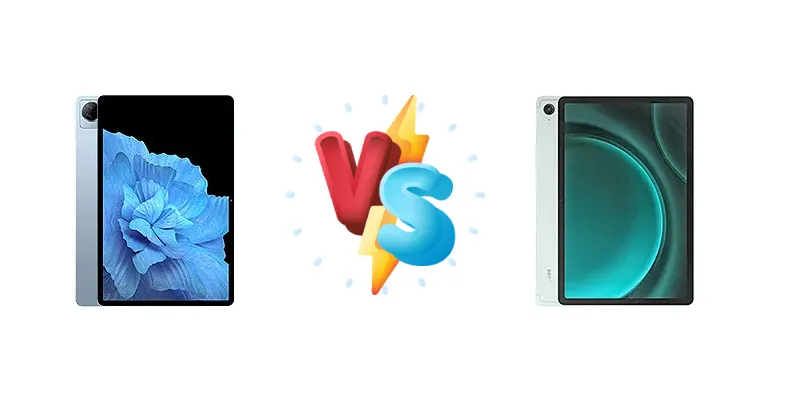
The mid-range Android tablet space is heating up. The vivo Pad, leveraging the proven Snapdragon 870, challenges Samsung’s latest offering, the Galaxy Tab S9 FE, powered by the Exynos 1380. This comparison dissects the core differences to help you determine which tablet best suits your needs, balancing performance, features, and price.
🏆 Quick Verdict
For users prioritizing raw performance and sustained gaming, the vivo Pad’s Snapdragon 870 offers a slight edge. However, the Samsung Galaxy Tab S9 FE’s newer Exynos 1380 and broader ecosystem integration make it the better all-around choice for most users, especially those invested in the Samsung ecosystem.
| Network |
|---|
| 2G bands | N/A | GSM 850 / 900 / 1800 / 1900 |
| 3G bands | N/A | HSDPA 850 / 900 / 1700(AWS) / 1900 / 2100 |
| 4G bands | N/A | 1, 2, 3, 4, 5, 7, 8, 12, 13, 17, 20, 26, 28, 32, 38, 40, 41, 66 |
| 5G bands | - | 1, 3, 5, 7, 8, 20, 28, 38, 40, 41, 66, 77, 78 SA/NSA/Sub6 |
| EDGE | No | - |
| GPRS | No | - |
| Speed | - | HSPA, LTE, 5G - cellular model only |
| Technology | No cellular connectivity | GSM / HSPA / LTE / 5G |
| Launch |
|---|
| Announced | 2022, April 11 | 2023, October 04 |
| Status | Available. Released 2022, April 15 | Available. Released 2023, October 16 |
| Body |
|---|
| Build | Glass front, aluminum back, aluminum frame | Glass front, aluminum back, aluminum frame |
| Dimensions | 253.2 x 164.7 x 6.6 mm (9.97 x 6.48 x 0.26 in) | 254.3 x 165.8 x 6.5 mm (10.01 x 6.53 x 0.26 in) |
| SIM | No | Nano-SIM + eSIM (cellular model only) |
| Weight | 489 g (1.08 lb) | 523 g or 524 g (1.15 lb) |
| | Stylus support | - |
| Display |
|---|
| Resolution | 1600 x 2560 pixels, 16:10 ratio (~274 ppi density) | 1440 x 2304 pixels, 16:10 ratio (~249 ppi density) |
| Size | 11.0 inches, 350.9 cm2 (~84.1% screen-to-body ratio) | 10.9 inches, 344.5 cm2 (~81.7% screen-to-body ratio) |
| Type | IPS LCD, 120Hz, HDR10 | IPS LCD, 90Hz |
| Platform |
|---|
| CPU | Octa-core (1x3.2 GHz Kryo 585 & 3x2.42 GHz Kryo 585 & 4x1.80 GHz Kryo 585) | Octa-core (4x2.4 GHz Cortex-A78 & 4x2.0 GHz Cortex-A55) |
| Chipset | Qualcomm SM8250-AC Snapdragon 870 5G (7 nm) | Exynos 1380 (5 nm) |
| GPU | Adreno 650 | Mali-G68 MP5 |
| OS | Android 12, OriginOS HD | Android 13, up to 4 major Android upgrades, One UI 6 |
| Memory |
|---|
| Card slot | No | microSDXC (dedicated slot) |
| Internal | 128GB 8GB RAM, 256GB 8GB RAM | 128GB 6GB RAM, 128GB 8GB RAM, 256GB 8GB RAM |
| | UFS 3.1 | - |
| Main Camera |
|---|
| Dual | 13 MP, f/2.2, 112˚ (ultrawide), 1.12µm, AF
8 MP, f/2.2, 112˚ (ultrawide), 1/4.0", 1.12µm | - |
| Features | LED flash, panorama | - |
| Single | 8 MP, f/2.0, (wide), 1/4.0", 1.12µm | 8 MP, (wide) |
| Video | 4K@30fps, 1080p@30fps | 4K@30fps, 1080p@30fps |
| Selfie camera |
|---|
| Single | 8 MP, f/2.0, (wide), 1/4.0", 1.12µm | 12 MP, (ultrawide) |
| Video | 1080p@30fps | Yes |
| Sound |
|---|
| 3.5mm jack | No | - |
| 35mm jack | No | No |
| Loudspeaker | Yes, with stereo speakers (4 speakers) | Yes, with stereo speakers |
| Comms |
|---|
| Bluetooth | 5.2, A2DP, LE | 5.3, A2DP, LE |
| NFC | Yes | No |
| Positioning | GPS | GPS, GALILEO, GLONASS, BDS, QZSS - cellular model only |
| Radio | No | No |
| USB | USB Type-C 3.1, OTG, magnetic connector | USB Type-C 2.0, magnetic connector |
| WLAN | Wi-Fi 802.11 a/b/g/n/ac/6, dual-band, Wi-Fi Direct | Wi-Fi 802.11 a/b/g/n/ac/6, dual-band, Wi-Fi Direct |
| Features |
|---|
| Sensors | Accelerometer, gyro, proximity, compass | Fingerprint (side-mounted), accelerometer, gyro, compass, proximity (accessories only) |
| Battery |
|---|
| Charging | 44W wired, PD
5W reverse wired | 45W wired, QC2.0 |
| Type | 8040 mAh | Li-Po 8000 mAh |
| Misc |
|---|
| Colors | Black, Blue | Mint, Silver, Gray, Lavender |
| Models | - | SM-X510, SM-X516B |
| Price | About 360 EUR | About 300 EUR |
| SAR | - | 1.55 W/kg (body) |
| SAR EU | - | 0.59 W/kg (body) |
vivo Pad
- Stronger GPU for gaming
- Faster charging (44W PD)
- Proven Snapdragon 870 performance
- Older 7nm manufacturing process
- Potentially less efficient than Exynos 1380
Samsung Galaxy Tab S9 FE
- More efficient 5nm Exynos 1380
- Samsung ecosystem integration
- Potentially better software support
- Slightly weaker GPU performance
- QC2.0 charging standard (less universal)
Display Comparison
Both tablets likely feature LCD panels, a common trait in this price bracket. While specific display specs (resolution, brightness) are missing, the focus shifts to processing power impacting UI smoothness. The Exynos 1380’s newer architecture *could* translate to slightly better image processing, but this is unlikely to be a significant difference without knowing the exact panel characteristics. Bezels are likely comparable, and color accuracy will depend on software calibration, a Samsung strength.
Camera Comparison
Camera performance is unlikely to be a deciding factor for most tablet buyers. Both devices likely feature modest camera setups. Without specific sensor details, it’s difficult to make a direct comparison. Samsung generally excels in image processing, potentially offering more pleasing results even with similar hardware. The presence of a 2MP macro camera on either device is largely a marketing feature with limited practical utility.
Performance
The core battle lies in the chipsets. The vivo Pad’s Snapdragon 870 (7nm) is a mature, well-regarded SoC known for its consistent performance. Its octa-core configuration, with a prime core clocked at 3.2 GHz, provides strong single-core performance. The Samsung Galaxy Tab S9 FE’s Exynos 1380 (5nm) benefits from a more efficient manufacturing process. While clock speeds are lower (2.4 GHz Cortex-A78), the 5nm node generally translates to better thermal efficiency and potentially less throttling under sustained load. However, the Snapdragon 870’s more powerful GPU gives it an edge in graphically intensive tasks. The S9 FE's use of Cortex-A55 efficiency cores may improve standby battery life.
Battery Life
Battery life will depend heavily on usage patterns. The vivo Pad’s 44W wired charging with PD is slightly faster than the S9 FE’s 45W with QC2.0, though the difference in real-world charging times will be minimal. The Exynos 1380’s 5nm process *should* contribute to better power efficiency, potentially offsetting a smaller battery capacity (assuming comparable sizes, which is unknown). The vivo Pad’s 5W reverse wired charging is a useful addition for topping up accessories.
Buying Guide
Buy the vivo Pad if you need a tablet primarily for demanding tasks like gaming or video editing and value raw processing power. Its Snapdragon 870 provides a noticeable performance advantage in these scenarios. Buy the Samsung Galaxy Tab S9 FE if you prioritize a balanced experience with a focus on productivity, content consumption, and seamless integration with other Samsung devices, benefiting from features like Quick Share and Samsung Notes.
Frequently Asked Questions
❓ Does the Exynos 1380 in the Galaxy Tab S9 FE overheat during extended gaming sessions?
The Exynos 1380’s 5nm process is designed for improved thermal efficiency. While some throttling is inevitable during prolonged, demanding gaming, it’s unlikely to experience significant overheating issues. Samsung’s software optimization also plays a role in managing thermal performance.
❓ Is the Snapdragon 870 in the vivo Pad still relevant in 2024, or is it showing its age?
The Snapdragon 870 remains a very capable SoC in 2024, particularly for tablet use cases. It still delivers excellent performance for gaming, multitasking, and content creation. While newer chips offer incremental improvements, the 870 provides a strong performance-to-price ratio.
❓ Which tablet is better for taking handwritten notes with a stylus?
While neither device's stylus support is explicitly detailed, Samsung generally offers superior stylus integration with features like palm rejection and pressure sensitivity. The S Pen ecosystem is well-established, making the Galaxy Tab S9 FE the likely better choice for note-taking.
❓ Can either tablet be used as a secondary display for a laptop?
Both tablets *could* potentially be used as secondary displays with the right adapters and software (like Duet Display). However, neither Samsung nor vivo explicitly markets this functionality, and compatibility may vary.