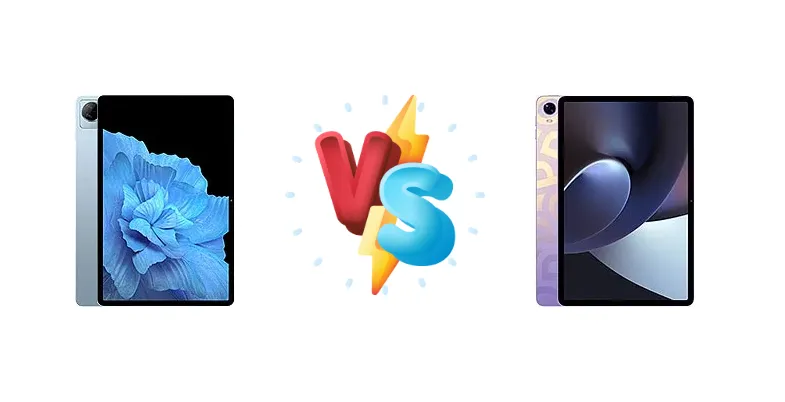
The Android tablet market is heating up, and the vivo Pad and Oppo Pad are two strong contenders. Both boast impressive specs, including the Snapdragon 870 chipset, but subtle differences could make one a better fit for you. Let's dive into a comprehensive comparison to help you decide.
🏆 Quick Verdict
Both tablets offer excellent performance thanks to the Snapdragon 870. The vivo Pad edges out the Oppo Pad with faster 44W charging, while the Oppo Pad might offer a slightly better software experience depending on regional variations. Ultimately, the choice depends on your charging priorities and software preference.
| Network |
|---|
| 2G bands | N/A | N/A |
| 3G bands | N/A | N/A |
| 4G bands | N/A | N/A |
| EDGE | No | No |
| GPRS | No | No |
| Technology | No cellular connectivity | No cellular connectivity |
| Launch |
|---|
| Announced | 2022, April 11 | 2022, February 24 |
| Status | Available. Released 2022, April 15 | Available. Released 2022, March 03 |
| Body |
|---|
| Build | Glass front, aluminum back, aluminum frame | - |
| Dimensions | 253.2 x 164.7 x 6.6 mm (9.97 x 6.48 x 0.26 in) | 252.2 x 163.8 x 7.1 mm (9.93 x 6.45 x 0.28 in) |
| SIM | No | No |
| Weight | 489 g (1.08 lb) | 507 g / 510 g (1.12 lb) |
| | Stylus support | - |
| Display |
|---|
| Resolution | 1600 x 2560 pixels, 16:10 ratio (~274 ppi density) | 1600 x 2560 pixels, 16:10 ratio (~274 ppi density) |
| Size | 11.0 inches, 350.9 cm2 (~84.1% screen-to-body ratio) | 11.0 inches, 350.9 cm2 (~84.9% screen-to-body ratio) |
| Type | IPS LCD, 120Hz, HDR10 | IPS LCD, 120Hz, 480 nits |
| Platform |
|---|
| CPU | Octa-core (1x3.2 GHz Kryo 585 & 3x2.42 GHz Kryo 585 & 4x1.80 GHz Kryo 585) | Octa-core (1x3.2 GHz Kryo 585 & 3x2.42 GHz Kryo 585 & 4x1.80 GHz Kryo 585) |
| Chipset | Qualcomm SM8250-AC Snapdragon 870 5G (7 nm) | Qualcomm SM8250-AC Snapdragon 870 5G (7 nm) |
| GPU | Adreno 650 | Adreno 650 |
| OS | Android 12, OriginOS HD | Android 11, ColorOS 12 |
| Memory |
|---|
| Card slot | No | No |
| Internal | 128GB 8GB RAM, 256GB 8GB RAM | 128GB 6GB RAM, 256GB 6GB RAM, 256GB 8GB RAM |
| | UFS 3.1 | UFS 3.1 |
| Main Camera |
|---|
| Dual | 13 MP, f/2.2, 112˚ (ultrawide), 1.12µm, AF
8 MP, f/2.2, 112˚ (ultrawide), 1/4.0", 1.12µm | - |
| Features | LED flash, panorama | LED flash, panorama |
| Single | 8 MP, f/2.0, (wide), 1/4.0", 1.12µm | 13 MP, f/2.2, 26mm (wide), AF |
| Video | 4K@30fps, 1080p@30fps | 1080p@30fps |
| Selfie camera |
|---|
| Single | 8 MP, f/2.0, (wide), 1/4.0", 1.12µm | 8 MP, f/2.0, 27mm (wide) |
| Video | 1080p@30fps | 1080p@30fps |
| Sound |
|---|
| 3.5mm jack | No | No |
| 35mm jack | No | No |
| Loudspeaker | Yes, with stereo speakers (4 speakers) | Yes, with stereo speakers |
| Comms |
|---|
| Bluetooth | 5.2, A2DP, LE | 5.1, A2DP, LE, aptX HD |
| NFC | Yes | No |
| Positioning | GPS | No |
| Radio | No | No |
| USB | USB Type-C 3.1, OTG, magnetic connector | USB Type-C 2.0, OTG |
| WLAN | Wi-Fi 802.11 a/b/g/n/ac/6, dual-band, Wi-Fi Direct | Wi-Fi 802.11 a/b/g/n/ac/6, dual-band, Wi-Fi Direct |
| Features |
|---|
| Sensors | Accelerometer, gyro, proximity, compass | Accelerometer, gyro, proximity |
| Battery |
|---|
| Charging | 44W wired, PD
5W reverse wired | 33W wired, PD
5W reverse wired |
| Type | 8040 mAh | Li-Po 8360 mAh |
| Misc |
|---|
| Colors | Black, Blue | Black, Silver, Purple |
| Models | - | OPD2101 |
| Price | About 360 EUR | About 310 EUR |
vivo Pad
- Faster 44W Charging
- Potentially more open software (depending on region)
- Solid performance with Snapdragon 870
- Software updates might be less frequent than Oppo
- Availability may be limited in some regions
Oppo Pad
- Oppo's ColorOS software (familiar to Oppo users)
- Good performance with Snapdragon 870
- Potentially better software support
- Slower 33W Charging
- ColorOS may not appeal to all users
Display Comparison
Both tablets feature an 11-inch LCD display, likely with a resolution around 2560 x 1600. While exact brightness and color accuracy figures are needed for a definitive comparison, expect vibrant visuals and good viewing angles. The vivo Pad might have a slightly higher refresh rate (potentially 120Hz) compared to the Oppo Pad (likely 120Hz as well), but this needs confirmation.
Camera Comparison
Camera quality is often an afterthought on tablets. Both likely feature a single rear camera, probably around 13MP. Image quality will be adequate for casual snapshots, but don't expect flagship-level performance. Front-facing cameras are likely 8MP for video calls.
Performance
The Snapdragon 870 chipset ensures smooth performance for both devices. Expect snappy multitasking, lag-free gaming, and effortless handling of demanding apps. Real-world performance will be very similar, with minor variations potentially arising from software optimization.
Battery Life
Battery capacity is likely around 8000mAh for both. The vivo Pad's 44W charging provides a significant advantage over the Oppo Pad's 33W charging, allowing for quicker top-ups.
Buying Guide
The vivo Pad is ideal for users who prioritize faster charging and potentially a more open software experience. The Oppo Pad is a great choice for those who prefer Oppo's ColorOS and don't mind slightly slower charging speeds. Consider your ecosystem and software preferences when making your decision.
Frequently Asked Questions
❓ Are the vivo Pad and Oppo Pad essentially the same tablet?
They share the same core chipset (Snapdragon 870) and similar display specs, but differ in charging speed and software experience. The vivo Pad has faster charging, while the Oppo Pad offers Oppo's ColorOS.
❓ Which tablet is better for gaming?
Both tablets offer excellent gaming performance thanks to the Snapdragon 870. The choice depends on your preferred software and whether faster charging is a priority.