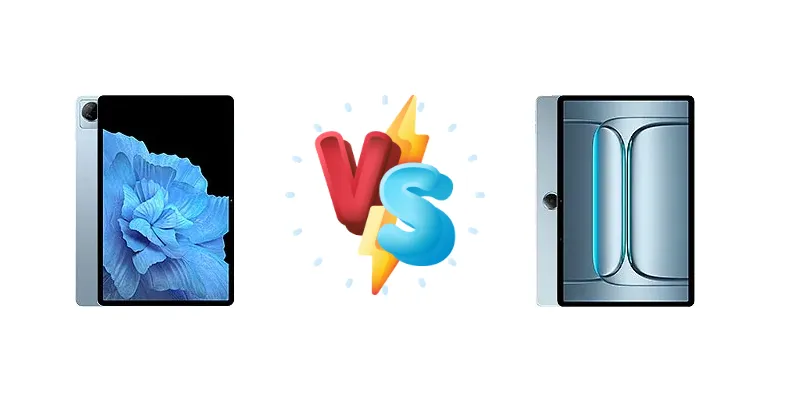
The Android tablet market is heating up, with both vivo and OnePlus offering compelling options. The vivo Pad, leveraging the proven Snapdragon 870, aims for a balance of power and features. Meanwhile, the OnePlus Pad Lite, powered by the MediaTek Helio G100, targets a more budget-conscious consumer. This comparison dissects the key differences to help you determine which tablet best suits your needs.
🏆 Quick Verdict
For users prioritizing sustained performance and future-proofing, the vivo Pad is the clear winner. Its Snapdragon 870 chipset offers a significant advantage in demanding tasks. However, the OnePlus Pad Lite presents a strong value proposition for casual users who prioritize affordability and don't require top-tier processing power.
| Network |
|---|
| 2G bands | N/A | GSM 850 / 900 / 1800 / 1900 - cellular model only |
| 3G bands | N/A | HSDPA 850 / 900 / 2100 - cellular model only |
| 4G bands | N/A | LTE - cellular model only |
| EDGE | No | - |
| GPRS | No | - |
| Speed | - | HSPA, LTE - cellular model only |
| Technology | No cellular connectivity | GSM / HSPA / LTE |
| Launch |
|---|
| Announced | 2022, April 11 | 2025, July 08 |
| Status | Available. Released 2022, April 15 | Available. Released 2025, August 14 |
| Body |
|---|
| Build | Glass front, aluminum back, aluminum frame | - |
| Dimensions | 253.2 x 164.7 x 6.6 mm (9.97 x 6.48 x 0.26 in) | 254.9 x 166.5 x 7.4 mm (10.04 x 6.56 x 0.29 in) |
| SIM | No | Yes - cellular model only |
| Weight | 489 g (1.08 lb) | 530 g (1.17 lb) |
| | Stylus support | - |
| Display |
|---|
| Resolution | 1600 x 2560 pixels, 16:10 ratio (~274 ppi density) | 1200 x 1920 pixels, 16:10 ratio (~207 ppi density) |
| Size | 11.0 inches, 350.9 cm2 (~84.1% screen-to-body ratio) | 11.0 inches, 347.5 cm2 (~81.9% screen-to-body ratio) |
| Type | IPS LCD, 120Hz, HDR10 | IPS LCD, 1B colors, 90Hz, 500 nits |
| Platform |
|---|
| CPU | Octa-core (1x3.2 GHz Kryo 585 & 3x2.42 GHz Kryo 585 & 4x1.80 GHz Kryo 585) | Octa-core (2x2.2 GHz Cortex-A76 & 6x2.0 GHz Cortex-A55) |
| Chipset | Qualcomm SM8250-AC Snapdragon 870 5G (7 nm) | Mediatek Helio G100 (6 nm) |
| GPU | Adreno 650 | Mali-G57 MC2 |
| OS | Android 12, OriginOS HD | Android 15, OxygenOS 15 |
| Memory |
|---|
| Card slot | No | Unspecified |
| Internal | 128GB 8GB RAM, 256GB 8GB RAM | 128GB 6GB RAM, 128GB 8GB RAM |
| | UFS 3.1 | - |
| Main Camera |
|---|
| Dual | 13 MP, f/2.2, 112˚ (ultrawide), 1.12µm, AF
8 MP, f/2.2, 112˚ (ultrawide), 1/4.0", 1.12µm | - |
| Features | LED flash, panorama | - |
| Single | 8 MP, f/2.0, (wide), 1/4.0", 1.12µm | 5 MP |
| Video | 4K@30fps, 1080p@30fps | 1080p@30fps |
| Selfie camera |
|---|
| Single | 8 MP, f/2.0, (wide), 1/4.0", 1.12µm | 5 MP |
| Video | 1080p@30fps | 1080p@30fps |
| Sound |
|---|
| 3.5mm jack | No | - |
| 35mm jack | No | No |
| Loudspeaker | Yes, with stereo speakers (4 speakers) | Yes, with stereo speakers (4 speakers, Hi-Res audio) |
| Comms |
|---|
| Bluetooth | 5.2, A2DP, LE | 5.2, A2DP, LE, aptX HD |
| NFC | Yes | No |
| Positioning | GPS | GPS, (cellular model only) - unconfirmed |
| Radio | No | No |
| USB | USB Type-C 3.1, OTG, magnetic connector | USB Type-C 2.0 |
| WLAN | Wi-Fi 802.11 a/b/g/n/ac/6, dual-band, Wi-Fi Direct | Wi-Fi 802.11 a/b/g/n/ac, dual-band |
| Features |
|---|
| Sensors | Accelerometer, gyro, proximity, compass | Unspecified |
| Battery |
|---|
| Charging | 44W wired, PD
5W reverse wired | 33W wired |
| Type | 8040 mAh | Li-Po 9340 mAh |
| Misc |
|---|
| Colors | Black, Blue | Aero Blue |
| Models | - | OPD2480 |
| Price | About 360 EUR | About 200 EUR |
vivo Pad
- Significantly more powerful Snapdragon 870 processor
- Faster 44W charging with PD support
- 5W reverse wired charging for topping up other devices
- Likely higher price point
- Battery capacity unknown
OnePlus Pad Lite
- More affordable price
- Modern 6nm chipset
- Potentially better power efficiency at lower workloads
- Less powerful Helio G100 processor
- Slower 33W charging
- No reverse charging
Display Comparison
While display specifications are missing, the vivo Pad’s higher price point suggests a potentially superior panel. However, without knowing resolution, refresh rate, or panel technology (LTPO vs. standard LCD/IPS), it’s difficult to definitively declare a winner. The OnePlus Pad Lite, aiming for affordability, likely utilizes a more standard display configuration. Bezels are also unknown, but generally, more expensive tablets feature slimmer bezels for a more immersive experience.
Camera Comparison
Camera details are absent for both devices. Given the tablet form factor, camera quality is typically less of a priority than on smartphones. However, we can infer that the vivo Pad, being the more premium device, likely features a more capable camera system. The OnePlus Pad Lite will likely focus on basic functionality for video calls and casual snapshots. Without specific sensor information, it’s impossible to make a meaningful comparison.
Performance
The core difference lies in the chipsets. The vivo Pad’s Qualcomm Snapdragon 870 5G (7nm) is a significant step up from the OnePlus Pad Lite’s MediaTek Helio G100 (6nm). The Snapdragon 870’s octa-core configuration, with a prime core clocked at 3.2 GHz, delivers substantially higher CPU performance. The Helio G100, while utilizing a more modern 6nm process, features a less powerful CPU architecture (Cortex-A76 vs Kryo 585). This translates to faster app loading, smoother multitasking, and better performance in graphically intensive games on the vivo Pad. The Snapdragon 870 also benefits from Qualcomm’s Adreno GPU, offering a more capable graphics experience. The 7nm process of the Snapdragon 870, while older, is well-optimized, and the chip's thermal headroom is generally better managed than the Helio G100.
Battery Life
Battery capacity is not specified for either device. However, the charging speeds provide insight. The vivo Pad’s 44W wired charging with PD (Power Delivery) is significantly faster than the OnePlus Pad Lite’s 33W charging. This means the vivo Pad will reach a full charge much quicker. The vivo Pad also offers 5W reverse wired charging, allowing it to charge other devices, a feature absent on the OnePlus Pad Lite. While a larger battery capacity is always desirable, faster charging can mitigate the impact of a slightly smaller battery, making the vivo Pad’s charging advantage a key benefit.
Buying Guide
Buy the vivo Pad if you need a tablet capable of handling demanding applications, multitasking, and occasional gaming without significant throttling. It’s ideal for professionals, students, or anyone who wants a long-lasting device. Buy the OnePlus Pad Lite if you prefer a more affordable tablet for basic tasks like media consumption, web browsing, and light productivity. It’s a great choice for families or users new to the tablet experience.
Frequently Asked Questions
❓ Will the Helio G100 in the OnePlus Pad Lite struggle with demanding games like Genshin Impact?
The MediaTek Helio G100 is a capable chip for casual gaming, but it will likely struggle with graphically intensive titles like Genshin Impact at higher settings. Expect reduced frame rates and potential stuttering. The Snapdragon 870 in the vivo Pad will provide a much smoother gaming experience.
❓ Is the 44W charging on the vivo Pad a significant improvement over the 33W charging on the OnePlus Pad Lite in real-world use?
Yes, the 44W charging on the vivo Pad will noticeably reduce charging times. While exact 0-100% times are unknown, expect the vivo Pad to charge considerably faster, potentially shaving off 30-60 minutes compared to the OnePlus Pad Lite.
❓ Does the Snapdragon 870 in the vivo Pad offer noticeable improvements in multitasking compared to the Helio G100?
Absolutely. The Snapdragon 870’s more powerful CPU and optimized architecture will result in smoother multitasking, allowing you to switch between apps more quickly and efficiently without experiencing lag or slowdowns. The Helio G100 may struggle with a large number of open applications.