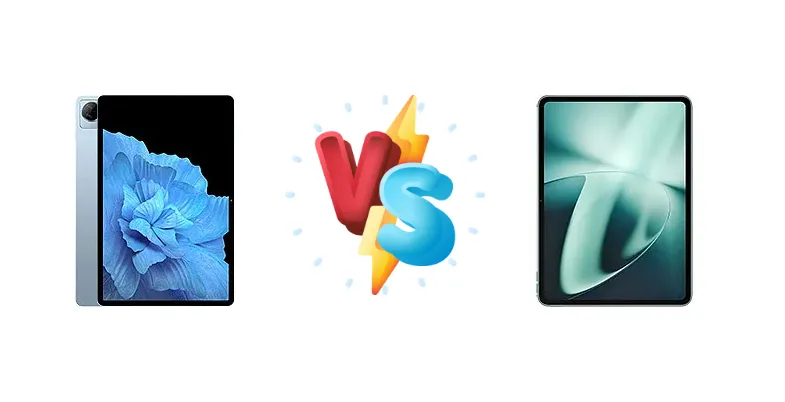
The Android tablet market is heating up, and the vivo Pad and OnePlus Pad are two strong contenders vying for your attention. Both offer premium features and impressive specs, but which one truly delivers the best experience? Let's dive into a detailed comparison to help you decide.
🏆 Quick Verdict
The OnePlus Pad edges out the vivo Pad thanks to its superior display, faster charging, and the powerful Dimensity 9000 chipset. While the vivo Pad offers a solid Snapdragon 870, the OnePlus Pad's overall package makes it the slightly better choice for most users.
| Network |
|---|
| 2G bands | N/A | N/A |
| 3G bands | N/A | N/A |
| 4G bands | N/A | N/A |
| EDGE | No | No |
| GPRS | No | No |
| Technology | No cellular connectivity | No cellular connectivity |
| Launch |
|---|
| Announced | 2022, April 11 | 2023, February 07 |
| Status | Available. Released 2022, April 15 | Available. Released 2023, April 28 |
| Body |
|---|
| Build | Glass front, aluminum back, aluminum frame | Glass front, aluminum back, aluminum frame |
| Dimensions | 253.2 x 164.7 x 6.6 mm (9.97 x 6.48 x 0.26 in) | 258 x 189.4 x 6.5 mm (10.16 x 7.46 x 0.26 in) |
| SIM | No | No |
| Weight | 489 g (1.08 lb) | 552 g (1.22 lb) |
| | Stylus support | Stylus support |
| Display |
|---|
| Resolution | 1600 x 2560 pixels, 16:10 ratio (~274 ppi density) | 2000 x 2800 pixels (~296 ppi density) |
| Size | 11.0 inches, 350.9 cm2 (~84.1% screen-to-body ratio) | 11.61 inches, 411.3 cm2 (~84.2% screen-to-body ratio) |
| Type | IPS LCD, 120Hz, HDR10 | IPS LCD, 1B colors, Dolby Vision, HDR10+, 144Hz, 500 nits (typ) |
| Platform |
|---|
| CPU | Octa-core (1x3.2 GHz Kryo 585 & 3x2.42 GHz Kryo 585 & 4x1.80 GHz Kryo 585) | Octa-core (1x3.05 GHz Cortex-X2 & 3x2.85 GHz Cortex-A710 & 4x1.80 GHz Cortex-A510) |
| Chipset | Qualcomm SM8250-AC Snapdragon 870 5G (7 nm) | Mediatek Dimensity 9000 (4 nm) |
| GPU | Adreno 650 | Mali-G710 MC10 |
| OS | Android 12, OriginOS HD | Android 13, upgradable to Android 15, OxygenOS 15 |
| Memory |
|---|
| Card slot | No | No |
| Internal | 128GB 8GB RAM, 256GB 8GB RAM | 128GB 8GB RAM, 256GB 12GB RAM |
| | UFS 3.1 | UFS 3.1 |
| Main Camera |
|---|
| Dual | 13 MP, f/2.2, 112˚ (ultrawide), 1.12µm, AF
8 MP, f/2.2, 112˚ (ultrawide), 1/4.0", 1.12µm | - |
| Features | LED flash, panorama | LED flash |
| Single | 8 MP, f/2.0, (wide), 1/4.0", 1.12µm | 13 MP, f/2.2, 23mm (wide) |
| Video | 4K@30fps, 1080p@30fps | 4K@30fps, 1080p@30ps, gyro-EIS |
| Selfie camera |
|---|
| Single | 8 MP, f/2.0, (wide), 1/4.0", 1.12µm | 8 MP, f/2.3, (wide), 1/4.0", 1.12µm |
| Video | 1080p@30fps | 1080p@30fps |
| Sound |
|---|
| 3.5mm jack | No | No |
| 35mm jack | No | No |
| Loudspeaker | Yes, with stereo speakers (4 speakers) | Yes, with stereo speakers (4 speakers) |
| Comms |
|---|
| Bluetooth | 5.2, A2DP, LE | 5.3, A2DP, LE, aptX HD |
| NFC | Yes | No |
| Positioning | GPS | GPS, GLONASS, GALILEO, BDS (B1+B1c) |
| Radio | No | No |
| USB | USB Type-C 3.1, OTG, magnetic connector | USB Type-C 2.0, OTG, accessory connector |
| WLAN | Wi-Fi 802.11 a/b/g/n/ac/6, dual-band, Wi-Fi Direct | Wi-Fi 802.11 a/b/g/n/ac/6, dual-band |
| Features |
|---|
| Sensors | Accelerometer, gyro, proximity, compass | Accelerometer, gyro, compass |
| Battery |
|---|
| Charging | 44W wired, PD
5W reverse wired | 67W wired |
| Type | 8040 mAh | Li-Po 9510 mAh |
| Misc |
|---|
| Colors | Black, Blue | Halo Green |
| Price | About 360 EUR | About 500 EUR |
| Tests |
|---|
| Display | - |
Contrast ratio: 1664:1 |
| Loudspeaker | - |
-22.5 LUFS (Excellent)
|
| Performance | - |
AnTuTu: 859019 (v9)
GeekBench: 3158 (v5.1)
GFXBench: 28fps (ES 3.1 onscreen) |
vivo Pad
- Solid Snapdragon 870 performance
- 44W fast charging
- Potentially more affordable
- Less impressive display compared to OnePlus Pad
- Slower charging speeds
- May lack some software features
OnePlus Pad
- Superior display with high contrast ratio
- Powerful Dimensity 9000 chipset
- 67W fast charging
- Generally better software experience
- Potentially higher price
- Camera performance may not be exceptional
Display Comparison
The OnePlus Pad boasts a significantly better display. Its 1664:1 contrast ratio and 442 nits brightness offer a more vibrant and immersive viewing experience compared to the vivo Pad. Both tablets feature high-resolution displays, but OnePlus takes the lead in visual quality.
Camera Comparison
Camera quality on tablets is often secondary, but the OnePlus Pad likely has a slight edge due to the generally superior image processing capabilities of the Dimensity 9000. Both tablets likely offer decent cameras for video calls and casual snapshots, but don't expect flagship-level photography.
Performance
The OnePlus Pad's Mediatek Dimensity 9000 chipset is a powerhouse, generally outperforming the vivo Pad's Snapdragon 870 in benchmarks and real-world usage. Expect smoother multitasking, faster app loading times, and better gaming performance on the OnePlus Pad. However, the Snapdragon 870 is still a very capable chip.
Battery Life
The OnePlus Pad's 67W fast charging is a major advantage. It can charge significantly faster than the vivo Pad's 44W charging. Battery capacity is likely similar between the two, so real-world battery life should be comparable, but the OnePlus Pad offers quicker top-ups.
Buying Guide
The vivo Pad is a great option for users prioritizing a balanced experience and potentially a slightly lower price point. The OnePlus Pad is ideal for those who demand top-tier performance, a stunning display for media consumption, and faster charging speeds.
Frequently Asked Questions
❓ Which tablet is better for gaming?
The OnePlus Pad is generally better for gaming due to its more powerful Dimensity 9000 chipset and superior cooling system.
❓ Is the vivo Pad worth considering if I'm on a budget?
Yes, the vivo Pad offers a good balance of performance and price, making it a worthwhile option for budget-conscious buyers.