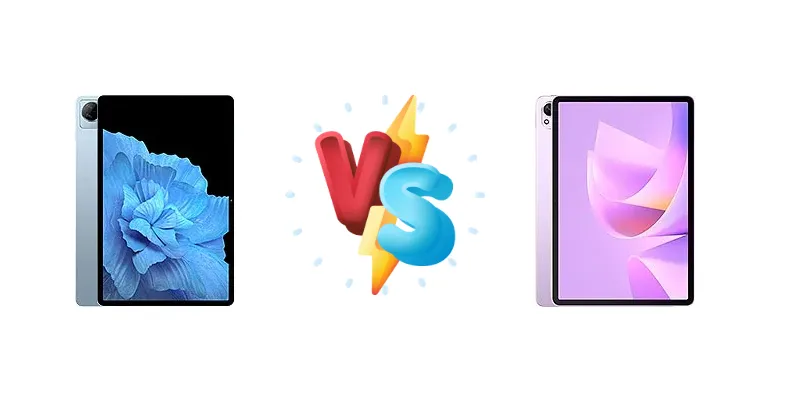
The Android tablet market is heating up, with both vivo and Huawei offering compelling options. The vivo Pad, leveraging the established Qualcomm Snapdragon 870, faces off against the newer Huawei MatePad 11.5 S (2025). This comparison dissects the key differences, focusing on performance, charging, and the overall user experience to determine which tablet best suits your needs.
🏆 Quick Verdict
For users prioritizing proven performance and a slightly faster charging experience, the vivo Pad emerges as the winner. Its Snapdragon 870 chipset provides a robust foundation for multitasking and gaming. However, the MatePad 11.5 S (2025) may appeal to those deeply embedded in the Huawei ecosystem and seeking a streamlined software experience.
| Network |
|---|
| 2G bands | N/A | N/A |
| 3G bands | N/A | N/A |
| 4G bands | N/A | N/A |
| EDGE | No | No |
| GPRS | No | No |
| Technology | No cellular connectivity | No cellular connectivity |
| Launch |
|---|
| Announced | 2022, April 11 | 2025, August 15 |
| Status | Available. Released 2022, April 15 | Available. Released 2025, August 21 |
| Body |
|---|
| Build | Glass front, aluminum back, aluminum frame | - |
| Dimensions | 253.2 x 164.7 x 6.6 mm (9.97 x 6.48 x 0.26 in) | 261 x 177.3 x 6.1 mm (10.28 x 6.98 x 0.24 in) |
| SIM | No | No |
| Weight | 489 g (1.08 lb) | 515 g (1.14 lb) |
| | Stylus support | - |
| Display |
|---|
| Resolution | 1600 x 2560 pixels, 16:10 ratio (~274 ppi density) | 1840 x 2800 pixels, 3:2 ratio (~291 ppi density) |
| Size | 11.0 inches, 350.9 cm2 (~84.1% screen-to-body ratio) | 11.5 inches, 391.6 cm2 (~84.6% screen-to-body ratio) |
| Type | IPS LCD, 120Hz, HDR10 | TFT LCD, 144Hz, HDR Vivid |
| Platform |
|---|
| CPU | Octa-core (1x3.2 GHz Kryo 585 & 3x2.42 GHz Kryo 585 & 4x1.80 GHz Kryo 585) | Octa-core |
| Chipset | Qualcomm SM8250-AC Snapdragon 870 5G (7 nm) | - |
| GPU | Adreno 650 | - |
| OS | Android 12, OriginOS HD | Harmony OS 5.0 |
| Memory |
|---|
| Card slot | No | No |
| Internal | 128GB 8GB RAM, 256GB 8GB RAM | 256GB 8GB RAM, 256GB 12GB RAM, 512GB 12GB RAM |
| | UFS 3.1 | - |
| Main Camera |
|---|
| Dual | 13 MP, f/2.2, 112˚ (ultrawide), 1.12µm, AF
8 MP, f/2.2, 112˚ (ultrawide), 1/4.0", 1.12µm | - |
| Features | LED flash, panorama | LED flash, panorama |
| Single | 8 MP, f/2.0, (wide), 1/4.0", 1.12µm | 13 MP, f/1.8, (wide), AF |
| Video | 4K@30fps, 1080p@30fps | 1080p@30fps |
| Selfie camera |
|---|
| Single | 8 MP, f/2.0, (wide), 1/4.0", 1.12µm | 8 MP, f/2.0 |
| Video | 1080p@30fps | 1080p@30fps |
| Sound |
|---|
| 3.5mm jack | No | - |
| 35mm jack | No | No |
| Loudspeaker | Yes, with stereo speakers (4 speakers) | Yes, with stereo speakers (4 speakers) |
| Comms |
|---|
| Bluetooth | 5.2, A2DP, LE | 5.2, A2DP, LE, L2HC |
| NFC | Yes | No |
| Positioning | GPS | No |
| Radio | No | No |
| USB | USB Type-C 3.1, OTG, magnetic connector | USB Type-C 3.1, OTG, magnetic accessory connector |
| WLAN | Wi-Fi 802.11 a/b/g/n/ac/6, dual-band, Wi-Fi Direct | Wi-Fi 802.11 a/b/g/n/ac/6, dual-band |
| Features |
|---|
| Sensors | Accelerometer, gyro, proximity, compass | Accelerometer, proximity (accessories only), gyro |
| Battery |
|---|
| Charging | 44W wired, PD
5W reverse wired | 40W wired
5W reverse wired |
| Type | 8040 mAh | 8800 mAh |
| Misc |
|---|
| Colors | Black, Blue | Gray, Silver, Mint, Purple |
| Models | - | SLG-W50, SLG-W10 |
| Price | About 360 EUR | About 250 EUR |
vivo Pad
- Proven Snapdragon 870 performance
- Faster 44W charging
- Wider Android app compatibility
- Brand recognition may be lower than Huawei
- Display specifications are unknown
Huawei MatePad 11.5 S (2025)
- Potential for optimized HarmonyOS experience
- Seamless integration with Huawei ecosystem
- Potentially competitive pricing
- Less powerful processor compared to Snapdragon 870
- Slower 40W charging
Display Comparison
Unfortunately, detailed display specifications are unavailable for either device. However, given the market positioning, we can infer that both likely utilize IPS LCD panels. The absence of LTPO technology suggests neither will offer adaptive refresh rates for power saving. Bezels will be a key differentiator, and real-world testing is needed to assess color accuracy and peak brightness. Huawei often emphasizes display quality, so the MatePad 11.5 S may have a slight edge in this area, but without concrete data, it remains speculative.
Camera Comparison
Camera details are sparse for both devices. Without sensor size, aperture, or OIS information, a meaningful comparison is difficult. It’s safe to assume both tablets feature basic camera setups suitable for video calls and casual snapshots. The absence of high-resolution sensors or advanced features suggests neither is intended as a primary photography device. Focusing on the core functionality of a tablet – productivity and entertainment – is more relevant than camera capabilities in this comparison.
Performance
The vivo Pad’s Qualcomm SM8250-AC Snapdragon 870 5G (7 nm) is the clear performance leader on paper. Its octa-core CPU, with a prime core clocked at 3.2 GHz, provides a significant advantage over the MatePad 11.5 S’s unspecified CPU. The Snapdragon 870’s Adreno 660 GPU is a well-established performer, capable of handling demanding games and applications. While the MatePad 11.5 S’s octa-core CPU is competent, it lacks the architectural advantages and clock speeds of the Snapdragon 870. The Snapdragon 870’s 7nm process node also contributes to better thermal efficiency, potentially reducing throttling during sustained workloads.
Battery Life
Both tablets offer 5W reverse wired charging, a useful feature for topping up accessories. The vivo Pad’s 44W wired charging provides a slight advantage over the MatePad 11.5 S’s 40W charging. This translates to potentially faster 0-100% charging times, though the actual difference will depend on battery capacity (which is currently unknown for both devices). The Snapdragon 870’s efficiency may also contribute to better battery life during typical usage scenarios, offsetting any potential capacity differences.
Buying Guide
Buy the vivo Pad if you need a tablet capable of handling demanding applications, consistent gaming performance, and benefit from the wider Android app ecosystem. It’s ideal for power users and those who value a proven chipset. Buy the Huawei MatePad 11.5 S (2025) if you prefer Huawei’s HarmonyOS, prioritize seamless integration with other Huawei devices, and are less concerned with raw processing power.
Frequently Asked Questions
❓ Will the Snapdragon 870 in the vivo Pad struggle with demanding games like Genshin Impact?
The Snapdragon 870 is a capable chipset and should handle Genshin Impact at medium to high settings with reasonable frame rates. While it won't match the performance of flagship Snapdragon 8 Gen series chips, it provides a smooth gaming experience for most titles.
❓ Does the Huawei MatePad 11.5 S (2025) support the M-Pencil or other Huawei accessories?
Given Huawei's history with its MatePad series, it's highly likely the MatePad 11.5 S (2025) supports the M-Pencil (sold separately). Compatibility with other Huawei accessories, such as the Smart Magnetic Keyboard, is also probable, offering a more complete productivity experience within the Huawei ecosystem.
❓ How does the software experience differ between the vivo Pad and the Huawei MatePad 11.5 S (2025)?
The vivo Pad runs on a standard Android build, offering access to the Google Play Store and a wide range of apps. The Huawei MatePad 11.5 S (2025) utilizes HarmonyOS, Huawei’s proprietary operating system. HarmonyOS offers a unique user interface and tight integration with other Huawei devices, but app availability may be more limited compared to the Google Play Store.