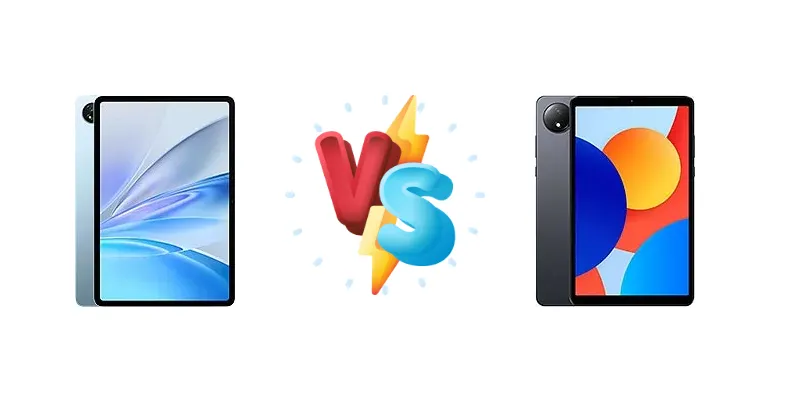
The budget tablet market is heating up, with the vivo Pad SE and Xiaomi Redmi Pad SE 8.7 vying for dominance. Both aim to deliver a capable Android experience without breaking the bank, but they take different approaches to achieving this. The vivo Pad SE leverages Qualcomm’s newer, more efficient Snapdragon 4 Gen 2, while the Redmi Pad SE 8.7 relies on the established MediaTek Helio G85. This comparison will dissect their key differences to determine which tablet offers the best value.
🏆 Quick Verdict
For the average user prioritizing long-term performance and efficiency, the vivo Pad SE emerges as the winner. Its Snapdragon 4 Gen 2 chipset, built on a 4nm process, provides a noticeable advantage in sustained performance and power management compared to the Redmi Pad SE 8.7’s 12nm Helio G85. While the Redmi Pad SE offers slightly faster charging in some regions, the overall experience favors the vivo.
| Network |
|---|
| 2G bands | N/A | GSM 850 / 900 / 1800 / 1900 |
| 3G bands | N/A | HSDPA 800 / 850 / 900 / 1700(AWS) / 1900 / 2100 |
| 4G bands | N/A | 1, 2, 3, 4, 5, 7, 8, 13, 18, 19, 20, 26, 28, 38, 40, 41, 66 |
| EDGE | No | - |
| GPRS | No | - |
| Speed | - | HSPA, LTE - cellular model only |
| Technology | No cellular connectivity | GSM / HSPA / LTE |
| Launch |
|---|
| Announced | 2025, April 21 | 2024, July 29 |
| Status | Available. Released 2025, April 25 | Available. Released 2024, August 08 |
| Body |
|---|
| Build | - | Glass front (Gorilla Glass 3) |
| Dimensions | 277.1 x 185.6 x 6.8 mm (10.91 x 7.31 x 0.27 in) | 211.6 x 125.5 x 8.8 mm (8.33 x 4.94 x 0.35 in) |
| SIM | No | Nano-SIM + Nano-SIM (cellular model only) |
| Weight | 559 g or 569 g (1.23 lb) | 370 / 373 / 375 g (13.05 oz) |
| Display |
|---|
| Protection | - | Corning Gorilla Glass 3 |
| Resolution | 1600 x 2464 pixels, 3:2 ratio (~239 ppi density) | 800 x 1340 pixels, 5:3 ratio (~179 ppi density) |
| Size | 12.3 inches, 445.8 cm2 (~86.7% screen-to-body ratio) | 8.7 inches, 214.9 cm2 (~80.9% screen-to-body ratio) |
| Type | IPS LCD, 90Hz, 600 nits | IPS LCD, 1B colors, 90Hz, 600 nits (HBM) |
| Platform |
|---|
| CPU | Octa-core (2x2.2 GHz Cortex-A78 & 6x1.95 GHz Cortex-A55) | Octa-core (2x2.0 GHz Cortex-A75 & 6x1.8 GHz Cortex-A55) |
| Chipset | Qualcomm SM4450 Snapdragon 4 Gen 2 (4 nm) | Mediatek Helio G85 (12 nm) |
| GPU | Adreno 613 | Mali-G52 MC2 |
| OS | Android 15, OriginOS 5 HD | Android 14, HyperOS |
| Memory |
|---|
| Card slot | No | microSDXC (dedicated slot) |
| Internal | 128GB 6GB RAM, 128GB 8GB RAM, 256GB 8GB RAM | 64GB 4GB RAM, 128GB 4GB RAM, 128GB 6GB RAM |
| Main Camera |
|---|
| Features | LED flash | LED flash |
| Single | 5 MP | 8 MP, f/2.0, (wide), 1/4.0", 1.12µm |
| Video | Yes | 1080p@30fps |
| Selfie camera |
|---|
| Single | 5 MP | 5 MP, f/2.2, (wide), 1/5.0", 1.12µm |
| Video | Yes | 1080p@30fps |
| Sound |
|---|
| 35mm jack | No | Yes |
| Loudspeaker | Yes, with stereo speakers (4 speakers) | Yes, with stereo speakers |
| Comms |
|---|
| Bluetooth | 4.2, A2DP | 5.3, A2DP, LE |
| Infrared port | - | Yes |
| NFC | No | No |
| Positioning | No | GPS, GALILEO, GLONASS, BDS - cellular model only |
| Radio | No | FM radio |
| USB | USB Type-C 2.0, OTG | USB Type-C 2.0 |
| WLAN | Wi-Fi 802.11 a/b/g/n/ac, dual-band | Wi-Fi 802.11 a/b/g/n/ac, dual-band |
| Features |
|---|
| Sensors | Accelerometer, proximity (accessories only) | Accelerometer, proximity (accessories only), compass |
| Battery |
|---|
| Charging | 15W wired | 18W wired (Int'l)
10W wired (India) |
| Type | 8500 mAh | 6650 mAh |
| Misc |
|---|
| Colors | Gray, Blue, Titanium | Aurora Green (Forest Green), Sky Blue (Ocean Blue), Graphite Gray (Urban Grey) |
| Models | - | 220233L2G |
| Price | About 120 EUR | About 120 EUR |
| SAR | - | 0.90 W/kg (head) 0.65 W/kg (body) |
| SAR EU | - | 0.40 W/kg (head) 0.99 W/kg (body) |
vivo Pad SE
- More efficient Snapdragon 4 Gen 2 chipset
- Better sustained performance due to 4nm process
- Potentially longer battery life
- Slower charging speed (15W)
- Limited detailed specs available
Xiaomi Redmi Pad SE 8.7
- Potentially faster charging (18W in some regions)
- Slightly more portable 8.7-inch screen
- Lower price point (likely)
- Less efficient Helio G85 chipset
- Potential for thermal throttling
- Older CPU architecture
Display Comparison
Neither device boasts a particularly standout display. Both are likely to utilize IPS LCD panels, common in this price bracket. However, detailed display specs (resolution, brightness, color gamut) are missing. The Redmi Pad SE’s 8.7-inch size offers slightly increased portability. Without specific data, it’s reasonable to assume both displays will be adequate for everyday use, but not ideal for color-critical work or HDR content. The smaller screen size of the Redmi Pad SE may result in a slightly higher pixel density.
Camera Comparison
Camera performance is unlikely to be a deciding factor for either tablet. Both are positioned as budget devices, and camera quality typically takes a backseat. Detailed camera specs are unavailable, but it’s safe to assume both will feature basic rear and front-facing cameras suitable for video calls and casual snapshots. Focusing on sensor size or aperture would be speculative without further information. The absence of OIS is almost certain on both devices.
Performance
The core difference lies in the chipsets. The vivo Pad SE’s Qualcomm Snapdragon 4 Gen 2 (4nm) is a significant upgrade over the Redmi Pad SE 8.7’s MediaTek Helio G85 (12nm). The 4nm fabrication process of the Snapdragon translates to superior power efficiency and reduced heat generation, meaning less performance throttling during sustained tasks. While both CPUs feature an octa-core configuration with similar core arrangements (2x performance cores + 6x efficiency cores), the Snapdragon’s Cortex-A78 cores are architecturally more advanced than the Helio’s Cortex-A75 cores, offering better single-core performance. This impacts app launch speeds and responsiveness. The Snapdragon also benefits from Qualcomm’s Adreno GPU, likely providing a more capable graphics experience.
Battery Life
The Redmi Pad SE 8.7 offers 18W wired charging (international markets) or 10W (India), while the vivo Pad SE is limited to 15W. This suggests potentially faster charging times for the Redmi Pad SE in regions where 18W charging is available. However, the Snapdragon 4 Gen 2’s superior power efficiency in the vivo Pad SE could offset the slower charging speed, resulting in comparable real-world battery life. Without knowing the battery capacity of each device, it’s difficult to definitively declare a winner, but the Snapdragon’s efficiency is a strong advantage.
Buying Guide
Buy the vivo Pad SE if you need a tablet for multitasking, light gaming, and appreciate a more future-proof chipset with better thermal efficiency. This is ideal for students or users who frequently use their tablet for extended periods. Buy the Xiaomi Redmi Pad SE 8.7 if you prioritize the absolute lowest price and faster charging (in international markets) and primarily use your tablet for basic media consumption and casual browsing. It’s a good option for those on a very tight budget.
Frequently Asked Questions
❓ Will the Helio G85 in the Redmi Pad SE 8.7 struggle with demanding games like PUBG Mobile?
The Helio G85 can run PUBG Mobile, but likely at lower graphics settings and frame rates to avoid significant lag or overheating. The Snapdragon 4 Gen 2 in the vivo Pad SE will provide a smoother and more consistent gaming experience, allowing for higher settings and potentially better frame rates.
❓ Does the difference in charging wattage (15W vs 18W) significantly impact the charging time difference between the vivo Pad SE and Redmi Pad SE 8.7?
While 18W is faster on paper, the actual difference in charging time will depend on the battery capacity of each device. The Snapdragon 4 Gen 2’s efficiency in the vivo Pad SE might mean you don’t notice a huge difference in overall usage time despite the slower charging speed.
❓ Is the 8.7-inch screen size of the Redmi Pad SE 8.7 noticeably more portable than a standard 10-inch tablet?
Yes, the 8.7-inch screen offers a more compact form factor, making it easier to hold and carry for extended periods. This is a benefit for users who prioritize portability and one-handed use.