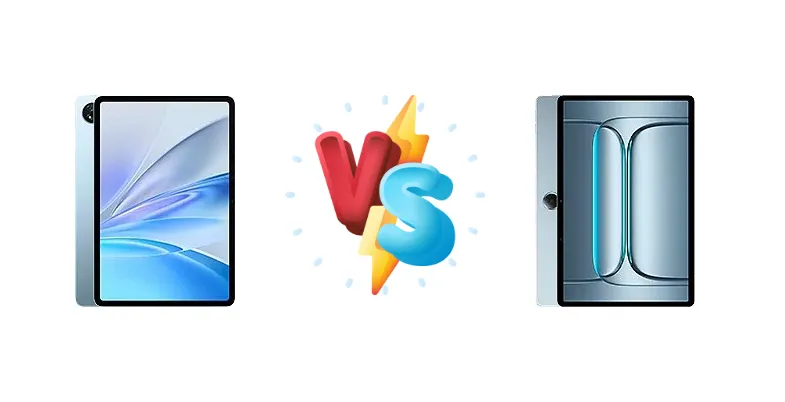
The budget tablet market is heating up, with the vivo Pad SE and OnePlus Pad Lite vying for dominance. Both aim to deliver a capable Android experience without breaking the bank, but they take different approaches to achieving this. The vivo Pad SE leverages Qualcomm’s efficiency-focused Snapdragon 4 Gen 2, while the OnePlus Pad Lite opts for MediaTek’s Helio G100. This comparison dissects the key differences to determine which tablet best suits your needs.
🏆 Quick Verdict
For the average user prioritizing faster charging and potentially smoother multitasking, the OnePlus Pad Lite emerges as the winner. Its 33W charging significantly reduces downtime compared to the vivo Pad SE’s 15W. However, the vivo Pad SE’s 4nm process offers a potential edge in long-term efficiency.
| Network |
|---|
| 2G bands | N/A | GSM 850 / 900 / 1800 / 1900 - cellular model only |
| 3G bands | N/A | HSDPA 850 / 900 / 2100 - cellular model only |
| 4G bands | N/A | LTE - cellular model only |
| EDGE | No | - |
| GPRS | No | - |
| Speed | - | HSPA, LTE - cellular model only |
| Technology | No cellular connectivity | GSM / HSPA / LTE |
| Launch |
|---|
| Announced | 2025, April 21 | 2025, July 08 |
| Status | Available. Released 2025, April 25 | Available. Released 2025, August 14 |
| Body |
|---|
| Dimensions | 277.1 x 185.6 x 6.8 mm (10.91 x 7.31 x 0.27 in) | 254.9 x 166.5 x 7.4 mm (10.04 x 6.56 x 0.29 in) |
| SIM | No | Yes - cellular model only |
| Weight | 559 g or 569 g (1.23 lb) | 530 g (1.17 lb) |
| Display |
|---|
| Resolution | 1600 x 2464 pixels, 3:2 ratio (~239 ppi density) | 1200 x 1920 pixels, 16:10 ratio (~207 ppi density) |
| Size | 12.3 inches, 445.8 cm2 (~86.7% screen-to-body ratio) | 11.0 inches, 347.5 cm2 (~81.9% screen-to-body ratio) |
| Type | IPS LCD, 90Hz, 600 nits | IPS LCD, 1B colors, 90Hz, 500 nits |
| Platform |
|---|
| CPU | Octa-core (2x2.2 GHz Cortex-A78 & 6x1.95 GHz Cortex-A55) | Octa-core (2x2.2 GHz Cortex-A76 & 6x2.0 GHz Cortex-A55) |
| Chipset | Qualcomm SM4450 Snapdragon 4 Gen 2 (4 nm) | Mediatek Helio G100 (6 nm) |
| GPU | Adreno 613 | Mali-G57 MC2 |
| OS | Android 15, OriginOS 5 HD | Android 15, OxygenOS 15 |
| Memory |
|---|
| Card slot | No | Unspecified |
| Internal | 128GB 6GB RAM, 128GB 8GB RAM, 256GB 8GB RAM | 128GB 6GB RAM, 128GB 8GB RAM |
| Main Camera |
|---|
| Features | LED flash | - |
| Single | 5 MP | 5 MP |
| Video | Yes | 1080p@30fps |
| Selfie camera |
|---|
| Single | 5 MP | 5 MP |
| Video | Yes | 1080p@30fps |
| Sound |
|---|
| 35mm jack | No | No |
| Loudspeaker | Yes, with stereo speakers (4 speakers) | Yes, with stereo speakers (4 speakers, Hi-Res audio) |
| Comms |
|---|
| Bluetooth | 4.2, A2DP | 5.2, A2DP, LE, aptX HD |
| NFC | No | No |
| Positioning | No | GPS, (cellular model only) - unconfirmed |
| Radio | No | No |
| USB | USB Type-C 2.0, OTG | USB Type-C 2.0 |
| WLAN | Wi-Fi 802.11 a/b/g/n/ac, dual-band | Wi-Fi 802.11 a/b/g/n/ac, dual-band |
| Features |
|---|
| Sensors | Accelerometer, proximity (accessories only) | Unspecified |
| Battery |
|---|
| Charging | 15W wired | 33W wired |
| Type | 8500 mAh | Li-Po 9340 mAh |
| Misc |
|---|
| Colors | Gray, Blue, Titanium | Aero Blue |
| Models | - | OPD2480 |
| Price | About 120 EUR | About 200 EUR |
vivo Pad SE
- Potentially better long-term efficiency with 4nm Snapdragon 4 Gen 2
- Cortex-A78 cores may offer snappier app launch speeds
- Qualcomm chipset generally has good software support
- Significantly slower 15W charging
- Performance may be limited by LPDDR4x RAM
- Unknown battery capacity
OnePlus Pad Lite
- Faster 33W wired charging for quicker top-ups
- Helio G100 GPU may provide a smoother gaming experience
- 6nm process offers potential efficiency gains
- Cortex-A76 cores may be slightly less responsive than A78
- MediaTek chipsets sometimes have less consistent software updates
- Unknown battery capacity
Display Comparison
Display specifications are currently unavailable for both devices. However, given their price points, we anticipate both tablets will utilize IPS LCD panels. The real-world impact will hinge on color accuracy and peak brightness, which are currently unknown. Bezels are likely to be similar, prioritizing cost-effectiveness over premium aesthetics. Without specific data, it's difficult to declare a clear winner in this category.
Camera Comparison
Camera details are sparse for both tablets. Given the budget nature of these devices, we expect modest camera performance. Focusing on the primary sensors is crucial; any secondary sensors (like 2MP macro lenses) are unlikely to significantly impact image quality. Without sensor size or aperture information, it’s impossible to assess which tablet will capture better photos. Image processing will likely be the differentiating factor, leaning towards software optimization rather than hardware prowess.
Performance
The core difference lies in the chipsets. The vivo Pad SE’s Qualcomm Snapdragon 4 Gen 2 (4nm) utilizes a 2x2.2 GHz Cortex-A78 and 6x1.95 GHz Cortex-A55 configuration. The OnePlus Pad Lite features the MediaTek Helio G100 (6nm) with a 2x2.2 GHz Cortex-A76 and 6x2.0 GHz Cortex-A55 setup. While clock speeds are similar, the 6nm process of the Helio G100 *should* offer a slight efficiency advantage over the Snapdragon’s 4nm node, but the architectural differences between the Cortex-A78 and A76 cores are more significant. The A78 generally provides better single-core performance, potentially benefiting app launch speeds on the vivo Pad SE. However, the Helio G100’s GPU may offer a more consistent gaming experience. The lack of LPDDR5x RAM specifications for either device suggests both likely utilize LPDDR4x, limiting memory bandwidth.
Battery Life
Battery capacity is currently unknown for both devices. However, the charging speeds are a clear differentiator. The OnePlus Pad Lite’s 33W wired charging is a substantial advantage over the vivo Pad SE’s 15W. This translates to significantly faster top-up times, reducing downtime. Even with a smaller battery, the OnePlus Pad Lite could offer a more convenient user experience due to its quicker charging. The Snapdragon 4 Gen 2’s 4nm process *could* contribute to better battery life during sustained use, but the impact will depend on the actual battery capacity.
Buying Guide
Buy the vivo Pad SE if you prioritize long-term battery efficiency and are comfortable with slower charging speeds. This tablet is ideal for users who consume media for extended periods and value a potentially cooler operating temperature. Buy the OnePlus Pad Lite if you need quick top-ups and value a slightly more responsive experience during multitasking, making it a better fit for students or those constantly on the go.
Frequently Asked Questions
❓ Will the Helio G100 in the OnePlus Pad Lite struggle with demanding games like Genshin Impact?
The Helio G100 is a capable chipset for casual gaming, but demanding titles like Genshin Impact will likely require reduced graphics settings to maintain a playable frame rate. The Snapdragon 4 Gen 2 in the vivo Pad SE may offer similar performance, but thermal throttling could become a factor during extended gaming sessions.
❓ How long will it take to fully charge the vivo Pad SE with its 15W charging?
Without knowing the battery capacity, it's difficult to provide an exact estimate. However, with 15W charging, a full charge will likely take between 3 to 4 hours, depending on the battery size. This is considerably slower than the OnePlus Pad Lite’s 33W charging.
❓ Is the difference between the Cortex-A78 and Cortex-A76 cores noticeable in everyday use?
The difference is subtle but present. The Cortex-A78 generally offers better single-core performance, which translates to snappier app launches and smoother scrolling. However, for most everyday tasks, the difference will be minimal and unlikely to be noticeable to the average user.
❓ Do either of these tablets support stylus input or keyboard attachments?
Currently, there is no information available regarding stylus or keyboard support for either the vivo Pad SE or the OnePlus Pad Lite. Given their budget positioning, it's unlikely they will offer these features, but it's something to consider if these functionalities are important to you.