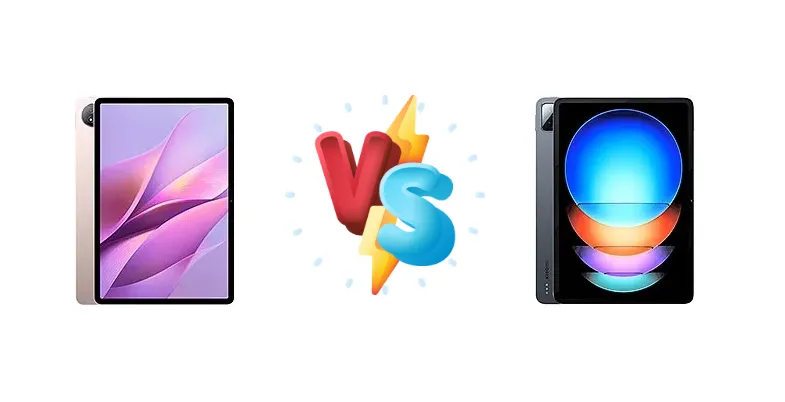
The Android tablet market is heating up, with both vivo and Xiaomi offering compelling options. The vivo Pad Air, leveraging the proven Snapdragon 870, aims for a balance of performance and affordability. Meanwhile, the Xiaomi Pad 6S Pro 12.4 throws down the gauntlet with the latest Snapdragon 8 Gen 2, promising a significant leap in processing power. This comparison dissects the key differences to determine which tablet best suits your needs.
🏆 Quick Verdict
For the average user prioritizing raw performance and future-proofing, the Xiaomi Pad 6S Pro 12.4 is the clear winner. Its Snapdragon 8 Gen 2 chipset delivers a substantial performance advantage. However, the vivo Pad Air remains a strong contender for budget-conscious users who don't require the absolute fastest speeds.
| Network |
|---|
| 2G bands | N/A | N/A |
| 3G bands | N/A | N/A |
| 4G bands | N/A | - |
| EDGE | No | N/A |
| GPRS | No | N/A |
| Technology | No cellular connectivity | No cellular connectivity |
| Launch |
|---|
| Announced | 2023, August 25 | 2024, February 22 |
| Status | Available. Released 2023, August 25 | Available. Released 2024, February 22 |
| Body |
|---|
| Build | Glass front, aluminum back, aluminum frame | Glass front (Gorilla Glass 5), aluminum frame, aluminum back |
| Dimensions | 259.7 x 176 x 6.7 mm (10.22 x 6.93 x 0.26 in) | 278.7 x 191.6 x 6.3 mm (10.97 x 7.54 x 0.25 in) |
| SIM | No | No |
| Weight | 530 g (1.17 lb) | 590 g (1.30 lb) |
| Display |
|---|
| Protection | - | Corning Gorilla Glass 5 |
| Resolution | 1840 x 2800 pixels, 3:2 ratio (~291 ppi density) | 2032 x 3048 pixels, 3:2 ratio (~295 ppi density) |
| Size | 11.5 inches, 391.6 cm2 (~85.7% screen-to-body ratio) | 12.4 inches, 457.8 cm2 (~85.7% screen-to-body ratio) |
| Type | IPS LCD, 1B colors, 144Hz, HDR10, 500 nits | IPS LCD, 68B colors, 144Hz, HDR10, Dolby Vision, 900 nits (peak) |
| Platform |
|---|
| CPU | Octa-core (1x3.2 GHz Kryo 585 & 3x2.42 GHz Kryo 585 & 4x1.80 GHz Kryo 585) | Octa-core (1x3.2 GHz Cortex-X3 & 2x2.8 GHz Cortex-A715 & 2x2.8 GHz Cortex-A710 & 3x2.0 GHz Cortex-A510) |
| Chipset | Qualcomm SM8250-AC Snapdragon 870 5G (7 nm) | Qualcomm SM8550-AB Snapdragon 8 Gen 2 (4 nm) |
| GPU | Adreno 650 | Adreno 740 |
| OS | Android 13, OriginOS 3 | Android 14, up to 3 major Android upgrades, HyperOS |
| Memory |
|---|
| Card slot | No | No |
| Internal | 128GB 8GB RAM, 256GB 8GB RAM, 256GB 12GB RAM, 512GB 12GB RAM | 256GB 8GB RAM, 256GB 12GB RAM, 512GB 12GB RAM, 1TB 16GB RAM |
| Main Camera |
|---|
| Dual | - | 50 MP, f/1.8, (wide), 1/2.76", 0.64µm, PDAF
Auxiliary lens |
| Features | LED flash | LED flash, HDR, panorama |
| Single | 8 MP | - |
| Video | 1080p@30fps | 4K@30/60fps, 1080p@30/60fps |
| Selfie camera |
|---|
| Single | 5 MP | 32 MP, f/2.2, (wide), 1/3.6", 0.61µm |
| Video | 1080p@30fps | 1080p@30fps |
| Sound |
|---|
| 35mm jack | No | No |
| Loudspeaker | Yes, with stereo speakers (4 speakers) | Yes, with stereo speakers (6 speakers) |
| Comms |
|---|
| Bluetooth | 5.2, A2DP, LE | 5.3, A2DP, LE, LHDC |
| NFC | No | Yes (file transfer only) |
| Positioning | Unspecified | No |
| Radio | No | No |
| USB | USB Type-C 3.0, OTG, magnetic connector | USB Type-C 3.2, accessory connector |
| WLAN | Wi-Fi 802.11 a/b/g/n/ac/6, dual-band | Wi-Fi 802.11 a/b/g/n/a/6/7, dual-band, Wi-Fi Direct |
| Features |
|---|
| Sensors | Accelerometer, gyro, proximity (accessories only) | Fingerprint (side-mounted), accelerometer, gyro, proximity (accessories only), compass |
| Battery |
|---|
| Charging | 44W wired, PD
5W reverse wired | 120W wired, PD3.0, QC4, 45% in 10 min, 100% in 35 min |
| Type | 8500 mAh | 10000 mAh |
| Misc |
|---|
| Colors | Blue, Silver, Rose Gold | Black, Blue, Green |
| Models | - | 24018RPACG |
| Price | About 230 EUR | About 700 EUR |
| SAR EU | - | 0.99 W/kg (body) |
vivo Pad Air
- More affordable price point
- Proven Snapdragon 870 performance
- 44W fast charging with PD support
- Older Snapdragon 870 chipset
- Likely lower display brightness and contrast
- Slower charging compared to Xiaomi
Xiaomi Pad 6S Pro 12.4
- Significantly faster Snapdragon 8 Gen 2 chipset
- Brighter and higher contrast display
- Ultra-fast 120W charging
- Higher price tag
- Potentially more expensive repairs
- May run hotter under sustained load (though 4nm helps)
Display Comparison
The Xiaomi Pad 6S Pro 12.4 boasts a significantly brighter display, reaching a measured 848 nits, compared to an unspecified brightness for the vivo Pad Air. This higher peak brightness translates to better visibility outdoors. The 1378:1 contrast ratio on the Xiaomi also suggests deeper blacks and more vibrant colors. While both likely utilize IPS LCD technology (given the lack of OLED specification), the Xiaomi’s superior contrast and brightness give it a clear edge for media consumption and creative work. Bezels are assumed to be similar, as neither manufacturer highlights particularly thin bezels as a key feature.
Camera Comparison
Neither tablet is positioned as a photography powerhouse, but the Xiaomi Pad 6S Pro 12.4 likely has an advantage due to the superior image signal processor (ISP) within the Snapdragon 8 Gen 2. Without specific camera specs for the vivo Pad Air, it’s difficult to make a direct comparison. However, the Xiaomi’s chipset will enable better noise reduction, dynamic range, and overall image quality. We can expect similar front-facing camera performance for video conferencing on both devices.
Performance
The core difference lies in the chipsets. The Xiaomi Pad 6S Pro 12.4’s Snapdragon 8 Gen 2 (4nm) represents a generational leap over the vivo Pad Air’s Snapdragon 870 (7nm). The 8 Gen 2 features the newer Cortex-X3 prime core, alongside improved Cortex-A715 and A710 performance cores, resulting in significantly faster CPU and GPU performance. The 4nm process node also contributes to better thermal efficiency, potentially reducing throttling during sustained workloads. While the Snapdragon 870 remains a capable performer, the 8 Gen 2 offers a substantial advantage for demanding tasks. The Xiaomi’s LPDDR5x RAM (assumed, based on the chipset) will also contribute to faster memory speeds compared to the Pad Air’s likely LPDDR4x.
Battery Life
The Xiaomi Pad 6S Pro 12.4’s 120W wired charging is a game-changer, achieving 45% charge in just 10 minutes and a full charge in 35 minutes. This is dramatically faster than the vivo Pad Air’s 44W charging. While the Xiaomi’s active use battery score of 11:14h provides a concrete benchmark, the vivo Pad Air’s battery life remains unknown. However, the more efficient Snapdragon 8 Gen 2 in the Xiaomi, combined with its fast charging, offers a more convenient user experience, mitigating concerns about battery drain.
Buying Guide
Buy the vivo Pad Air if you need a capable tablet for everyday tasks like browsing, streaming, and light productivity, and value affordability. It's ideal for students or casual users. Buy the Xiaomi Pad 6S Pro 12.4 if you demand the highest possible performance for demanding applications like video editing, gaming, or multitasking, and are willing to pay a premium for it. This is the tablet for power users.
Frequently Asked Questions
❓ Will the Snapdragon 870 in the vivo Pad Air struggle with demanding games like Genshin Impact?
While the Snapdragon 870 is capable, you'll likely need to lower graphics settings in demanding titles like Genshin Impact to maintain a smooth frame rate. The Xiaomi Pad 6S Pro 12.4’s Snapdragon 8 Gen 2 will handle these games at higher settings with ease.
❓ How much faster is the 120W charging on the Xiaomi Pad 6S Pro 12.4 compared to the 44W on the vivo Pad Air in real-world use?
The Xiaomi can go from 0-100% in 35 minutes, while the vivo Pad Air will take considerably longer. This means you can quickly top up the Xiaomi during short breaks, making it ideal for users on the go. The difference is particularly noticeable when starting from a very low battery level.
❓ Does the Xiaomi Pad 6S Pro 12.4 get noticeably hot during extended gaming sessions?
The Snapdragon 8 Gen 2 is more efficient than the 870, but it can still generate heat under sustained load. However, the 4nm process node and Xiaomi’s thermal management system should prevent significant throttling, maintaining consistent performance for longer periods.