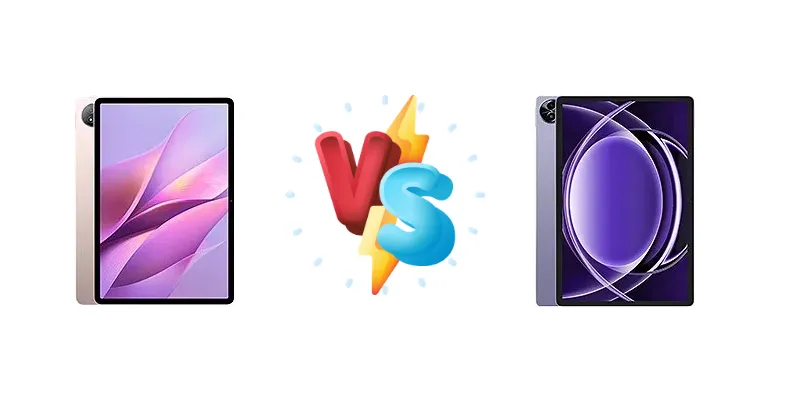
The Android tablet market is heating up, with options ranging from ultra-premium flagships to aggressively priced contenders. The vivo Pad Air and Realme Pad 2 Lite represent opposite ends of this spectrum within the budget-to-midrange space. The Pad Air boasts a flagship-level Snapdragon 870, while the Pad 2 Lite prioritizes efficiency with a MediaTek Helio G99. This comparison dissects their strengths and weaknesses to determine which tablet best suits your needs.
🏆 Quick Verdict
For users prioritizing raw performance and future-proofing, the vivo Pad Air is the clear winner. Its Snapdragon 870 delivers significantly more processing power. However, the Realme Pad 2 Lite offers a compelling value proposition for everyday tasks and media consumption, especially for those seeking longer battery life and a lower price point.
| Network |
|---|
| 2G bands | N/A | GSM 850 / 900 / 1800 / 1900 |
| 3G bands | N/A | HSDPA 850 / 900 / 2100 |
| 4G bands | N/A | 1, 3, 5, 7, 8, 20, 28, 38, 40, 41 |
| EDGE | No | - |
| GPRS | No | - |
| Speed | - | HSPA, LTE |
| Technology | No cellular connectivity | GSM / HSPA / LTE |
| Launch |
|---|
| Announced | 2023, August 25 | 2024, September 13 |
| Status | Available. Released 2023, August 25 | Available. Released 2024, September 26 |
| Body |
|---|
| Build | Glass front, aluminum back, aluminum frame | - |
| Dimensions | 259.7 x 176 x 6.7 mm (10.22 x 6.93 x 0.26 in) | 258 x 169.5 x 8.3 mm (10.16 x 6.67 x 0.33 in) |
| SIM | No | No |
| Weight | 530 g (1.17 lb) | 525 g (1.16 lb) |
| Display |
|---|
| Resolution | 1840 x 2800 pixels, 3:2 ratio (~291 ppi density) | 1200 x 1920 pixels, 16:10 ratio (~207 ppi density) |
| Size | 11.5 inches, 391.6 cm2 (~85.7% screen-to-body ratio) | 10.95 inches, 347.7 cm2 (~79.5% screen-to-body ratio) |
| Type | IPS LCD, 1B colors, 144Hz, HDR10, 500 nits | IPS LCD, 1B colors, 90Hz, 450 nits (peak) |
| Platform |
|---|
| CPU | Octa-core (1x3.2 GHz Kryo 585 & 3x2.42 GHz Kryo 585 & 4x1.80 GHz Kryo 585) | Octa-core (2x2.2 GHz Cortex-A76 & 6x2.0 GHz Cortex-A55) |
| Chipset | Qualcomm SM8250-AC Snapdragon 870 5G (7 nm) | Mediatek Helio G99 (6 nm) |
| GPU | Adreno 650 | Mali-G57 MC2 |
| OS | Android 13, OriginOS 3 | Android 14, Realme UI 5.0 for Pad |
| Memory |
|---|
| Card slot | No | Unspecified |
| Internal | 128GB 8GB RAM, 256GB 8GB RAM, 256GB 12GB RAM, 512GB 12GB RAM | 128GB 4GB RAM, 128GB 8GB RAM |
| Main Camera |
|---|
| Features | LED flash | Panorama |
| Single | 8 MP | 8 MP, f/2.0 |
| Video | 1080p@30fps | 1080p@30fps |
| Selfie camera |
|---|
| Features | - | Panorama |
| Single | 5 MP | 5 MP, f/2.2 |
| Video | 1080p@30fps | 1080p@30fps |
| Sound |
|---|
| 35mm jack | No | No |
| Loudspeaker | Yes, with stereo speakers (4 speakers) | Yes, with stereo speakers (4 speakers) |
| Comms |
|---|
| Bluetooth | 5.2, A2DP, LE | 5.2, A2DP, LE |
| NFC | No | No |
| Positioning | Unspecified | GPS, GALILEO, GLONASS, BDS |
| Radio | No | No |
| USB | USB Type-C 3.0, OTG, magnetic connector | USB Type-C |
| WLAN | Wi-Fi 802.11 a/b/g/n/ac/6, dual-band | Wi-Fi 802.11 a/b/g/n/ac, dual-band |
| Features |
|---|
| Sensors | Accelerometer, gyro, proximity (accessories only) | Accelerometer |
| Battery |
|---|
| Charging | 44W wired, PD
5W reverse wired | 15W wired |
| Type | 8500 mAh | 8300 mAh |
| Misc |
|---|
| Colors | Blue, Silver, Rose Gold | Nebula Purple, Space Grey |
| Models | - | RMP2402 |
| Price | About 230 EUR | About 160 EUR |
vivo Pad Air
- Significantly faster processor (Snapdragon 870)
- Much faster charging (44W with PD)
- Reverse wired charging capability
- Likely higher price
- Potentially shorter battery life due to more powerful processor
Realme Pad 2 Lite
- More affordable price
- Potentially better battery life due to efficient processor
- Lightweight and portable
- Slower processor (Helio G99)
- Slow charging speed (15W)
- Limited performance for demanding tasks
Display Comparison
Both tablets' display specifications are not provided, so a direct comparison is limited. However, given the Pad Air's positioning, it likely features a higher-quality panel with potentially higher brightness and color accuracy. The Realme Pad 2 Lite, aiming for affordability, likely utilizes a more cost-effective LCD panel. Bezels are a key area to consider; thinner bezels on the Pad Air would contribute to a more immersive viewing experience. Without specific nit ratings, it's reasonable to assume the Pad Air offers a more vibrant and detailed visual experience.
Camera Comparison
Camera details are absent for both devices. Given the tablet form factor, camera quality is typically less of a priority. However, we can infer that the vivo Pad Air, positioned as a more premium device, likely features a more capable camera system. Expect a larger sensor and potentially more advanced image processing algorithms. The Realme Pad 2 Lite will likely feature a basic camera setup suitable for casual snapshots and video calls. Without specific sensor sizes or aperture information, it’s difficult to make a definitive judgment.
Performance
The core difference lies in the chipsets. The vivo Pad Air’s Qualcomm Snapdragon 870 5G (7nm) is a significant step up from the Realme Pad 2 Lite’s MediaTek Helio G99 (6nm). The Snapdragon 870’s octa-core configuration, with a prime core clocked at 3.2 GHz, provides substantially more processing power than the Helio G99’s 2.2 GHz Cortex-A76 cores. This translates to faster app loading times, smoother multitasking, and a more responsive user experience. The 7nm process node of the Snapdragon 870, while older, is still competitive and offers a good balance of performance and efficiency. While the Helio G99’s 6nm process is more modern, it doesn’t compensate for the architectural advantages of the Snapdragon 870. Gamers and power users will overwhelmingly benefit from the Pad Air’s superior processing capabilities.
Battery Life
The Realme Pad 2 Lite’s 15W wired charging is a significant drawback compared to the vivo Pad Air’s 44W wired charging with PD support. This means the Pad Air will charge considerably faster, reducing downtime. While battery capacity isn’t specified, the more power-hungry Snapdragon 870 in the Pad Air is offset by the faster charging. The Pad Air also offers 5W reverse wired charging, a useful feature for topping up accessories. The Pad 2 Lite’s slower charging speed will be noticeable, especially for users who rely on their tablet throughout the day.
Buying Guide
Buy the vivo Pad Air if you need a tablet capable of demanding tasks like gaming, video editing, or running multiple apps simultaneously. Its superior chipset and faster charging will significantly enhance your productivity and entertainment. Buy the Realme Pad 2 Lite if you prefer a lightweight, affordable tablet for casual browsing, streaming, and light productivity. Its focus on efficiency makes it ideal for extended use without frequent charging, and its lower price makes it a more accessible option.
Frequently Asked Questions
❓ Will the Helio G99 in the Realme Pad 2 Lite struggle with graphically intensive games like Genshin Impact?
Yes, the MediaTek Helio G99 is not designed for high-end gaming. While it can handle less demanding titles, Genshin Impact and similar games will likely require significant graphical settings reductions and may still experience frame drops. The Snapdragon 870 in the vivo Pad Air offers a much smoother gaming experience.
❓ How long will it take to fully charge the vivo Pad Air from 0% with the 44W charger?
Based on typical 44W charging speeds and tablet battery capacities, the vivo Pad Air should fully charge from 0% to 100% in approximately 60-75 minutes. This is significantly faster than the Realme Pad 2 Lite’s 15W charging, which could take over 3 hours.
❓ Is the Snapdragon 870 in the vivo Pad Air likely to throttle under sustained load, like during long gaming sessions?
The Snapdragon 870 is known for its relatively good thermal management, but some throttling is possible under prolonged, heavy load. However, it's generally less prone to throttling than more powerful, but also hotter-running, chipsets. The tablet's cooling solution will play a crucial role, but the 870's efficiency helps mitigate this issue.
❓ Does the Realme Pad 2 Lite support any form of video streaming in HD or higher resolutions?
The Realme Pad 2 Lite should support HD and potentially Full HD video streaming from popular platforms like YouTube and Netflix, assuming the display resolution is sufficient. However, it may struggle with higher resolutions like 4K due to the limitations of the Helio G99 and potential bandwidth constraints.