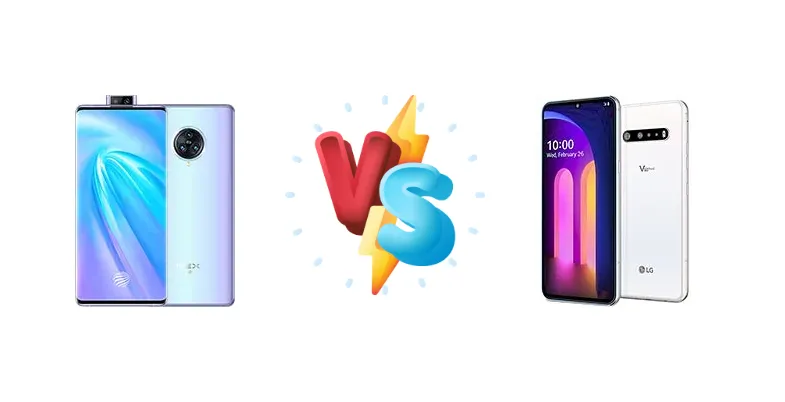
Released within months of each other in 2020, the vivo NEX 3 5G and LG V60 ThinQ 5G UW represent distinct approaches to the flagship 5G experience. The NEX 3 aimed for a striking design with its waterfall display, while the V60 prioritized a more conventional, yet refined, feature set alongside the latest Snapdragon silicon. This comparison dissects their key differences to determine which device offers the best value today.
🏆 Quick Verdict
For the average user seeking a balance of performance and features, the LG V60 ThinQ 5G UW emerges as the stronger contender. Its Snapdragon 865 chipset provides a noticeable performance uplift over the NEX 3’s Snapdragon 855+, and the inclusion of faster charging standards adds to its practicality. However, the NEX 3’s unique design remains a compelling factor for those prioritizing aesthetics.
| Network |
|---|
| 2G bands | GSM 850 / 900 / 1800 / 1900 | GSM 850 / 900 / 1800 / 1900 |
| 3G bands | HSDPA 850 / 900 / 1900 / 2100 | HSDPA 850 / 900 / 1700(AWS) / 1900 / 2100 |
| 4G bands | 1, 2, 3, 4, 5, 7, 8, 12, 17, 18, 19, 20, 26, 28, 34, 38, 39, 40, 41 | 2, 3, 4, 5, 7, 12, 13, 20, 28, 46, 48, 66 |
| 5G bands | 41, 78 NSA | 260, 261 mmWave |
| Speed | HSPA 42.2/5.76 Mbps, LTE (5CA) Cat18 1200/150 Mbps, 5G (2+ Gbps DL) | HSPA 42.2/5.76 Mbps, LTE (7CA) Cat22, 5G |
| Technology | GSM / CDMA / HSPA / EVDO / LTE / 5G | GSM / CDMA / HSPA / EVDO / LTE / 5G |
| | - | CDMA2000 1xEV-DO |
| Launch |
|---|
| Announced | 2019, September. Released 2019, September | 2020, February 26. Released 2020, April 02 |
| Status | Discontinued | Discontinued |
| Body |
|---|
| Build | Glass front, glass back, aluminum frame | Glass front (Gorilla Glass 5), glass back (Gorilla Glass 6), aluminum frame |
| Dimensions | 167.4 x 76.1 x 9.4 mm (6.59 x 3.00 x 0.37 in) | 169.3 x 77.6 x 8.9 mm (6.67 x 3.06 x 0.35 in) |
| SIM | Nano-SIM + Nano-SIM | Nano-SIM (pre-installed) |
| Weight | 218.5 g (7.72 oz) | 218 g (7.69 oz) |
| | - | IP68 dust/water resistant (up to 1.5m for 30 min)
MIL-STD-810G compliant*
Method 516.6, Procedure IV "Transit Drop"
*does not guarantee ruggedness or use in extreme conditions |
| Display |
|---|
| Protection | - | Corning Gorilla Glass 5 |
| Resolution | 1080 x 2256 pixels (~363 ppi density) | 1080 x 2460 pixels (~395 ppi density) |
| Size | 6.89 inches, 119.3 cm2 (~93.6% screen-to-body ratio) | 6.8 inches, 109.8 cm2 (~83.6% screen-to-body ratio) |
| Type | Super AMOLED, HDR10 | P-OLED, HDR10+ |
| | - | Always-on display |
| Platform |
|---|
| CPU | Octa-core (1x2.96 GHz Kryo 485 & 3x2.42 GHz Kryo 485 & 4x1.8 GHz Kryo 485) | Octa-core (1x2.84 GHz Cortex-A77 & 3x2.42 GHz Cortex-A77 & 4x1.80 GHz Cortex-A55) |
| Chipset | Qualcomm SM8150 Snapdragon 855+ (7 nm) | Qualcomm SM8250 Snapdragon 865 5G (7 nm+) |
| GPU | Adreno 640 (700 MHz) | Adreno 650 |
| OS | Android 9.0 (Pie), upgradable to Android 10, Funtouch 10 | Android 10, upgradable to Android 13 |
| Memory |
|---|
| Card slot | No | microSDXC (uses shared SIM slot) - dual-SIM model |
| Internal | 256GB 8GB RAM, 256GB 12GB RAM | 128GB 8GB RAM |
| | - | UFS 2.1 |
| Main Camera |
|---|
| Dual | - | 64 MP, f/1.8, 27mm (standard), 1/1.72", 0.8µm, dual pixel PDAF, OIS
13 MP, f/1.9, 12mm (ultrawide), 1/3.4", 1.0µm
0.3 MP, TOF 3D, f/1.4, (depth) |
| Features | LED flash, HDR, panorama | Dual-LED dual-tone flash, HDR, panorama |
| Triple | 64 MP, f/1.8, 26mm (wide), 1/1.72", 0.8µm, PDAF
13 MP, f/2.5, 52mm (telephoto), PDAF, 2x optical zoom
13 MP, f/2.2, 13mm (ultrawide), PDAF | - |
| Video | 4K@30fps, 1080p@30/60/120fps, 720p@960fps, gyro-EIS | 8K@30fps, 4K@30/60fps, 1080p, HDR10+, 24-bit/192kHz stereo sound rec., gyro-EIS |
| Selfie camera |
|---|
| Features | LED flash, HDR | HDR |
| Single | Motorized pop-up 16 MP, f/2.1, 26mm (wide), 1/3.06", 1.0µm | 10 MP, f/1.9, 30mm (standard), 1/3.1", 1.22µm |
| Video | 1080p@30fps | 4K@30fps, gyro-EIS |
| Sound |
|---|
| 3.5mm jack | Yes | Yes |
| 35mm jack | Yes | Yes |
| Loudspeaker | Yes | Yes, with stereo speakers |
| | - | 32-bit/192kHz audio
24-bit/192kHz audio recording |
| Comms |
|---|
| Bluetooth | 5.0, A2DP, LE | 5.1, A2DP, LE, aptX HD |
| NFC | No | Yes |
| Positioning | GPS, GLONASS, GALILEO, BDS | GPS, GLONASS, GALILEO, BDS |
| Radio | No | FM radio (USA model only) |
| USB | USB Type-C 2.0, OTG | USB Type-C 3.1, OTG |
| WLAN | Wi-Fi 802.11 a/b/g/n/ac, dual-band, Wi-Fi Direct | Wi-Fi 802.11 a/b/g/n/ac/6, dual-band, Wi-Fi Direct, DLNA |
| Features |
|---|
| Sensors | Fingerprint (under display, optical), accelerometer, gyro, proximity, compass | Fingerprint (under display, optical), accelerometer, gyro, proximity, compass, barometer |
| Battery |
|---|
| Charging | 44W wired | Wired, PD2.0, QC4
Wireless |
| Type | 4500 mAh, non-removable | Li-Po 5000 mAh |
| Misc |
|---|
| Colors | Black, Blue | Classy Blue, Classy White |
| Models | V1924A, V1924T, 1913 | LM-V600VML, LMV600VML |
| Price | About 730 EUR | About 870 EUR |
| SAR | - | 0.85 W/kg (head) 1.12 W/kg (body) |
| Tests |
|---|
| Audio quality |
Noise -93.7dB / Crosstalk -93.1dB | - |
| Battery life | Endurance rating 110h | - |
| Camera |
Photo / Video | - |
| Display |
Contrast ratio: Infinite (nominal) | - |
| Loudspeaker |
Voice 70dB / Noise 73dB / Ring 72dB | - |
| Performance |
AnTuTu: 388878 (v7), 497858 (v8)
GeekBench: 11060 (v4.4)
GFXBench: 37fps (ES 3.1 onscreen) | - |
vivo NEX 3 5G
- Unique Waterfall Display Design
- Fast 44W Wired Charging
- Respectable Battery Endurance (110h)
- Older Snapdragon 855+ Chipset
- Potential for Accidental Touches on Curved Screen
- Limited Camera Information
LG V60 ThinQ 5G UW
- More Powerful Snapdragon 865 Chipset
- Faster Charging Standards (PD2.0, QC4)
- Likely Superior Video Recording Capabilities
- Conventional Design Compared to NEX 3
- No Specific Battery Capacity Information
- May Require Verizon 5G UW for Optimal Performance
Display Comparison
The vivo NEX 3 5G boasts a visually arresting waterfall display, a design element the LG V60 lacks. While the NEX 3’s display achieves a measured peak brightness of 610 nits, the LG V60 likely surpasses this, typical for LG’s OLED panels, though a specific measurement is unavailable. Both displays feature an infinite (nominal) contrast ratio, characteristic of OLED technology. The absence of high refresh rate information for either device means smooth scrolling and gaming aren’t guaranteed, a common omission in 2020 flagships. The NEX 3’s extreme curvature, while visually striking, could introduce accidental touches and reflections, a trade-off for its unique aesthetic.
Camera Comparison
Both devices feature capable camera systems, but detailed sensor information is limited. The context data only indicates 'Photo / Video' capabilities for the NEX 3. The LG V60, being a V-series device, historically prioritizes video recording, and likely includes features like 8K video capture. The Snapdragon 865’s image signal processor (ISP) offers superior image processing capabilities compared to the 855+, resulting in better dynamic range and noise reduction in the V60. Without specific sensor size or aperture details, it’s difficult to definitively declare a camera winner, but the LG V60’s chipset advantage suggests superior image quality, particularly in challenging lighting conditions.
Performance
The core difference lies in the chipsets: the vivo NEX 3 5G utilizes the Qualcomm Snapdragon 855+ (7nm), while the LG V60 ThinQ 5G UW features the Snapdragon 865 5G (7nm+). The 865 represents a generational leap, offering improvements in CPU and GPU performance, as well as enhanced 5G modem capabilities. The LG V60’s CPU, with its Cortex-A77 cores, provides a more efficient architecture compared to the Kryo 485 cores in the NEX 3. While both utilize an octa-core configuration, the 865’s architecture translates to faster application loading and smoother multitasking. The 7nm+ process node of the 865 also contributes to improved thermal efficiency, potentially mitigating throttling during sustained workloads.
Battery Life
The vivo NEX 3 5G boasts an endurance rating of 110 hours, suggesting respectable battery life. However, the LG V60’s charging capabilities are more advanced, supporting Wired, PD2.0, and QC4 standards, alongside wireless charging. While the NEX 3 offers 44W wired charging, the V60’s support for PD2.0 and QC4 allows for potentially faster charging speeds with compatible chargers. The absence of battery capacity information for both devices makes a direct comparison difficult, but the LG V60’s faster charging and broader compatibility provide a more convenient user experience.
Buying Guide
Buy the vivo NEX 3 5G if you prioritize a truly unique and immersive display experience with its waterfall screen and are willing to accept slightly older processing power. Buy the LG V60 ThinQ 5G UW if you value raw performance, faster charging capabilities, and a more versatile feature set, particularly if you're on a Verizon 5G UW network.
Frequently Asked Questions
❓ Does the LG V60 ThinQ 5G UW require a Verizon SIM card to function properly?
While the LG V60 ThinQ 5G UW is optimized for Verizon’s 5G Ultra Wideband (UW) network, it is not strictly limited to Verizon. It will function on other carriers, but you may not experience the full benefits of the UW 5G speeds. Compatibility with specific bands should be verified with your carrier.
❓ Is the waterfall display on the vivo NEX 3 5G prone to accidental touches?
The extreme curvature of the NEX 3’s waterfall display does increase the risk of accidental touches, particularly along the edges of the screen. Users have reported needing an adjustment period to minimize these occurrences. A screen protector may exacerbate the issue.
❓ How does the Snapdragon 865 in the LG V60 handle sustained gaming sessions compared to the Snapdragon 855+ in the NEX 3?
The Snapdragon 865’s 7nm+ process and improved thermal design generally result in better sustained performance during gaming. While both chips are capable, the 865 is less likely to experience significant thermal throttling, maintaining higher frame rates for longer periods, especially in demanding titles.