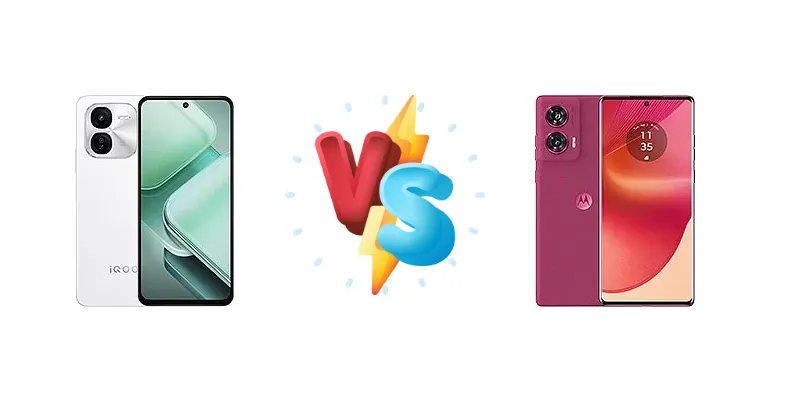
The mid-range smartphone market is fiercely competitive, and the vivo iQOO Z9x and Motorola Edge 50 Fusion represent compelling options for budget-conscious buyers. While both aim to deliver a solid experience, they take different approaches to performance and features. The Z9x focuses on value, while the Fusion prioritizes a more refined experience with faster charging and a brighter display. This comparison will dissect their key differences to help you choose the right phone.
🏆 Quick Verdict
For the average user prioritizing a smoother overall experience and faster charging, the Motorola Edge 50 Fusion is the better choice, *assuming* you're getting the international version with the Snapdragon 7s Gen 2. However, the iQOO Z9x remains a strong contender if you find it at a significantly lower price point and don't mind the potential performance limitations of the Snapdragon 6 Gen 1 in some regions.
| Network |
|---|
| 2G bands | GSM 850 / 900 / 1800 / 1900 | GSM 850 / 900 / 1800 / 1900 |
| 3G bands | HSDPA 850 / 900 / 2100 | HSDPA 850 / 900 / 1900 / 2100 |
| 4G bands | 1, 3, 5, 7, 8, 20, 28, 38, 40, 41 - Global | 1, 2, 3, 5, 7, 8, 18, 19, 20, 26, 28, 32, 38, 40, 41, 42, 71 - International |
| 5G bands | 1, 3, 8, 28, 38, 40, 41, 77, 78 SA/NSA - Global | 1, 3, 5, 7, 8, 20, 26, 28, 38, 40, 41, 77, 78 SA/NSA |
| Speed | HSPA, LTE, 5G | HSPA, LTE, 5G |
| Technology | GSM / CDMA / HSPA / LTE / 5G | GSM / HSPA / LTE / 5G |
| Launch |
|---|
| Announced | 2024, April 24 | 2024, April 16 |
| Status | Available. Released 2024, April 29 | Available. Released 2024, May 15 |
| Body |
|---|
| Build | Glass front, plastic back, plastic frame | Glass front, silicone polymer back (eco leather), plastic frame |
| Dimensions | 165.7 x 76 x 8 mm (6.52 x 2.99 x 0.31 in) | 161.9 x 73.1 x 7.9 mm (6.37 x 2.88 x 0.31 in) |
| SIM | Nano-SIM + Nano-SIM | · Nano-SIM + eSIM· Nano-SIM + Nano-SIM |
| Weight | 199 g (7.05 oz) | 174.9 g (6.17 oz) |
| Display |
|---|
| Protection | - | Corning Gorilla Glass 5 |
| Resolution | 1080 x 2408 pixels, 20:9 ratio (~393 ppi density) | 1080 x 2400 pixels, 20:9 ratio (~393 ppi density) |
| Size | 6.72 inches, 108.8 cm2 (~86.4% screen-to-body ratio) | 6.7 inches, 108.4 cm2 (~91.6% screen-to-body ratio) |
| Type | IPS LCD, 120Hz, 1000 nits (peak) | P-OLED, 1B colors, 120Hz (LATAM), 144Hz (INT), 1600 nits (peak) |
| Platform |
|---|
| CPU | Octa-core (4x2.2 GHz Cortex-A78 & 4x1.8 GHz Cortex-A55) | Octa-core (4x2.40 GHz Cortex-A78 & 4x1.95 GHz Cortex-A55) - InternationalOcta-core (4x2.2 GHz Cortex-A78 & 4x1.8 GHz Cortex-A55) - LATAM |
| Chipset | Qualcomm SM6450 Snapdragon 6 Gen 1 (4 nm) | Qualcomm SM7435-AB Snapdragon 7s Gen 2 (4 nm) - InternationalQualcomm SM6450 Snapdragon 6 Gen 1 (4 nm) - LATAM |
| GPU | Adreno 710 | Adreno 710 |
| OS | Android 14, Funtouch OS 14 (International), OriginOS (China) | Android 14, upgradable to Android 15, up to 3 major Android upgrades |
| Memory |
|---|
| Card slot | microSDXC (uses shared SIM slot) | No |
| Internal | 128GB 4GB RAM, 128GB 6GB RAM, 128GB 8GB RAM, 256GB 8GB RAM, 256GB 12GB RAM | 128GB 8GB RAM, 256GB 8GB RAM, 256GB 12GB RAM, 512GB 8GB RAM, 512GB 12GB RAM |
| Main Camera |
|---|
| Dual | 50 MP, f/1.8, (wide), 1/1.95", 0.8µm, PDAF
Auxiliary lens | 50 MP, f/1.9, (wide), 1/1.56", 1.0µm, multi-directional PDAF, OIS
13 MP, f/2.2, 120˚ (ultrawide), 1/3.0", 1.12µm, AF |
| Features | LED flash, panorama, HDR | LED flash, HDR, panorama |
| Video | 4K, 1080p, gyro-EIS | 4K@30fps, 1080p@30/60/120fps, gyro-EIS |
| Selfie camera |
|---|
| Features | - | HDR |
| Single | 8 MP, f/2.1, (wide) | 32 MP, f/2.5, (wide), 1/3.14", 0.7µm |
| Video | 1080p@30fps | 4K@30fps, 1080p@30fps |
| Sound |
|---|
| 35mm jack | Yes | No |
| Loudspeaker | Yes, with stereo speakers | Yes, with stereo speakers |
| Comms |
|---|
| Bluetooth | 5.1, A2DP, LE, aptX HD, aptX Adaptive | 5.2, A2DP, LE |
| NFC | Yes (market/region dependent) | Yes |
| Positioning | GPS, GALILEO, GLONASS, QZSS, BDS (B1I+B1c) | GPS, GLONASS, GALILEO |
| Radio | Unspecified | No |
| USB | USB Type-C 2.0, OTG | USB Type-C 2.0, OTG |
| WLAN | Wi-Fi 802.11 a/b/g/n/ac, dual-band | Wi-Fi 802.11 a/b/g/n/ac, dual-band |
| Features |
|---|
| Sensors | Fingerprint (side-mounted), accelerometer, gyro, proximity, compass | Fingerprint (under display, optical), accelerometer, gyro, proximity, compass |
| Battery |
|---|
| Charging | 44W wired
Reverse wired | 68W wired, 50% in 15 min |
| Type | 6000 mAh | 5000 mAh |
| Misc |
|---|
| Colors | Tornado Green (Northern Green), Storm Grey (Mystic Black), White | Forest Blue, Marshmallow Blue, Hot Pink |
| Models | V2353A, I2219 | XT2429-1 |
| Price | ₹ 13,499 | € 208.99 / $ 245.00 / ₹ 18,667 |
vivo iQOO Z9x
- Potentially lower price point
- 4nm Snapdragon 6 Gen 1 offers decent efficiency
- Reverse wired charging capability
- Performance varies significantly by region (LATAM gets Snapdragon 6 Gen 1)
- Display brightness likely lower than the Fusion
- Limited camera details available
Motorola Edge 50 Fusion
- Faster 68W charging
- Brighter 1322 nit display
- More powerful Snapdragon 7s Gen 2 (International version)
- Snapdragon 6 Gen 1 variant exists in LATAM
- No OIS for camera stabilization
- Potentially higher price than the Z9x
Display Comparison
The Motorola Edge 50 Fusion boasts a significantly brighter display, reaching a measured 1322 nits. This is a substantial advantage for outdoor visibility compared to the iQOO Z9x, which lacks published brightness data. While both likely utilize AMOLED panels, the Fusion’s higher peak brightness translates to a more usable experience in direct sunlight. The Z9x’s display specifications are currently unknown, making a direct comparison of color accuracy and resolution impossible, but the Fusion’s panel is demonstrably superior in brightness.
Camera Comparison
Detailed camera specifications for both devices are limited. Without knowing sensor sizes, apertures, or image processing algorithms, a definitive comparison is difficult. However, given the market positioning, it’s reasonable to assume both phones will rely on computational photography to enhance image quality. The absence of optical image stabilization (OIS) on either device suggests a focus on affordability over advanced camera features. We can expect both to perform adequately in good lighting conditions, but struggle in low-light scenarios. The inclusion of a 2MP macro camera on either device is largely a marketing gimmick and unlikely to deliver significant photographic value.
Performance
This is where the biggest divergence lies. The Motorola Edge 50 Fusion, in its international configuration, features the Qualcomm SM7435-AB Snapdragon 7s Gen 2 (4nm). This chipset’s octa-core CPU, with 4x2.40 GHz Cortex-A78 cores, offers a noticeable performance uplift over the iQOO Z9x’s Snapdragon 6 Gen 1 (4nm). The Z9x’s CPU configuration of 4x2.2 GHz Cortex-A78 and 4x1.8 GHz Cortex-A55 cores is less powerful. Critically, the Edge 50 Fusion *also* ships with the Snapdragon 6 Gen 1 in LATAM markets, effectively negating this performance advantage. The 4nm process node on both chips contributes to improved efficiency, but the architectural differences favor the 7s Gen 2. The Fusion’s superior CPU and GPU will translate to smoother multitasking, faster app loading times, and better gaming performance.
Battery Life
The Motorola Edge 50 Fusion’s 68W wired charging is a clear advantage, promising a 50% charge in just 15 minutes. The iQOO Z9x’s 44W charging is slower, requiring more time to reach a full charge. The Edge 50 Fusion also boasts an active use battery score of 12:40h, indicating strong battery life. While the Z9x’s battery capacity is unknown, the Fusion’s combination of efficient chipset and fast charging provides a more convenient user experience. The faster charging speed mitigates any potential concerns about battery capacity differences.
Buying Guide
Buy the vivo iQOO Z9x if you need a highly affordable smartphone and are comfortable with potentially lower performance depending on your region (LATAM models have the Snapdragon 6 Gen 1). Buy the Motorola Edge 50 Fusion if you prefer a brighter, more vibrant display, significantly faster 68W charging, and a more consistently powerful processor – specifically the international version with the Snapdragon 7s Gen 2.
Frequently Asked Questions
❓ Is the Snapdragon 6 Gen 1 in the iQOO Z9x sufficient for playing demanding games like PUBG Mobile?
The Snapdragon 6 Gen 1 can handle PUBG Mobile, but you'll likely need to lower graphics settings for a consistently smooth experience. The Snapdragon 7s Gen 2 in the international Edge 50 Fusion offers a more comfortable gaming experience with higher frame rates and graphical fidelity. The LATAM version of the Edge 50 Fusion with the Snapdragon 6 Gen 1 will perform similarly to the iQOO Z9x.
❓ How does the 68W charging on the Motorola Edge 50 Fusion compare to using a standard 25W charger?
The 68W charging on the Edge 50 Fusion is significantly faster than a standard 25W charger. Motorola claims a 50% charge in 15 minutes, whereas a 25W charger would take considerably longer – likely over 30 minutes to reach the same level. This faster charging is particularly beneficial for users who frequently need to top up their battery quickly.
❓ Does the Motorola Edge 50 Fusion support 5G connectivity?
Yes, the Motorola Edge 50 Fusion supports 5G connectivity, allowing you to take advantage of faster mobile data speeds where available. The iQOO Z9x also supports 5G, so this isn't a differentiating factor between the two devices.
❓ Which phone is better for watching videos outdoors?
The Motorola Edge 50 Fusion is the clear winner for outdoor video viewing due to its significantly brighter display (1322 nits). The higher peak brightness ensures better visibility even in direct sunlight, while the iQOO Z9x’s display is likely to appear washed out in the same conditions.