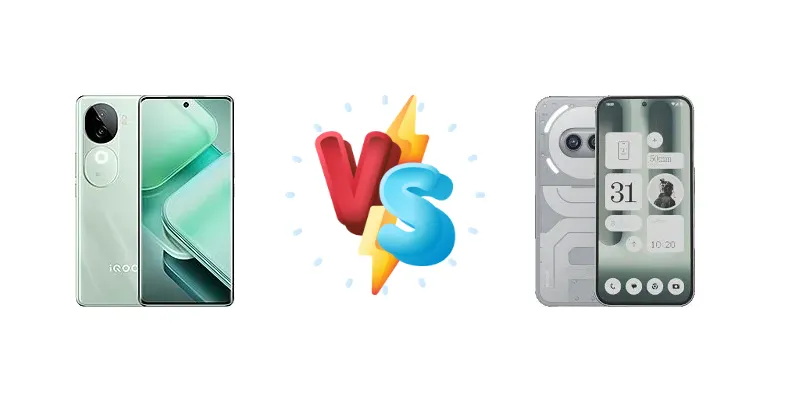
The mid-range smartphone market is fiercely competitive, and the vivo iQOO Z9s and Nothing Phone (2a) Plus represent compelling options. The iQOO Z9s aims for aggressive value, while the Nothing Phone (2a) Plus focuses on a refined user experience and distinctive design. This comparison dissects their key differences to help you choose the right device.
🏆 Quick Verdict
For the average user prioritizing all-day battery life and a brighter display, the Nothing Phone (2a) Plus emerges as the winner. Its 16:34h active use score and 1097 nits peak brightness provide a tangible advantage. However, the iQOO Z9s offers a strong performance-per-dollar ratio.
| Network |
|---|
| 2G bands | GSM 850 / 900 / 1800 / 1900 | GSM 850 / 900 / 1800 / 1900 |
| 3G bands | HSDPA 850 / 900 / 2100 | HSDPA 800 / 850 / 900 / 1700(AWS) / 1900 / 2100 |
| 4G bands | 1, 3, 5, 8, 28, 38, 40, 41 | 1, 3, 4, 5, 7, 8, 18, 19, 20, 26, 28, 38, 39, 40, 41, 42, 66 |
| 5G bands | 1, 3, 5, 8, 28, 40, 77, 78 SA/NSA | 1, 3, 5, 7, 8, 20, 28, 38, 40, 41, 66, 77, 78 SA/NSA |
| Speed | HSPA, LTE, 5G | HSPA, LTE, 5G |
| Technology | GSM / HSPA / LTE / 5G | GSM / HSPA / LTE / 5G |
| Launch |
|---|
| Announced | 2024, August 21 | 2024, July 31 |
| Status | Available. Released 2024, August 23 | Available. Released 2024, August 03 |
| Body |
|---|
| Build | - | Glass front (Gorilla Glass 5), plastic frame, plastic back |
| Dimensions | 163.7 x 75 x 7.5 mm (6.44 x 2.95 x 0.30 in) | 161.7 x 76.3 x 8.5 mm (6.37 x 3.00 x 0.33 in) |
| SIM | Nano-SIM + Nano-SIM | Nano-SIM + Nano-SIM |
| Weight | 180 g or 182 g (6.35 oz) | 190 g (6.70 oz) |
| Display |
|---|
| Protection | Schott Xensation | Corning Gorilla Glass 5 |
| Resolution | 1080 x 2392 pixels (~388 ppi density) | 1080 x 2412 pixels, 20:9 ratio (~395 ppi density) |
| Size | 6.77 inches, 110.9 cm2 (~90.3% screen-to-body ratio) | 6.7 inches, 107.5 cm2 (~87.1% screen-to-body ratio) |
| Type | AMOLED, 1B colors, 120Hz, HDR10+, 1800 nits (peak) | AMOLED, 1B colors, 120Hz, 2160Hz PWM, HDR10+, 700 nits (typ), 1100 nits (HBM), 1300 nits (peak) |
| Platform |
|---|
| CPU | Octa-core (4x2.5 GHz Cortex-A78 & 4x2.0 GHz Cortex-A55) | Octa-core (2x3.0 GHz Cortex-A715 & 6x 2.0 GHz Cortex-A510) |
| Chipset | Mediatek Dimensity 7300 (4 nm) | Mediatek Dimensity 7350 Pro (4 nm) |
| GPU | Mali-G615 MC2 | Mali-G610 MC4 |
| OS | Android 14, up to 2 major Android upgrades, Funtouch 14 | Android 14, up to 3 major Android upgrades, Nothing OS 3.0 |
| Memory |
|---|
| Card slot | No | No |
| Internal | 128GB 8GB RAM, 256GB 8GB RAM, 256GB 12GB RAM | 256GB 8GB RAM, 256GB 12GB RAM |
| Main Camera |
|---|
| Dual | 50 MP, f/1.8, (wide), 1/1.95", 0.8µm, PDAF, OIS
Auxiliary lens | 50 MP, f/1.9, 24mm (wide), 1/1.57", 1.0µm, PDAF, OIS
50 MP, f/2.2, 114˚ (ultrawide), 1/2.76", 0.64µm |
| Features | LED flash, panorama, HDR | LED flash, panorama, HDR |
| Video | 4K@30/60fps, 1080p, gyro-EIS, OIS | 4K@30fps, 1080p@60/120fps, gyro-EIS |
| Selfie camera |
|---|
| Features | - | HDR |
| Single | 16 MP, f/2.5, (wide), 1/3.0", 1.0µm | 50 MP, f/2.2, (wide), 1/2.76" |
| Video | 1080p@30fps | 4K@30fps |
| Sound |
|---|
| 35mm jack | No | No |
| Loudspeaker | Yes, with stereo speakers | Yes, with stereo speakers |
| Comms |
|---|
| Bluetooth | 5.4, A2DP, LE | 5.3, A2DP, LE |
| NFC | No | Yes, 360˚ |
| Positioning | GPS, GALILEO, GLONASS, BDS, QZSS | GPS, GALILEO, GLONASS, BDS, QZSS |
| Radio | FM radio | No |
| USB | USB Type-C 2.0, OTG | USB Type-C 2.0, OTG |
| WLAN | Wi-Fi 802.11 a/b/g/n/ac/6, dual-band | Wi-Fi 802.11 a/b/g/n/ac/6, dual-band, Wi-Fi Direct |
| Features |
|---|
| Sensors | Fingerprint (under display, optical), accelerometer, gyro, proximity, compass | Fingerprint (under display, optical), accelerometer, gyro, proximity, compass |
| Battery |
|---|
| Charging | 44W wired
7.5W reverse wired | 50W wired, 50% in 21 min, 100% in 56 min |
| Type | Li-Ion 5500 mAh | 5000 mAh |
| Misc |
|---|
| Colors | Titanium Matte, Onyx Green | Black, Grey |
| Models | I2403 | A142P |
| Price | About 220 EUR | € 269.90 / ₹ 22,599 |
vivo iQOO Z9s
- Potentially more affordable price point
- Strong CPU performance for the price
- 44W fast charging is still respectable
- Likely dimmer display compared to the competition
- Battery life is likely shorter than the Nothing Phone (2a) Plus
Nothing Phone (2a) Plus
- Exceptional battery life (16:34h active use)
- Bright and vibrant display (1097 nits)
- Faster 50W charging
- May be more expensive than the iQOO Z9s
- Dimensity 7350 Pro is a step up, but not a flagship-level chip
Display Comparison
The Nothing Phone (2a) Plus boasts a significantly brighter display, reaching a measured 1097 nits, making it far more usable outdoors under direct sunlight. While the iQOO Z9s’ display specifications are not provided, it’s likely to be dimmer. The Nothing Phone (2a) Plus’s brightness advantage benefits content consumers and users who frequently use their phones outdoors. The panel technology is not specified for either, but the Nothing Phone (2a) Plus’s brightness suggests a higher-quality panel.
Camera Comparison
Without detailed camera specifications for the iQOO Z9s, a direct comparison is limited. However, the Nothing Phone (2a) Plus likely benefits from more advanced image processing capabilities due to its newer chipset. The focus should be on the main sensor quality and aperture. The absence of information on OIS for either device suggests a reliance on software stabilization. Users prioritizing photography should investigate sample images from both devices before making a decision.
Performance
Both phones utilize Mediatek’s 4nm Dimensity series, but the Nothing Phone (2a) Plus features the Dimensity 7350 Pro, a step up from the iQOO Z9s’ Dimensity 7300. The 7350 Pro’s CPU configuration – 2x3.0 GHz Cortex-A715 and 6x2.0 GHz Cortex-A510 – offers higher peak clock speeds compared to the iQOO’s 4x2.5 GHz Cortex-A78 & 4x2.0 GHz Cortex-A55. This translates to snappier app launches and smoother multitasking. While both use the same node size, the architectural improvements in the 7350 Pro provide a performance edge, particularly in CPU-intensive tasks. The iQOO Z9s, however, may still offer competitive gaming performance due to its Cortex-A78 cores.
Battery Life
The Nothing Phone (2a) Plus clearly excels in battery life, achieving an impressive 16:34h of active use. While the iQOO Z9s’ battery capacity is unknown, its 44W charging is slower than the Nothing Phone (2a) Plus’s 50W charging, which can reach 50% in 21 minutes and 100% in 56 minutes. The faster charging on the Nothing Phone (2a) Plus is a significant convenience factor, especially for users who frequently need to top up their battery quickly. The longer active use time of the Nothing Phone (2a) Plus suggests a more efficient combination of hardware and software optimization.
Buying Guide
Buy the vivo iQOO Z9s if you need maximum performance for gaming and demanding tasks on a tight budget, and are willing to compromise slightly on battery life and display brightness. Buy the Nothing Phone (2a) Plus if you prefer a more balanced experience with exceptional battery endurance, a vibrant display, and a unique, minimalist aesthetic.
Frequently Asked Questions
❓ Does the Dimensity 7350 Pro in the Nothing Phone (2a) Plus get noticeably warmer during extended gaming sessions compared to the Dimensity 7300 in the iQOO Z9s?
While both chips are built on a 4nm process, the Dimensity 7350 Pro's higher clock speeds and more complex architecture could lead to slightly higher temperatures under sustained load. However, Nothing's thermal management system is likely optimized to mitigate this, and real-world performance will depend on the phone's cooling solution. The iQOO Z9s may maintain slightly cooler temperatures, but potentially at the cost of some performance.
❓ How does the 50W charging on the Nothing Phone (2a) Plus compare to the 44W charging on the iQOO Z9s in terms of real-world usability?
The Nothing Phone (2a) Plus’s 50W charging is demonstrably faster, reaching 50% charge in just 21 minutes and 100% in 56 minutes. While 44W is still considered fast charging, the 6-minute difference to reach 50% and the 12-minute difference to full charge can be significant for users who need a quick top-up before leaving the house. The Nothing Phone (2a) Plus offers a more convenient charging experience.
❓ Is the difference in CPU performance between the Dimensity 7300 and 7350 Pro noticeable in everyday tasks like browsing and social media?
For typical everyday tasks like browsing, social media, and email, the difference in CPU performance between the two chips will likely be minimal and imperceptible to most users. Both processors are more than capable of handling these workloads smoothly. The performance gap becomes more apparent in demanding applications like video editing or graphically intensive games.