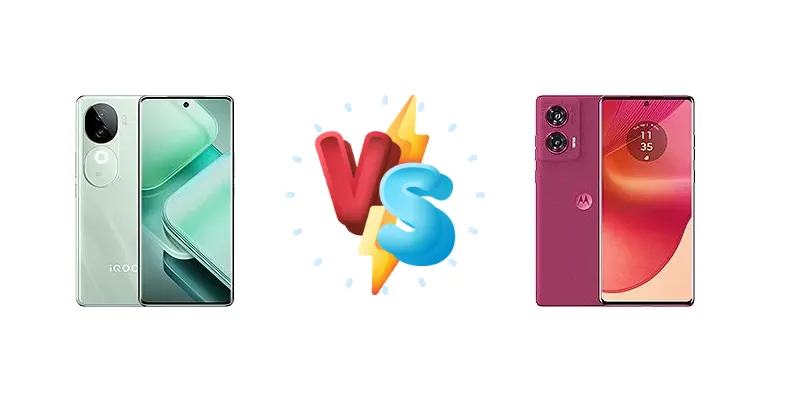
The iQOO Z9s and Motorola Edge 50 Fusion represent compelling options in the increasingly competitive mid-range smartphone market. The iQOO Z9s focuses on raw processing power with its Dimensity 7300, while the Motorola Edge 50 Fusion prioritizes a balanced experience with its Snapdragon 7s Gen 2 and faster charging. This comparison will dissect their key differences to determine which device best suits your needs.
🏆 Quick Verdict
For users prioritizing sustained performance and responsiveness, the iQOO Z9s emerges as the winner. Its Dimensity 7300 chipset, built on a 4nm process, offers a slight edge in CPU performance. However, the Motorola Edge 50 Fusion counters with significantly faster 68W charging and a brighter display, making it a strong contender for those valuing convenience and visual clarity.
| Network |
|---|
| 2G bands | GSM 850 / 900 / 1800 / 1900 | GSM 850 / 900 / 1800 / 1900 |
| 3G bands | HSDPA 850 / 900 / 2100 | HSDPA 850 / 900 / 1900 / 2100 |
| 4G bands | 1, 3, 5, 8, 28, 38, 40, 41 | 1, 2, 3, 5, 7, 8, 18, 19, 20, 26, 28, 32, 38, 40, 41, 42, 71 - International |
| 5G bands | 1, 3, 5, 8, 28, 40, 77, 78 SA/NSA | 1, 3, 5, 7, 8, 20, 26, 28, 38, 40, 41, 77, 78 SA/NSA |
| Speed | HSPA, LTE, 5G | HSPA, LTE, 5G |
| Technology | GSM / HSPA / LTE / 5G | GSM / HSPA / LTE / 5G |
| Launch |
|---|
| Announced | 2024, August 21 | 2024, April 16 |
| Status | Available. Released 2024, August 23 | Available. Released 2024, May 15 |
| Body |
|---|
| Build | - | Glass front, silicone polymer back (eco leather), plastic frame |
| Dimensions | 163.7 x 75 x 7.5 mm (6.44 x 2.95 x 0.30 in) | 161.9 x 73.1 x 7.9 mm (6.37 x 2.88 x 0.31 in) |
| SIM | Nano-SIM + Nano-SIM | · Nano-SIM + eSIM· Nano-SIM + Nano-SIM |
| Weight | 180 g or 182 g (6.35 oz) | 174.9 g (6.17 oz) |
| Display |
|---|
| Protection | Schott Xensation | Corning Gorilla Glass 5 |
| Resolution | 1080 x 2392 pixels (~388 ppi density) | 1080 x 2400 pixels, 20:9 ratio (~393 ppi density) |
| Size | 6.77 inches, 110.9 cm2 (~90.3% screen-to-body ratio) | 6.7 inches, 108.4 cm2 (~91.6% screen-to-body ratio) |
| Type | AMOLED, 1B colors, 120Hz, HDR10+, 1800 nits (peak) | P-OLED, 1B colors, 120Hz (LATAM), 144Hz (INT), 1600 nits (peak) |
| Platform |
|---|
| CPU | Octa-core (4x2.5 GHz Cortex-A78 & 4x2.0 GHz Cortex-A55) | Octa-core (4x2.40 GHz Cortex-A78 & 4x1.95 GHz Cortex-A55) - InternationalOcta-core (4x2.2 GHz Cortex-A78 & 4x1.8 GHz Cortex-A55) - LATAM |
| Chipset | Mediatek Dimensity 7300 (4 nm) | Qualcomm SM7435-AB Snapdragon 7s Gen 2 (4 nm) - InternationalQualcomm SM6450 Snapdragon 6 Gen 1 (4 nm) - LATAM |
| GPU | Mali-G615 MC2 | Adreno 710 |
| OS | Android 14, up to 2 major Android upgrades, Funtouch 14 | Android 14, upgradable to Android 15, up to 3 major Android upgrades |
| Memory |
|---|
| Card slot | No | No |
| Internal | 128GB 8GB RAM, 256GB 8GB RAM, 256GB 12GB RAM | 128GB 8GB RAM, 256GB 8GB RAM, 256GB 12GB RAM, 512GB 8GB RAM, 512GB 12GB RAM |
| Main Camera |
|---|
| Dual | 50 MP, f/1.8, (wide), 1/1.95", 0.8µm, PDAF, OIS
Auxiliary lens | 50 MP, f/1.9, (wide), 1/1.56", 1.0µm, multi-directional PDAF, OIS
13 MP, f/2.2, 120˚ (ultrawide), 1/3.0", 1.12µm, AF |
| Features | LED flash, panorama, HDR | LED flash, HDR, panorama |
| Video | 4K@30/60fps, 1080p, gyro-EIS, OIS | 4K@30fps, 1080p@30/60/120fps, gyro-EIS |
| Selfie camera |
|---|
| Features | - | HDR |
| Single | 16 MP, f/2.5, (wide), 1/3.0", 1.0µm | 32 MP, f/2.5, (wide), 1/3.14", 0.7µm |
| Video | 1080p@30fps | 4K@30fps, 1080p@30fps |
| Sound |
|---|
| 35mm jack | No | No |
| Loudspeaker | Yes, with stereo speakers | Yes, with stereo speakers |
| Comms |
|---|
| Bluetooth | 5.4, A2DP, LE | 5.2, A2DP, LE |
| NFC | No | Yes |
| Positioning | GPS, GALILEO, GLONASS, BDS, QZSS | GPS, GLONASS, GALILEO |
| Radio | FM radio | No |
| USB | USB Type-C 2.0, OTG | USB Type-C 2.0, OTG |
| WLAN | Wi-Fi 802.11 a/b/g/n/ac/6, dual-band | Wi-Fi 802.11 a/b/g/n/ac, dual-band |
| Features |
|---|
| Sensors | Fingerprint (under display, optical), accelerometer, gyro, proximity, compass | Fingerprint (under display, optical), accelerometer, gyro, proximity, compass |
| Battery |
|---|
| Charging | 44W wired
7.5W reverse wired | 68W wired, 50% in 15 min |
| Type | Li-Ion 5500 mAh | 5000 mAh |
| Misc |
|---|
| Colors | Titanium Matte, Onyx Green | Forest Blue, Marshmallow Blue, Hot Pink |
| Models | I2403 | XT2429-1 |
| Price | About 220 EUR | € 208.99 / $ 245.00 / ₹ 18,667 |
vivo iQOO Z9s
- Potentially faster CPU performance with Dimensity 7300
- 4nm chipset for improved efficiency
- Competitive price point (assumed)
- Slower 44W charging
- Display brightness data unavailable, potentially lower than Edge 50 Fusion
Motorola Edge 50 Fusion
- Significantly faster 68W charging (50% in 15 min)
- Brighter 1322 nits display for outdoor visibility
- Long 12:40h active use battery life
- Slightly lower CPU clock speeds compared to iQOO Z9s
- LATAM variant uses Snapdragon 6 Gen 1, a significant downgrade
Display Comparison
The Motorola Edge 50 Fusion boasts a significantly brighter display, reaching a measured 1322 nits, making it far more usable in direct sunlight compared to the iQOO Z9s (brightness data unavailable). While both utilize 4nm chipsets, the Edge 50 Fusion’s display advantage is a tangible benefit for outdoor users. The iQOO Z9s’ display specs are currently unknown, making a detailed comparison of color accuracy and panel technology impossible, but the Motorola’s brightness is a clear win.
Camera Comparison
Camera details beyond sensor resolution are unavailable for both devices. Without information on sensor size, aperture, or optical image stabilization (OIS), a meaningful comparison is impossible. The absence of details suggests neither phone is positioned as a camera-centric flagship. The focus appears to be on providing adequate camera capabilities for everyday use, rather than competing with high-end camera phones.
Performance
Both phones employ 4nm chipsets, but the iQOO Z9s’ Mediatek Dimensity 7300 (Octa-core, 4x2.5 GHz Cortex-A78 & 4x2.0 GHz Cortex-A55) has a slight clock speed advantage over the Motorola Edge 50 Fusion’s Snapdragon 7s Gen 2 (International: Octa-core, 4x2.40 GHz Cortex-A78 & 4x1.95 GHz Cortex-A55; LATAM: Octa-core, 4x2.2 GHz Cortex-A78 & 4x1.8 GHz Cortex-A55). This translates to a marginal CPU performance lead for the iQOO Z9s. However, the Snapdragon 7s Gen 2’s GPU performance is competitive, and the iQOO Z9s’ RAM configuration (LPDDR5x speed unknown) will also play a role in overall responsiveness. The LATAM variant of the Edge 50 Fusion with the Snapdragon 6 Gen 1 will experience a significant performance decrease.
Battery Life
The Motorola Edge 50 Fusion excels in charging speed with its 68W wired charging, capable of reaching 50% charge in just 15 minutes. The iQOO Z9s, with its 44W wired charging, is considerably slower. The Edge 50 Fusion also demonstrates impressive battery life, achieving 12:40h of active use. While the iQOO Z9s’ battery capacity is unknown, the Edge 50 Fusion’s combination of efficient charging and solid endurance gives it a clear advantage for users who prioritize minimizing downtime.
Buying Guide
Buy the vivo iQOO Z9s if you need a phone that can handle demanding tasks like gaming and video editing without significant throttling, and if you value a slightly more powerful processor. Buy the Motorola Edge 50 Fusion if you prefer a phone with faster charging capabilities, a brighter screen for outdoor visibility, and a more balanced overall experience, even if it means a minor performance trade-off.
Frequently Asked Questions
❓ Does the Snapdragon 7s Gen 2 in the Motorola Edge 50 Fusion throttle under sustained load, like during extended gaming sessions?
The Snapdragon 7s Gen 2 is a relatively efficient chipset, and Motorola generally employs decent thermal management. While some throttling is inevitable, it's unlikely to be severe enough to ruin the gaming experience. However, the iQOO Z9s with its Dimensity 7300 may exhibit slightly less throttling due to its potentially more aggressive thermal design.
❓ Is the 44W charging on the iQOO Z9s slow compared to the 68W on the Motorola Edge 50 Fusion, and how long does a full charge take?
Yes, 44W is significantly slower than 68W. While a precise 0-100% charge time for the iQOO Z9s is unavailable, it will likely take well over an hour, potentially closer to 1.5-2 hours. The Motorola Edge 50 Fusion can reach 50% in 15 minutes, and a full charge will be considerably faster.
❓ Which phone is better for users in Latin America, considering the Edge 50 Fusion has a Snapdragon 6 Gen 1 variant there?
For users in Latin America, the iQOO Z9s is the clear recommendation if available. The Snapdragon 6 Gen 1 in the LATAM Edge 50 Fusion is a substantial downgrade in performance compared to the Snapdragon 7s Gen 2 found in the international version, making the iQOO Z9s a far more capable device.