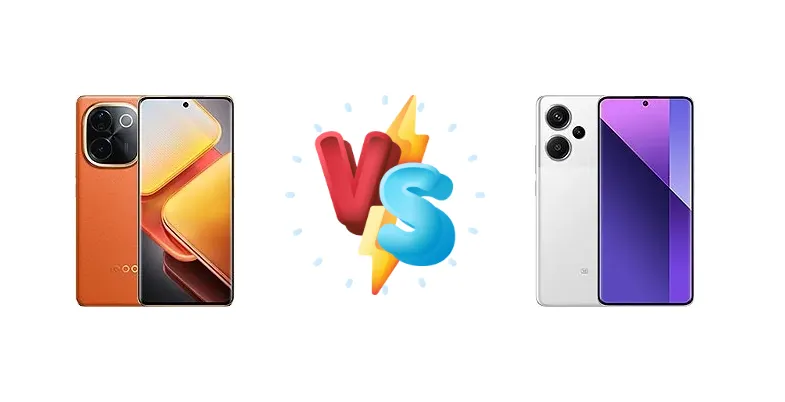
The vivo iQOO Z9s Pro and Xiaomi Redmi Note 13 Pro+ represent compelling options in the increasingly competitive mid-range smartphone market. The iQOO Z9s Pro focuses on delivering strong performance with Qualcomm’s Snapdragon 7 Gen 3, while the Redmi Note 13 Pro+ prioritizes rapid charging and a bright display. This comparison dissects their key differences to help you determine which device best suits your needs.
🏆 Quick Verdict
For the average user prioritizing speed and efficient charging, the Xiaomi Redmi Note 13 Pro+ emerges as the winner. Its 120W charging significantly reduces downtime, and the Dimensity 7200 Ultra provides ample power for daily tasks and moderate gaming. However, the iQOO Z9s Pro is a strong contender for those seeking a slightly more power-efficient chipset.
| Network |
|---|
| 2G bands | GSM 850 / 900 / 1800 / 1900 | GSM 850 / 900 / 1800 / 1900 |
| 3G bands | HSDPA 850 / 900 / 2100 | HSDPA 800 / 850 / 900 / 1700(AWS) / 1900 / 2100 - International |
| 4G bands | 1, 3, 5, 8, 28, 38, 40, 41 | 1, 2, 3, 4, 5, 7, 8, 12, 13, 17, 18, 19, 20, 26, 28, 32, 38, 40, 41, 66 - International |
| 5G bands | 1, 3, 5, 8, 28, 40, 77, 78 SA/NSA | 1, 3, 5, 7, 8, 20, 28, 38, 40, 41, 66, 77, 78 SA/NSA- International |
| Speed | HSPA, LTE, 5G | HSPA, LTE, 5G |
| Technology | GSM / HSPA / LTE / 5G | GSM / CDMA / HSPA / EVDO / LTE / 5G |
| Launch |
|---|
| Announced | 2024, August 21 | 2023, September 21 |
| Status | Available. Released 2024, August 23 | Available. Released 2023, September 21 |
| Body |
|---|
| Build | - | Glass front (Gorilla Glass Victus), glass back or silicone polymer back (eco leather) |
| Dimensions | 163.7 x 75 x 7.5 or 8.0 mm | 161.4 x 74.2 x 8.9 mm (6.35 x 2.92 x 0.35 in) |
| SIM | Nano-SIM + Nano-SIM | · Nano-SIM + eSIM· Nano-SIM + Nano-SIM |
| Weight | 185 g or 190 g (6.53 oz) | 199 g or 204.5 g (7.02 oz) |
| Display |
|---|
| Protection | Schott Xensation | Corning Gorilla Glass Victus |
| Resolution | 1080 x 2392 pixels (~388 ppi density) | 1220 x 2712 pixels, 20:9 ratio (~446 ppi density) |
| Size | 6.77 inches, 110.9 cm2 (~90.3% screen-to-body ratio) | 6.67 inches, 107.4 cm2 (~89.7% screen-to-body ratio) |
| Type | AMOLED, 1B colors, 120Hz, HDR10+, 4500 nits (peak) | AMOLED, 68B colors, 120Hz, 1920Hz PWM, Dolby Vision, HDR10+, 1800 nits (peak) |
| Platform |
|---|
| CPU | Octa-core (1x2.63 GHz Cortex-A715 & 3x2.4 GHz Cortex-A715 & 4x1.8 GHz Cortex-A510) | Octa-core (2x2.8 GHz Cortex-A715 & 6x2.0 GHz Cortex-A510) |
| Chipset | Qualcomm SM7550-AB Snapdragon 7 Gen 3 (4 nm) | Mediatek Dimensity 7200 Ultra (4 nm) |
| GPU | Adreno 720 | Mali-G610 MC4 |
| OS | Android 14, up to 2 major Android upgrades, Funtouch 14 | Android 13, up to 3 major Android upgrades, HyperOS |
| Memory |
|---|
| Card slot | No | No |
| Internal | 128GB 8GB RAM, 256GB 8GB RAM, 256GB 12GB RAM | 256GB 8GB RAM, 256GB 12GB RAM, 512GB 8GB RAM, 512GB 12GB RAM, 512GB 16GB RAM |
| Main Camera |
|---|
| Dual | 50 MP, f/1.8, (wide), 1/1.95", 0.8µm, PDAF, OIS
8 MP, f/2.2, 120˚ (ultrawide) | - |
| Features | LED flash, panorama, HDR | Dual-LED dual-tone flash, HDR, panorama |
| Triple | - | 200 MP, f/1.7, 23mm (wide), 1/1.4", 0.56µm, multi-directional PDAF, OIS
8 MP, f/2.2, 16mm, 120˚ (ultrawide), 1/4.0", 1.12µm
2 MP (macro) |
| Video | 4K@30fps, 1080p@30/60fps, gyro-EIS, OIS | 4K@24/30fps, 1080p@30/60/120fps, gyro-EIS |
| Selfie camera |
|---|
| Features | - | HDR, panorama |
| Single | 16 MP, f/2.5, (wide), 1/3.0", 1.0µm | 16 MP, f/2.4, (wide) |
| Video | 1080p@30fps | 1080p@30/60fps |
| Sound |
|---|
| 35mm jack | No | No |
| Loudspeaker | Yes, with stereo speakers | Yes, with stereo speakers |
| Comms |
|---|
| Bluetooth | 5.4, A2DP, LE | 5.3, A2DP, LE |
| Infrared port | - | Yes |
| NFC | No | Yes (market/region dependent) |
| Positioning | GPS, GALILEO, GLONASS, BDS, QZSS | GPS, GLONASS, BDS, GALILEO, QZSS |
| Radio | FM radio | No |
| USB | USB Type-C 2.0, OTG | USB Type-C 2.0, OTG |
| WLAN | Wi-Fi 802.11 a/b/g/n/ac/6, dual-band | Wi-Fi 802.11 a/b/g/n/ac/6, dual-band, Wi-Fi Direct |
| Features |
|---|
| Sensors | Fingerprint (under display, optical), accelerometer, gyro, proximity, compass | Fingerprint (under display, optical), accelerometer, gyro, proximity, compass |
| Battery |
|---|
| Charging | 80W wired, 50% in 21 min
7.5W reverse wired | 120W wired, PD3.0, 100% in 19 min |
| Type | Li-Ion 5500 mAh | Li-Po 5000 mAh |
| Misc |
|---|
| Colors | Flamboyant Orange, Luxe Marble | Midnight Black (Fushion Black), Moonlight White (Fushion White), Aurora Purple, Fushion Purple, Camo Green |
| Models | I2305 | 23090RA98C, 23090RA98G, 23090RA98I |
| Price | About 270 EUR | $ 299.98 / £ 299.00 / € 208.98 / ₹ 24,999 |
| SAR | - | 1.09 W/kg (head) 0.85 W/kg (body) |
| SAR EU | - | 0.98 W/kg (head) 1.00 W/kg (body) |
vivo iQOO Z9s Pro
- Potentially more efficient Snapdragon 7 Gen 3 chipset
- Balanced CPU core configuration for sustained performance
- Competitive price point (likely)
- Slower 80W charging compared to the Redmi
- Display brightness likely lower than the Redmi
- Camera specifications are currently unknown
Xiaomi Redmi Note 13 Pro+
- Ultra-fast 120W charging (100% in 19 minutes)
- Bright 1283 nits display for excellent outdoor visibility
- Powerful Dimensity 7200 Ultra CPU for multitasking
- Potentially less power-efficient than the Snapdragon 7 Gen 3
- Higher price point (likely)
- Software bloat (typical of Xiaomi)
Display Comparison
The Redmi Note 13 Pro+ boasts a significantly brighter display, reaching a measured 1283 nits, making it more usable outdoors under direct sunlight. While the iQOO Z9s Pro’s display specifications are not provided, the Redmi’s brightness advantage is substantial. Both devices utilize 4nm chipsets, suggesting similar power efficiency in display operation, but the Redmi’s higher peak brightness will inevitably draw more power when actively used at maximum levels. The Redmi’s panel is likely AMOLED, common in this price bracket, offering vibrant colors and deep blacks, while the iQOO’s panel type remains unknown.
Camera Comparison
Without detailed camera specifications for the iQOO Z9s Pro, a direct comparison is limited. However, the Redmi Note 13 Pro+ is expected to feature a high-resolution main sensor (likely 200MP, based on market trends for this series) with optical image stabilization (OIS). The iQOO Z9s Pro’s camera performance will likely be competitive, but the Redmi’s OIS and potentially larger sensor size will provide an advantage in low-light conditions and image stabilization. We can assume both phones will include standard ultra-wide and macro lenses, but the quality of these secondary sensors is often less critical.
Performance
The core difference lies in the chipsets: the iQOO Z9s Pro features the Qualcomm Snapdragon 7 Gen 3, while the Redmi Note 13 Pro+ utilizes the MediaTek Dimensity 7200 Ultra. Both are built on a 4nm process, ensuring good efficiency. However, the Redmi’s CPU configuration (2x2.8 GHz Cortex-A715 & 6x2.0 GHz Cortex-A510) offers higher peak clock speeds compared to the iQOO’s (1x2.63 GHz Cortex-A715 & 3x2.4 GHz Cortex-A715 & 4x1.8 GHz Cortex-A510). This translates to snappier responsiveness in CPU-intensive tasks. The iQOO’s CPU core arrangement, with more A715 cores, *could* offer better sustained multi-core performance, but the clock speed difference favors the Redmi. Both likely utilize LPDDR5x RAM, but specific speeds are not provided.
Battery Life
The Redmi Note 13 Pro+’s 120W wired charging is a standout feature, achieving a full charge in just 19 minutes. The iQOO Z9s Pro’s 80W charging, while still fast, takes 21 minutes to reach 50% and a longer time for a full charge. The Redmi Note 13 Pro+ also boasts an impressive active use battery score of 10:38h, indicating excellent battery life. While the iQOO Z9s Pro’s battery capacity is unknown, the more efficient Snapdragon 7 Gen 3 *could* partially offset the charging speed difference, but the Redmi’s overall battery endurance appears superior.
Buying Guide
Buy the vivo iQOO Z9s Pro if you need a balance of performance and efficiency, and value Qualcomm’s Snapdragon chipset. It’s ideal for users who prioritize sustained performance over absolute peak speeds. Buy the Xiaomi Redmi Note 13 Pro+ if you prefer blazing-fast 120W charging, a brighter display, and a slightly more powerful CPU for multitasking and demanding applications.
Frequently Asked Questions
❓ Does the Dimensity 7200 Ultra in the Redmi Note 13 Pro+ tend to overheat during prolonged gaming sessions?
The Dimensity 7200 Ultra, built on a 4nm process, is generally efficient. However, sustained gaming will inevitably generate heat. The Redmi Note 13 Pro+ likely incorporates thermal management solutions, but performance throttling may occur during extended, graphically demanding games. Monitoring temperatures during gameplay is recommended.
❓ Is the 80W charging on the iQOO Z9s Pro sufficient for a typical user, or is the 120W on the Redmi Note 13 Pro+ a necessity?
80W charging is still considered fast and will adequately recharge the device overnight. However, the 120W charging on the Redmi Note 13 Pro+ offers a significant time saving, especially for users who frequently need to top up their battery quickly. If you often find yourself needing a quick charge during the day, the 120W is a worthwhile advantage.
❓ How does the Snapdragon 7 Gen 3 in the iQOO Z9s Pro compare to the Snapdragon 695 found in older Redmi Note models?
The Snapdragon 7 Gen 3 represents a substantial upgrade over the Snapdragon 695. It offers significantly improved CPU and GPU performance, resulting in faster app loading times, smoother multitasking, and a better gaming experience. The 7 Gen 3 also benefits from a more efficient 4nm process, leading to better battery life.