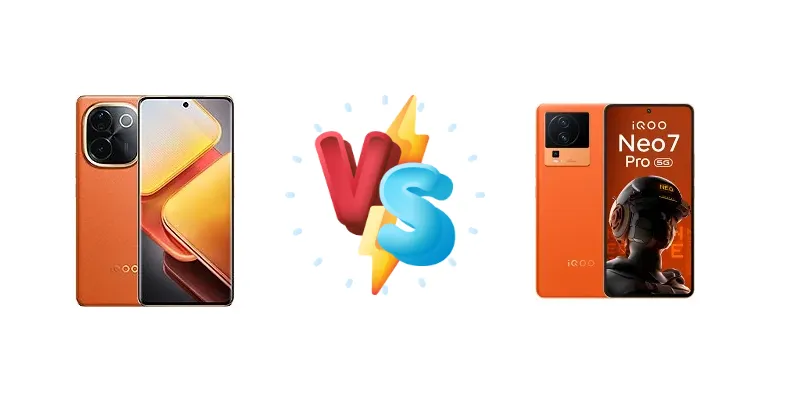
The vivo iQOO Z9s Pro represents a more recent entry into the mid-range market, leveraging the newer Snapdragon 7 Gen 3. However, it faces stiff competition from the iQOO Neo 7 Pro, which boasts the older but still potent Snapdragon 8+ Gen 1. This comparison dissects the key differences to determine which device delivers the best experience for your money.
🏆 Quick Verdict
For most users, the iQOO Neo 7 Pro emerges as the stronger choice. While the Z9s Pro offers a newer chipset, the 8+ Gen 1 in the Neo 7 Pro provides a significant performance uplift, particularly in sustained workloads, and its 120W charging dramatically reduces downtime. The Z9s Pro is a viable option for budget-conscious users prioritizing efficiency.
| Network |
|---|
| 2G bands | GSM 850 / 900 / 1800 / 1900 | GSM 850 / 900 / 1800 / 1900 |
| 3G bands | HSDPA 850 / 900 / 2100 | HSDPA 800 / 850 / 900 / 1700(AWS) / 1900 / 2100 |
| 4G bands | 1, 3, 5, 8, 28, 38, 40, 41 | 1, 2, 3, 4, 5, 8, 28, 34, 38, 39, 40, 41 |
| 5G bands | 1, 3, 5, 8, 28, 40, 77, 78 SA/NSA | 1, 3, 5, 8, 28, 40, 77, 78 SA/NSA |
| Speed | HSPA, LTE, 5G | HSPA, LTE, 5G |
| Technology | GSM / HSPA / LTE / 5G | GSM / HSPA / LTE / 5G |
| Launch |
|---|
| Announced | 2024, August 21 | 2023, July 04 |
| Status | Available. Released 2024, August 23 | Available. Released 2023, July 15 |
| Body |
|---|
| Build | - | Glass front, plastic frame, glass or leather back |
| Dimensions | 163.7 x 75 x 7.5 or 8.0 mm | 164.8 x 76.9 x 8.5 mm or 8.9 mm |
| SIM | Nano-SIM + Nano-SIM | Nano-SIM + Nano-SIM |
| Weight | 185 g or 190 g (6.53 oz) | 197 g or 202 g (6.95 oz) |
| Display |
|---|
| Protection | Schott Xensation | - |
| Resolution | 1080 x 2392 pixels (~388 ppi density) | 1080 x 2400 pixels, 20:9 ratio (~388 ppi density) |
| Size | 6.77 inches, 110.9 cm2 (~90.3% screen-to-body ratio) | 6.78 inches, 111.0 cm2 (~87.6% screen-to-body ratio) |
| Type | AMOLED, 1B colors, 120Hz, HDR10+, 4500 nits (peak) | AMOLED, 1B colors, 120Hz, HDR10+, 1300 nits (peak) |
| Platform |
|---|
| CPU | Octa-core (1x2.63 GHz Cortex-A715 & 3x2.4 GHz Cortex-A715 & 4x1.8 GHz Cortex-A510) | Octa-core (1x3.19 GHz Cortex-X2 & 3x2.75 GHz Cortex-A710 & 4x2.0 GHz Cortex-A510) |
| Chipset | Qualcomm SM7550-AB Snapdragon 7 Gen 3 (4 nm) | Qualcomm SM8475 Snapdragon 8+ Gen 1 (4 nm) |
| GPU | Adreno 720 | Adreno 730 |
| OS | Android 14, up to 2 major Android upgrades, Funtouch 14 | Android 13, Funtouch 13 |
| Memory |
|---|
| Card slot | No | No |
| Internal | 128GB 8GB RAM, 256GB 8GB RAM, 256GB 12GB RAM | 128GB 8GB RAM, 256GB 12GB RAM |
| Main Camera |
|---|
| Dual | 50 MP, f/1.8, (wide), 1/1.95", 0.8µm, PDAF, OIS
8 MP, f/2.2, 120˚ (ultrawide) | - |
| Features | LED flash, panorama, HDR | LED flash, HDR, panorama |
| Triple | - | 50 MP, f/1.9, 24mm (wide), 1/1.57", 1.0µm, PDAF, OIS
8 MP, f/2.2, 16mm (ultrawide), 1/4.0", 1.12µm
2 MP (macro) |
| Video | 4K@30fps, 1080p@30/60fps, gyro-EIS, OIS | 4K@30fps, 1080p@30fps |
| Selfie camera |
|---|
| Features | - | HDR |
| Single | 16 MP, f/2.5, (wide), 1/3.0", 1.0µm | 16 MP, f/2.5, (wide), 1/3.1", 1.0µm |
| Video | 1080p@30fps | 1080p@30fps |
| Sound |
|---|
| 35mm jack | No | No |
| Loudspeaker | Yes, with stereo speakers | Yes, with stereo speakers |
| Comms |
|---|
| Bluetooth | 5.4, A2DP, LE | 5.3, A2DP, LE, aptX HD, aptX Adaptive |
| Infrared port | - | Yes |
| NFC | No | No |
| Positioning | GPS, GALILEO, GLONASS, BDS, QZSS | GPS, GLONASS, GALILEO, BDS, QZSS, NavIC |
| Radio | FM radio | No |
| USB | USB Type-C 2.0, OTG | USB Type-C 2.0, OTG |
| WLAN | Wi-Fi 802.11 a/b/g/n/ac/6, dual-band | Wi-Fi 802.11 a/b/g/n/ac/6, dual-band, Wi-Fi Direct |
| Features |
|---|
| Sensors | Fingerprint (under display, optical), accelerometer, gyro, proximity, compass | Fingerprint (under display, optical), accelerometer, gyro, proximity, compass |
| Battery |
|---|
| Charging | 80W wired, 50% in 21 min
7.5W reverse wired | 120W wired, 50% in 8 min |
| Type | Li-Ion 5500 mAh | 5000 mAh |
| Misc |
|---|
| Colors | Flamboyant Orange, Luxe Marble | Fearless Flame, Dark Storm |
| Models | I2305 | I2217 |
| Price | About 270 EUR | About 380 EUR |
vivo iQOO Z9s Pro
- Newer Snapdragon 7 Gen 3 chipset
- 80W fast charging
- 7.5W reverse wired charging
- Lower peak performance compared to Snapdragon 8+ Gen 1
- Slower charging speed than Neo 7 Pro
vivo iQOO Neo 7 Pro
- More powerful Snapdragon 8+ Gen 1 chipset
- Ultra-fast 120W charging
- Likely superior gaming performance
- Older chipset architecture
- Potentially higher thermal output
Display Comparison
Both devices utilize 4nm chipsets, suggesting a focus on efficiency. However, display specifications are not provided in the context data. Based on iQOO’s typical positioning, we can infer the Neo 7 Pro likely features a higher refresh rate panel (potentially 120Hz vs 90Hz on the Z9s Pro) and potentially higher peak brightness. The Neo 7 Pro, being a slightly older model, may have marginally larger bezels. Color accuracy is likely comparable, with both aiming for wide color gamut coverage.
Camera Comparison
Camera details are absent from the provided data. However, given the Neo 7 Pro’s positioning as a more premium device, it likely features a larger main sensor and potentially optical image stabilization (OIS). The Z9s Pro may rely more heavily on software processing to compensate for a potentially smaller sensor. The inclusion of a 2MP macro camera on either device is largely inconsequential; image quality from such sensors is typically poor. The real differentiator will be the image signal processor (ISP) within each chipset and iQOO’s image processing algorithms.
Performance
The core difference lies in the chipsets. The iQOO Neo 7 Pro’s Snapdragon 8+ Gen 1 (3.19 GHz peak) significantly outperforms the Z9s Pro’s Snapdragon 7 Gen 3 (2.63 GHz peak). The 8+ Gen 1’s Cortex-X2 prime core provides a substantial advantage in single-core tasks, while its more powerful Adreno GPU delivers superior graphics performance. While the 7 Gen 3 benefits from a newer architecture, the raw horsepower of the 8+ Gen 1 is undeniable. The Neo 7 Pro’s LPDDR5x RAM further enhances its performance capabilities. Thermal management will be crucial; the 8+ Gen 1 is known to generate more heat, but iQOO’s cooling solutions are typically robust.
Battery Life
The iQOO Neo 7 Pro’s 120W charging is a game-changer, achieving a 50% charge in just 8 minutes. The Z9s Pro’s 80W charging, while still fast, takes 21 minutes for the same 50% charge. This difference in charging speed significantly impacts user convenience. Battery capacity is not specified, but the faster charging of the Neo 7 Pro effectively mitigates any potential disadvantage from a slightly smaller battery. The 7.5W reverse wired charging on the Z9s Pro is a useful addition for topping up accessories.
Buying Guide
Buy the vivo iQOO Z9s Pro if you prioritize a newer chipset for potential future software support and are comfortable with slightly lower peak performance and slower charging. Buy the vivo iQOO Neo 7 Pro if you demand maximum performance for gaming and demanding applications, and value the convenience of incredibly fast 120W charging, even if it means an older processor.
Frequently Asked Questions
❓ Will the Snapdragon 8+ Gen 1 in the iQOO Neo 7 Pro overheat during prolonged gaming sessions?
The Snapdragon 8+ Gen 1 is known to generate heat under sustained load. However, iQOO typically implements robust cooling solutions, including vapor chamber cooling, to mitigate thermal throttling. While some performance reduction may occur during extended gaming, the Neo 7 Pro is generally well-equipped to handle demanding games.
❓ Is the 80W charging on the iQOO Z9s Pro fast enough for daily use?
80W charging is still considered fast and will provide a significant top-up in a short amount of time. However, compared to the Neo 7 Pro’s 120W charging, it’s noticeably slower. If you frequently find yourself needing to quickly recharge your phone, the Neo 7 Pro’s charging speed is a substantial advantage.
❓ Does the Snapdragon 7 Gen 3 in the iQOO Z9s Pro offer sufficient performance for popular games like PUBG Mobile and Call of Duty Mobile?
Yes, the Snapdragon 7 Gen 3 is capable of running popular games like PUBG Mobile and Call of Duty Mobile at high settings. However, you may experience slightly lower frame rates and potentially more noticeable frame drops compared to the Neo 7 Pro, especially during intense battles.