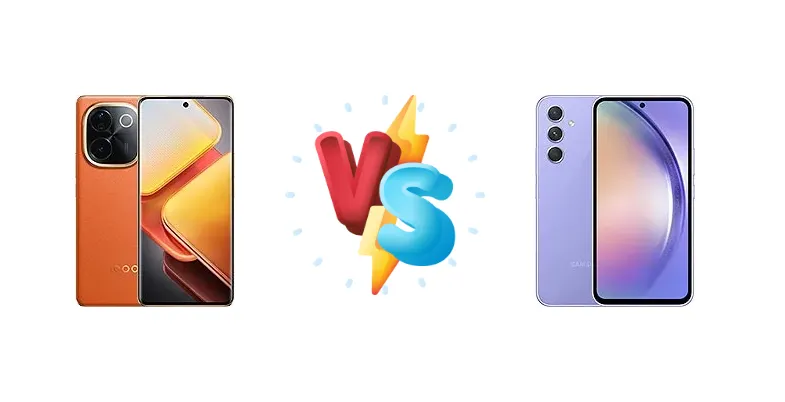
The iQOO Z9s Pro and Samsung Galaxy A54 represent compelling options in the competitive mid-range smartphone market. The iQOO Z9s Pro aggressively targets performance with its newer Snapdragon 7 Gen 3 chipset and rapid 80W charging, while the Galaxy A54 emphasizes a refined user experience, strong battery endurance, and Samsung’s established camera expertise. This comparison dissects their key differences to help you choose the right device.
🏆 Quick Verdict
For users prioritizing raw performance and incredibly fast charging, the iQOO Z9s Pro is the clear winner. However, the Samsung Galaxy A54 offers a more balanced package with excellent battery life and a polished software experience, making it ideal for everyday users who value longevity and reliability.
| Network |
|---|
| 2G bands | GSM 850 / 900 / 1800 / 1900 | GSM 850 / 900 / 1800 / 1900 |
| 3G bands | HSDPA 850 / 900 / 2100 | HSDPA 850 / 900 / 1700(AWS) / 1900 / 2100 |
| 4G bands | 1, 3, 5, 8, 28, 38, 40, 41 | 1, 2, 3, 4, 5, 7, 8, 12, 17, 20, 26, 28, 32, 38, 40, 41, 66 - International |
| 5G bands | 1, 3, 5, 8, 28, 40, 77, 78 SA/NSA | 1, 3, 7, 8, 20, 28, 38, 40, 41, 77, 78 SA/NSA/Sub6 - International |
| Speed | HSPA, LTE, 5G | HSPA, LTE, 5G |
| Technology | GSM / HSPA / LTE / 5G | GSM / HSPA / LTE / 5G |
| | - | 25, 41, 66, 71 SA/NSA/Sub6/mmWave - USA |
| Launch |
|---|
| Announced | 2024, August 21 | 2023, March 15 |
| Status | Available. Released 2024, August 23 | Available. Released 2023, March 24 |
| Body |
|---|
| Build | - | Glass front (Gorilla Glass 5), glass back (Gorilla Glass 5), plastic frame |
| Dimensions | 163.7 x 75 x 7.5 or 8.0 mm | 158.2 x 76.7 x 8.2 mm (6.23 x 3.02 x 0.32 in) |
| SIM | Nano-SIM + Nano-SIM | · Nano-SIM + eSIM· Nano-SIM + Nano-SIM |
| Weight | 185 g or 190 g (6.53 oz) | 202 g (7.13 oz) |
| | - | IP67 dust/water resistant (up to 1m for 30 min) |
| Display |
|---|
| Protection | Schott Xensation | Corning Gorilla Glass 5 |
| Resolution | 1080 x 2392 pixels (~388 ppi density) | 1080 x 2340 pixels, 19.5:9 ratio (~403 ppi density) |
| Size | 6.77 inches, 110.9 cm2 (~90.3% screen-to-body ratio) | 6.4 inches, 100.5 cm2 (~82.9% screen-to-body ratio) |
| Type | AMOLED, 1B colors, 120Hz, HDR10+, 4500 nits (peak) | Super AMOLED, 120Hz, HDR10+, 1000 nits (HBM) |
| Platform |
|---|
| CPU | Octa-core (1x2.63 GHz Cortex-A715 & 3x2.4 GHz Cortex-A715 & 4x1.8 GHz Cortex-A510) | Octa-core (4x2.4 GHz Cortex-A78 & 4x2.0 GHz Cortex-A55) |
| Chipset | Qualcomm SM7550-AB Snapdragon 7 Gen 3 (4 nm) | Exynos 1380 (5 nm) |
| GPU | Adreno 720 | Mali-G68 MP5 |
| OS | Android 14, up to 2 major Android upgrades, Funtouch 14 | Android 13, up to 4 major Android upgrades, One UI 7 |
| Memory |
|---|
| Card slot | No | microSDXC (uses shared SIM slot) |
| Internal | 128GB 8GB RAM, 256GB 8GB RAM, 256GB 12GB RAM | 128GB 4GB RAM, 128GB 6GB RAM, 128GB 8GB RAM, 256GB 6GB RAM, 256GB 8GB RAM |
| Main Camera |
|---|
| Dual | 50 MP, f/1.8, (wide), 1/1.95", 0.8µm, PDAF, OIS
8 MP, f/2.2, 120˚ (ultrawide) | - |
| Features | LED flash, panorama, HDR | LED flash, panorama, HDR |
| Single | - | 32 MP, f/2.2, 26mm (wide), 1/2.8", 0.8µm |
| Triple | - | 50 MP, f/1.8, 23mm (wide), 1/1.56", 1.0µm, PDAF, OIS
12 MP, f/2.2, 13mm, 123˚ (ultrawide), 1/3.X", 1.12µm
5 MP (macro) |
| Video | 4K@30fps, 1080p@30/60fps, gyro-EIS, OIS | 4K@30fps, 1080p@30/60fps, 720p@480fps, gyro-EIS |
| Selfie camera |
|---|
| Single | 16 MP, f/2.5, (wide), 1/3.0", 1.0µm | 32 MP, f/2.2, 26mm (wide), 1/2.8", 0.8µm |
| Video | 1080p@30fps | 4K@30fps, 1080p@30/60fps |
| Sound |
|---|
| 3.5mm jack | - | No |
| 35mm jack | No | No |
| Loudspeaker | Yes, with stereo speakers | Yes, with stereo speakers |
| Comms |
|---|
| Bluetooth | 5.4, A2DP, LE | 5.3, A2DP, LE |
| NFC | No | Yes (market/region dependent) |
| Positioning | GPS, GALILEO, GLONASS, BDS, QZSS | GPS, GLONASS, GALILEO, BDS |
| Radio | FM radio | No |
| USB | USB Type-C 2.0, OTG | USB Type-C 2.0, OTG |
| WLAN | Wi-Fi 802.11 a/b/g/n/ac/6, dual-band | Wi-Fi 802.11 a/b/g/n/ac/6, dual-band, Wi-Fi Direct |
| Features |
|---|
| Sensors | Fingerprint (under display, optical), accelerometer, gyro, proximity, compass | Fingerprint (under display, optical), accelerometer, gyro, compass, barometer (USA only) |
| | - | Virtual proximity sensing |
| Battery |
|---|
| Charging | 80W wired, 50% in 21 min
7.5W reverse wired | 25W wired |
| Type | Li-Ion 5500 mAh | 5000 mAh |
| Misc |
|---|
| Colors | Flamboyant Orange, Luxe Marble | Lime, Graphite, Violet, White |
| Models | I2305 | SM-A546V, SM-A546U, SM-A546U1, SM-A546B, SM-A546B/DS, SM-A546E, SM-A546E/DS, SM-A5460, SM-A546M, SM-A546M/DS, SM-A546W |
| Price | About 270 EUR | € 210.00 / $ 119.11 / £ 169.95 / ₹ 28,999 |
| SAR | - | 0.81 W/kg (head) 0.67 W/kg (body) |
| SAR EU | - | 0.69 W/kg (head) 1.34 W/kg (body) |
| Tests |
|---|
| Battery life | - |
Endurance rating 119h
|
| Camera | - |
Photo / Video |
| Display | - |
Contrast ratio: Infinite (nominal) |
| Loudspeaker | - |
-26.6 LUFS (Good)
|
| Performance | - |
AnTuTu: 506678 (v9)
GeekBench: 2703 (v5.1), 2797 (v6)
GFXBench: 25fps (ES 3.1 onscreen) |
vivo iQOO Z9s Pro
- Significantly faster charging (80W)
- More powerful Snapdragon 7 Gen 3 chipset
- Potentially better thermal management due to 4nm process
- Battery life potentially lower than Galaxy A54
- Camera specs unknown, potential for inconsistent results
Samsung Galaxy A54
- Excellent battery life (119h endurance)
- Bright and vibrant display (980 nits)
- Refined software experience and established brand reputation
- Slower charging speed (25W)
- Less powerful Exynos 1380 chipset
Display Comparison
The Samsung Galaxy A54 boasts a 980 nits peak brightness, ensuring excellent visibility even in direct sunlight. While the iQOO Z9s Pro’s display specs are not provided, Samsung’s display technology is known for its color accuracy and viewing angles. The Galaxy A54’s ‘Infinite’ contrast ratio (nominal) suggests a strong AMOLED panel, likely offering deeper blacks and more vibrant colors. Without specific details on the iQOO Z9s Pro’s panel type, the A54 holds a clear advantage in display quality based on its measured brightness and established Samsung display reputation.
Camera Comparison
Both devices offer photo and video capabilities, but detailed sensor information is limited for the iQOO Z9s Pro. The Galaxy A54 likely features a more refined camera system, benefiting from Samsung’s image processing algorithms and potentially offering better low-light performance. Without knowing the main sensor size or aperture of the iQOO Z9s Pro, it’s difficult to make a direct comparison. The A54’s camera system is known for its consistent results and user-friendly interface. It's reasonable to assume the A54 will deliver more consistent and reliable image quality across various shooting conditions.
Performance
The iQOO Z9s Pro’s Qualcomm Snapdragon 7 Gen 3 (4nm) chipset represents a significant leap in efficiency and performance compared to the Samsung Galaxy A54’s Exynos 1380 (5nm). The 4nm process node of the Snapdragon allows for greater transistor density and reduced heat generation, potentially leading to sustained performance during intensive tasks. While the Exynos 1380 utilizes a Cortex-A78 core configuration, the iQOO Z9s Pro leverages Cortex-A715 cores, which offer architectural improvements. This translates to faster application loading, smoother multitasking, and a more responsive gaming experience on the iQOO Z9s Pro. The iQOO's CPU configuration (1x2.63 GHz Cortex-A715 & 3x2.4 GHz Cortex-A715 & 4x1.8 GHz Cortex-A510) suggests a focus on sustained performance, while the A54's (4x2.4 GHz Cortex-A78 & 4x2.0 GHz Cortex-A55) is more balanced.
Battery Life
The Samsung Galaxy A54 boasts an impressive endurance rating of 119 hours and an active use score of 11:15h, demonstrating excellent battery life. The iQOO Z9s Pro compensates for potentially lower battery capacity with its blazing-fast 80W wired charging, capable of reaching 50% charge in just 21 minutes. This is a substantial advantage over the Galaxy A54’s 25W charging. While the A54 excels in longevity, the iQOO Z9s Pro prioritizes convenience, allowing users to quickly top up their battery when needed. The 7.5W reverse wired charging on the iQOO Z9s Pro is a useful addition for charging accessories.
Buying Guide
Buy the vivo iQOO Z9s Pro if you need a phone for demanding mobile gaming, frequently transfer large files, or value the convenience of extremely fast charging. Buy the Samsung Galaxy A54 if you prefer a phone with a consistently smooth experience, exceptional battery life for all-day use, and a well-regarded camera system for capturing everyday moments.
Frequently Asked Questions
❓ Does the Exynos 1380 in the Galaxy A54 tend to overheat during prolonged gaming sessions?
The Exynos 1380 is generally efficient, but can experience some throttling under sustained heavy load. While not a severe issue, users engaging in extended gaming may notice a slight performance dip after a while. The iQOO Z9s Pro's Snapdragon 7 Gen 3, built on a 4nm process, is better equipped to handle sustained performance without significant throttling.
❓ Is the 80W charging on the iQOO Z9s Pro compatible with Power Delivery (PD) chargers?
While the iQOO Z9s Pro supports 80W charging, it's crucial to use a compatible charger to achieve those speeds. It's likely to support PD, but confirm compatibility with the charger's specifications to ensure optimal charging performance and avoid potential issues.
❓ How does the software experience differ between iQOO's Funtouch OS and Samsung's One UI?
Samsung's One UI is known for its feature-rich interface and polished user experience. iQOO's Funtouch OS, while improving, historically has been more customized and may include pre-installed apps. One UI generally offers more consistent updates and a wider range of customization options.
❓ What kind of gaming performance can I expect from the iQOO Z9s Pro with titles like PUBG Mobile and Genshin Impact?
The Snapdragon 7 Gen 3 in the iQOO Z9s Pro should deliver a smooth gaming experience in PUBG Mobile, likely achieving high frame rates with balanced graphics settings. Genshin Impact may require slightly lower settings to maintain consistent performance, but the chipset is capable of running the game effectively.