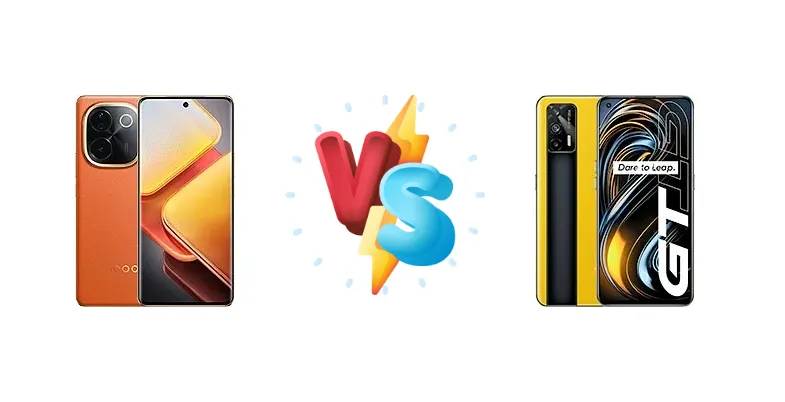
The iQOO Z9s Pro and Realme GT 5G represent distinct approaches to the mid-range smartphone market. The Z9s Pro, powered by the newer Snapdragon 7 Gen 3, focuses on efficiency and sustained performance. Conversely, the Realme GT 5G, with its older but more powerful Snapdragon 888, aims for peak performance, even if it comes at the cost of thermal management. This comparison will dissect their strengths and weaknesses to determine which device best suits your needs.
🏆 Quick Verdict
For the average user prioritizing all-day battery life and consistent performance, the iQOO Z9s Pro is the better choice. Its Snapdragon 7 Gen 3 offers a compelling balance of power and efficiency, coupled with faster 80W charging. However, the Realme GT 5G remains a strong contender for users who prioritize raw processing power and don't mind potential throttling under heavy load.
| Network |
|---|
| 2G bands | GSM 850 / 900 / 1800 / 1900 | GSM 850 / 900 / 1800 / 1900 |
| 3G bands | HSDPA 850 / 900 / 2100 | HSDPA 850 / 900 / 1700(AWS) / 1900 / 2100 |
| 4G bands | 1, 3, 5, 8, 28, 38, 40, 41 | 1, 2, 3, 4, 5, 7, 8, 12, 17, 18, 19, 20, 26, 34, 38, 39, 40, 41 |
| 5G bands | 1, 3, 5, 8, 28, 40, 77, 78 SA/NSA | 1, 3, 28, 41, 77, 78, 79 SA/NSA |
| Speed | HSPA, LTE, 5G | HSPA, LTE, 5G |
| Technology | GSM / HSPA / LTE / 5G | GSM / CDMA / HSPA / EVDO / LTE / 5G |
| | - | CDMA2000 1xEV-DO |
| Launch |
|---|
| Announced | 2024, August 21 | 2021, March 04 |
| Status | Available. Released 2024, August 23 | Available. Released 2021, March 10 |
| Body |
|---|
| Build | - | Glass front, glass back or eco leather back, plastic frame |
| Dimensions | 163.7 x 75 x 7.5 or 8.0 mm | 158.5 x 73.3 x 8.4 mm (Glass) / 9.1 mm (Leather) |
| SIM | Nano-SIM + Nano-SIM | Nano-SIM + Nano-SIM |
| Weight | 185 g or 190 g (6.53 oz) | 186 g (6.56 oz) |
| Display |
|---|
| Protection | Schott Xensation | - |
| Resolution | 1080 x 2392 pixels (~388 ppi density) | 1080 x 2400 pixels, 20:9 ratio (~409 ppi density) |
| Size | 6.77 inches, 110.9 cm2 (~90.3% screen-to-body ratio) | 6.43 inches, 99.8 cm2 (~85.9% screen-to-body ratio) |
| Type | AMOLED, 1B colors, 120Hz, HDR10+, 4500 nits (peak) | Super AMOLED, 120Hz, HDR10+ |
| Platform |
|---|
| CPU | Octa-core (1x2.63 GHz Cortex-A715 & 3x2.4 GHz Cortex-A715 & 4x1.8 GHz Cortex-A510) | Octa-core (1x2.84 GHz Cortex-X1 & 3x2.42 GHz Cortex-A78 & 4x1.80 GHz Cortex-A55 |
| Chipset | Qualcomm SM7550-AB Snapdragon 7 Gen 3 (4 nm) | Qualcomm SM8350 Snapdragon 888 5G (5 nm) |
| GPU | Adreno 720 | Adreno 660 |
| OS | Android 14, up to 2 major Android upgrades, Funtouch 14 | Android 11, upgradable to Android 14, Realme UI 5.0 |
| Memory |
|---|
| Card slot | No | No |
| Internal | 128GB 8GB RAM, 256GB 8GB RAM, 256GB 12GB RAM | 128GB 8GB RAM, 256GB 12GB RAM |
| | - | UFS 3.1 |
| Main Camera |
|---|
| Dual | 50 MP, f/1.8, (wide), 1/1.95", 0.8µm, PDAF, OIS
8 MP, f/2.2, 120˚ (ultrawide) | - |
| Features | LED flash, panorama, HDR | Dual-LED dual-tone flash, HDR, panorama |
| Triple | - | 64 MP, f/1.8, 26mm (wide), 1/1.73", 0.8µm, PDAF
8 MP, f/2.3, 16mm, 119˚ (ultrawide), 1/4.0", 1.12µm
2 MP (macro) |
| Video | 4K@30fps, 1080p@30/60fps, gyro-EIS, OIS | 4K@30/60fps, 1080p@30/60/240fps, gyro-EIS |
| Selfie camera |
|---|
| Features | - | HDR, panorama |
| Single | 16 MP, f/2.5, (wide), 1/3.0", 1.0µm | 16 MP, f/2.5, 26mm (wide), 1/3.0", 1.0µm |
| Video | 1080p@30fps | 1080p@30fps |
| Sound |
|---|
| 3.5mm jack | - | Yes |
| 35mm jack | No | Yes |
| Loudspeaker | Yes, with stereo speakers | Yes, with stereo speakers |
| | - | 24-bit/192kHz audio |
| Comms |
|---|
| Bluetooth | 5.4, A2DP, LE | 5.2, A2DP, LE, aptX HD |
| NFC | No | Yes |
| Positioning | GPS, GALILEO, GLONASS, BDS, QZSS | GPS (L1+L5), GLONASS, BDS, GALILEO, QZSS |
| Radio | FM radio | No |
| USB | USB Type-C 2.0, OTG | USB Type-C 2.0, OTG |
| WLAN | Wi-Fi 802.11 a/b/g/n/ac/6, dual-band | Wi-Fi 802.11 a/b/g/n/ac/6, dual-band, Wi-Fi Direct |
| Features |
|---|
| Sensors | Fingerprint (under display, optical), accelerometer, gyro, proximity, compass | Fingerprint (under display, optical), accelerometer, gyro, proximity, compass |
| Battery |
|---|
| Charging | 80W wired, 50% in 21 min
7.5W reverse wired | 65W wired, 100% in 35 min |
| Type | Li-Ion 5500 mAh | 4500 mAh |
| Misc |
|---|
| Colors | Flamboyant Orange, Luxe Marble | Gold/Black, Blue, Silver |
| Models | I2305 | RMX2202 |
| Price | About 270 EUR | About 330 EUR |
| Tests |
|---|
| Battery life | - |
Endurance rating 98h
|
| Camera | - |
Photo / Video |
| Display | - |
Contrast ratio: Infinite (nominal) |
| Loudspeaker | - |
-24.5 LUFS (Very good)
|
| Performance | - |
AnTuTu: 703986 (v8), 810433 (v9)
GeekBench: 3555 (v5.1)
GFXBench: 55fps (ES 3.1 onscreen) |
vivo iQOO Z9s Pro
- More efficient Snapdragon 7 Gen 3 chipset
- Faster 80W wired charging
- 7.5W reverse wired charging
- Performance may not match the Snapdragon 888 in peak loads
- Display specifications currently unknown
Realme GT 5G
- More powerful Snapdragon 888 chipset for peak performance
- Excellent 98-hour endurance rating
- 650 nits peak brightness
- Snapdragon 888 prone to thermal throttling
- Slower 65W charging
Display Comparison
The Realme GT 5G boasts a measured peak brightness of 650 nits, which is respectable, but the iQOO Z9s Pro’s display specifications are currently unavailable. Given the market positioning, we anticipate a similar brightness level. The Realme GT 5G’s ‘Infinite’ contrast ratio is a marketing term; real-world contrast will depend on the panel technology. Without knowing the panel type of the iQOO Z9s Pro, it’s difficult to assess color accuracy, but both devices likely utilize AMOLED panels common in this price bracket. The absence of LTPO technology on either device suggests standard refresh rate management, impacting power consumption.
Camera Comparison
Both phones offer photo and video capabilities, but detailed camera specifications are limited. Without sensor size or aperture information, a direct comparison is difficult. The Realme GT 5G likely benefits from the image signal processor (ISP) within the Snapdragon 888, potentially offering better image processing. The presence of a 2MP macro camera on either device is largely inconsequential; image quality will be limited by the small sensor size. The iQOO Z9s Pro’s camera performance will depend heavily on its primary sensor and software optimization.
Performance
The core difference lies in the chipsets. The Realme GT 5G’s Snapdragon 888 (5nm) features a Cortex-X1 prime core clocked at 2.84 GHz, offering peak performance. However, the Snapdragon 7 Gen 3 (4nm) in the iQOO Z9s Pro, while clocked lower at 2.63 GHz on its Cortex-A715 prime core, benefits from a more efficient manufacturing process. This 4nm node translates to better thermal efficiency, potentially mitigating throttling during sustained workloads. The CPU configuration of the Z9s Pro (1x2.63GHz Cortex-A715, 3x2.4GHz Cortex-A715, 4x1.8GHz Cortex-A510) is designed for balanced performance, while the GT 5G’s (1x2.84 GHz Cortex-X1, 3x2.42 GHz Cortex-A78, 4x1.80 GHz Cortex-A55) prioritizes raw speed. RAM specifications are currently unknown for the iQOO Z9s Pro, but both devices likely utilize LPDDR5 RAM, impacting application loading times and multitasking.
Battery Life
The Realme GT 5G boasts an endurance rating of 98 hours, indicating excellent battery life. However, the Snapdragon 888 is known to be power-hungry. The iQOO Z9s Pro’s battery capacity is unknown, but its more efficient Snapdragon 7 Gen 3 chipset should deliver competitive endurance. The Z9s Pro’s 80W wired charging is significantly faster than the GT 5G’s 65W, achieving 50% charge in just 21 minutes compared to the GT 5G’s 100% charge in 35 minutes. The Z9s Pro also offers 7.5W reverse wired charging, a feature absent on the GT 5G.
Buying Guide
Buy the vivo iQOO Z9s Pro if you need a phone that can comfortably handle daily tasks, moderate gaming, and offers excellent battery life with rapid charging. It's ideal for users who value efficiency and long-term usability. Buy the Realme GT 5G if you prefer a phone capable of maximum performance for demanding games and applications, and are willing to accept potentially shorter battery life and the possibility of thermal throttling during extended intensive use.
Frequently Asked Questions
❓ Will the Snapdragon 888 in the Realme GT 5G overheat during prolonged gaming sessions?
The Snapdragon 888 is known to generate significant heat under sustained load. While the Realme GT 5G likely incorporates thermal management solutions, users should expect some degree of throttling during extended gaming sessions, potentially impacting frame rates and performance consistency.
❓ How does the Snapdragon 7 Gen 3 in the iQOO Z9s Pro handle demanding games like PUBG or Genshin Impact?
The Snapdragon 7 Gen 3 is a capable chipset that can handle popular games like PUBG and Genshin Impact at medium to high settings. While it won't match the peak performance of the Snapdragon 888, its improved efficiency will result in more stable frame rates and less thermal throttling during extended gameplay.
❓ Is the 80W charging on the iQOO Z9s Pro safe for long-term battery health?
80W charging is considered fast, but modern smartphones incorporate battery management systems to mitigate potential damage from rapid charging. While extremely fast charging *can* theoretically contribute to faster battery degradation over years of use, the convenience and speed offered by 80W charging generally outweigh the minimal long-term impact.