
iQOO Z9s Pro vs Nothing Phone (2): A Deep Dive into Performance and Value
| Phones Images | |||||
|---|---|---|---|---|---|
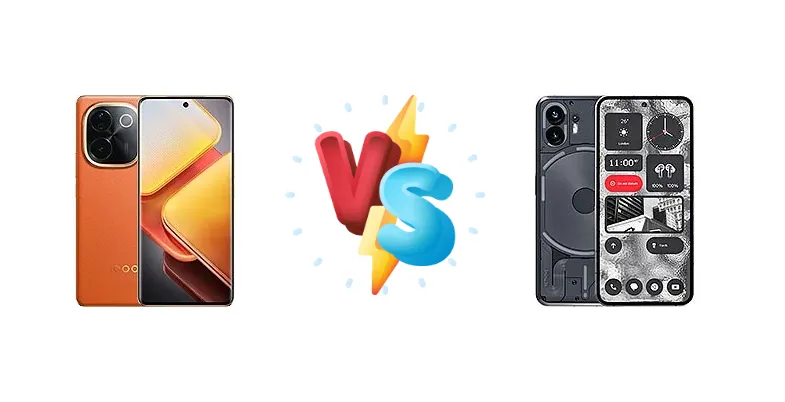
|
🏆 Quick Verdict
For the average user prioritizing all-around experience and a distinctive design, the Nothing Phone (2) emerges as the stronger contender. However, the iQOO Z9s Pro’s blazing-fast 80W charging and competitive Snapdragon 7 Gen 3 chipset make it a compelling choice for users who prioritize speed and value.
| PHONES | ||
|---|---|---|
| Phone Names | vivo iQOO Z9s Pro | Nothing Phone (2) |
| Network | ||
|---|---|---|
| 2G bands | GSM 850 / 900 / 1800 / 1900 | GSM 850 / 900 / 1800 / 1900 |
| 3G bands | HSDPA 850 / 900 / 2100 | HSDPA 800 / 850 / 900 / 1700(AWS) / 1900 / 2100 |
| 4G bands | 1, 3, 5, 8, 28, 38, 40, 41 | 1, 2, 3, 4, 5, 7, 8, 12, 17, 18, 19, 20, 25, 26, 28, 30, 32, 34, 38, 39, 40, 41, 42, 48, 66, 71 |
| 5G bands | 1, 3, 5, 8, 28, 40, 77, 78 SA/NSA | 1, 2, 3, 5, 7, 8, 12, 20, 25, 28, 30, 38, 40, 41, 66, 71, 75, 77, 78 SA/NSA |
| Speed | HSPA, LTE, 5G | HSPA, LTE, 5G |
| Technology | GSM / HSPA / LTE / 5G | GSM / HSPA / LTE / 5G |
| Launch | ||
|---|---|---|
| Announced | 2024, August 21 | 2023, July 11 |
| Status | Available. Released 2024, August 23 | Available. Released 2023, July 17 |
| Body | ||
|---|---|---|
| Build | - | Glass front (Gorilla Glass 5), glass back (Gorilla Glass 5), aluminum frame |
| Dimensions | 163.7 x 75 x 7.5 or 8.0 mm | 162.1 x 76.4 x 8.6 mm (6.38 x 3.01 x 0.34 in) |
| SIM | Nano-SIM + Nano-SIM | Nano-SIM + Nano-SIM |
| Weight | 185 g or 190 g (6.53 oz) | 201.2 g (7.09 oz) |
| Display | ||
|---|---|---|
| Protection | Schott Xensation | Corning Gorilla Glass 5 |
| Resolution | 1080 x 2392 pixels (~388 ppi density) | 1080 x 2412 pixels, 20:9 ratio (~394 ppi density) |
| Size | 6.77 inches, 110.9 cm2 (~90.3% screen-to-body ratio) | 6.7 inches, 108.0 cm2 (~87.2% screen-to-body ratio) |
| Type | AMOLED, 1B colors, 120Hz, HDR10+, 4500 nits (peak) | LTPO OLED, 1B colors, 120Hz, 1920Hz PWM, HDR10+, 1600 nits (HBM), 1600 nits (peak) |
| Platform | ||
|---|---|---|
| CPU | Octa-core (1x2.63 GHz Cortex-A715 & 3x2.4 GHz Cortex-A715 & 4x1.8 GHz Cortex-A510) | Octa-core (1x3.0 GHz Cortex-X2 & 3x2.5 GHz Cortex-A710 & 4x1.80 GHz Cortex-A510) |
| Chipset | Qualcomm SM7550-AB Snapdragon 7 Gen 3 (4 nm) | Qualcomm SM8475 Snapdragon 8+ Gen 1 (4 nm) |
| GPU | Adreno 720 | Adreno 730 |
| OS | Android 14, up to 2 major Android upgrades, Funtouch 14 | Android 13, upgradable to Android 15, up to 3 major Android upgrades, Nothing OS 3.0 |
| Memory | ||
|---|---|---|
| Card slot | No | No |
| Internal | 128GB 8GB RAM, 256GB 8GB RAM, 256GB 12GB RAM | 128GB 8GB RAM, 256GB 12GB RAM, 512GB 12GB RAM |
| Main Camera | ||
|---|---|---|
| Dual | 50 MP, f/1.8, (wide), 1/1.95", 0.8µm, PDAF, OIS 8 MP, f/2.2, 120˚ (ultrawide) | 50 MP, f/1.9, 24mm (wide), 1/1.56", 1.0µm, PDAF, OIS 50 MP, f/2.2, 114˚ (ultrawide), 1/2.76", 0.64µm, AF |
| Features | LED flash, panorama, HDR | LED flash, panorama, HDR |
| Video | 4K@30fps, 1080p@30/60fps, gyro-EIS, OIS | 4K@30/60fps, 1080p@30/60fps, gyro-EIS, live HDR, OIS |
| Selfie camera | ||
|---|---|---|
| Features | - | HDR |
| Single | 16 MP, f/2.5, (wide), 1/3.0", 1.0µm | 32 MP, f/2.5, (wide), 1/2.74", 0.8µm |
| Video | 1080p@30fps | 1080p@30fps |
| Sound | ||
|---|---|---|
| 35mm jack | No | No |
| Loudspeaker | Yes, with stereo speakers | Yes, with stereo speakers |
| Comms | ||
|---|---|---|
| Bluetooth | 5.4, A2DP, LE | 5.3, A2DP, LE, aptX HD, aptX Adaptive |
| NFC | No | Yes |
| Positioning | GPS, GALILEO, GLONASS, BDS, QZSS | GPS (L1+L5), GLONASS (L1), BDS (B1I+B1c), GALILEO (E1), QZSS (L1), NavIC |
| Radio | FM radio | No |
| USB | USB Type-C 2.0, OTG | USB Type-C 2.0, OTG |
| WLAN | Wi-Fi 802.11 a/b/g/n/ac/6, dual-band | Wi-Fi 802.11 a/b/g/n/ac/6, dual-band, Wi-Fi Direct |
| Features | ||
|---|---|---|
| Sensors | Fingerprint (under display, optical), accelerometer, gyro, proximity, compass | Fingerprint (under display, optical), accelerometer, proximity, gyro, compass |
| Battery | ||
|---|---|---|
| Charging | 80W wired, 50% in 21 min 7.5W reverse wired | 45W wired, PD3.0, PPS, QC4, 100% in 55 min 15W wireless, 100% in 130 min 5W reverse wireless |
| Type | Li-Ion 5500 mAh | Li-Ion 4700 mAh |
| Misc | ||
|---|---|---|
| Colors | Flamboyant Orange, Luxe Marble | White, Dark Gray |
| Models | I2305 | A065 |
| Price | About 270 EUR | $ 379.99 / £ 370.00 |
vivo iQOO Z9s Pro
- Incredibly fast 80W wired charging
- Competitive Snapdragon 7 Gen 3 chipset
- Potentially more affordable price point
- Limited camera information
- Unknown battery capacity
- Less refined software experience (likely)
Nothing Phone (2)
- Superior performance with Snapdragon 8+ Gen 1
- Brighter display with 998 nits peak brightness
- Unique and stylish design with Glyph Interface
- Slower 45W wired charging
- Higher price point
- Wireless charging adds bulk and slower speeds
Display Comparison
The Nothing Phone (2) boasts a brighter display, reaching a measured 998 nits, offering superior visibility in direct sunlight compared to the iQOO Z9s Pro (brightness data unavailable). While both utilize 4nm chipsets, the Nothing Phone (2)'s display technology likely contributes to a more vibrant and immersive viewing experience. The iQOO Z9s Pro’s display specs are currently limited, making a detailed comparison of color accuracy and panel type difficult, but the Nothing Phone (2) holds an advantage in peak brightness.
Camera Comparison
Camera details for the iQOO Z9s Pro are currently limited. The Nothing Phone (2) offers a more comprehensive camera system, likely featuring a larger main sensor and advanced image processing algorithms. While megapixel count isn't everything, the Nothing Phone (2)'s focus on photo and video quality suggests a more refined camera experience. Without specific sensor details for the iQOO Z9s Pro, it's difficult to assess its low-light performance or dynamic range capabilities. The Nothing Phone (2)'s image processing is known for its natural color reproduction, while the iQOO Z9s Pro’s style remains unknown.
Performance
The Nothing Phone (2) is equipped with the Snapdragon 8+ Gen 1, a significant step up from the iQOO Z9s Pro’s Snapdragon 7 Gen 3. The 8+ Gen 1 features a Cortex-X2 prime core clocked at 3.0 GHz, providing a noticeable performance boost in demanding tasks and gaming. While the Snapdragon 7 Gen 3 (with its Cortex-A715 cores) is efficient, the 8+ Gen 1’s architecture delivers superior sustained performance. The iQOO Z9s Pro’s 4nm process node helps mitigate thermal throttling, but the Nothing Phone (2) will likely maintain higher frame rates for longer periods. Both phones utilize a Cortex-A510 cluster for efficiency, but the core count and clock speeds differ, favoring the Nothing Phone (2).
Battery Life
The Nothing Phone (2) demonstrates impressive battery endurance, achieving an active use score of 14:21h and an endurance rating of 103h. While the iQOO Z9s Pro’s battery capacity is unknown, its 80W wired charging is a standout feature, achieving 50% charge in just 21 minutes. The Nothing Phone (2) offers 45W wired charging (100% in 55 minutes) and 15W wireless charging (100% in 130 minutes). The iQOO Z9s Pro also includes 7.5W reverse wired charging. The Nothing Phone (2)'s longer battery life is offset by slower charging speeds, while the iQOO Z9s Pro prioritizes rapid replenishment, even if it means potentially shorter overall battery life.
Buying Guide
Buy the vivo iQOO Z9s Pro if you need incredibly fast charging, prioritize gaming on a budget, and aren't overly concerned with software customization or a unique aesthetic. Buy the Nothing Phone (2) if you prefer a refined software experience, a distinctive transparent design, and a more balanced feature set with wireless charging capabilities, even if it means slightly slower wired charging.