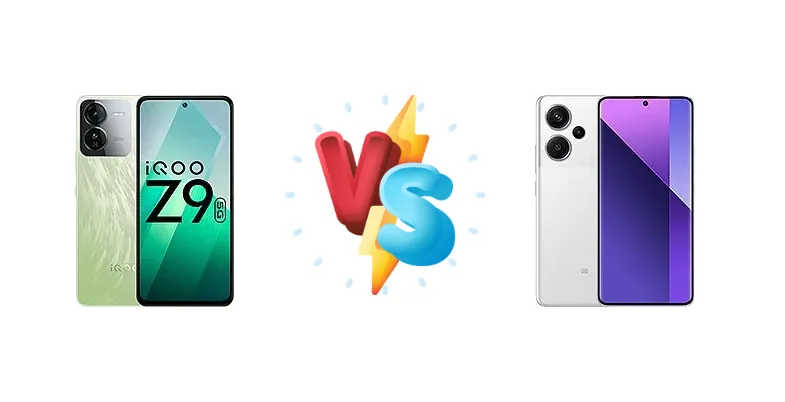
The iQOO Z9 and Xiaomi Redmi Note 13 Pro+ both target the competitive mid-range smartphone market, powered by variations of MediaTek’s Dimensity 7200 series. This comparison dissects the key differences – from charging speeds to display quality – to determine which device delivers the best value and performance for your needs.
🏆 Quick Verdict
For most users, the Xiaomi Redmi Note 13 Pro+ is the stronger choice. While both phones share the same core CPU architecture, the Redmi Note 13 Pro+ boasts significantly faster 120W charging and a brighter display, offsetting the iQOO Z9’s potentially more efficient base chipset.
| Network |
|---|
| 2G bands | GSM 850 / 900 / 1800 / 1900 | GSM 850 / 900 / 1800 / 1900 |
| 3G bands | HSDPA 850 / 900 / 2100 | HSDPA 800 / 850 / 900 / 1700(AWS) / 1900 / 2100 - International |
| 4G bands | 1, 3, 5, 8, 28, 38, 40, 41 | 1, 2, 3, 4, 5, 7, 8, 12, 13, 17, 18, 19, 20, 26, 28, 32, 38, 40, 41, 66 - International |
| 5G bands | 1, 3, 5, 8, 28, 40, 77, 78 SA/NSA | 1, 3, 5, 7, 8, 20, 28, 38, 40, 41, 66, 77, 78 SA/NSA- International |
| Speed | HSPA, LTE, 5G | HSPA, LTE, 5G |
| Technology | GSM / HSPA / LTE / 5G | GSM / CDMA / HSPA / EVDO / LTE / 5G |
| Launch |
|---|
| Announced | 2024, March 12 | 2023, September 21 |
| Status | Available. Released 2024, March 13 | Available. Released 2023, September 21 |
| Body |
|---|
| Build | Glass front, plastic back, plastic frame | Glass front (Gorilla Glass Victus), glass back or silicone polymer back (eco leather) |
| Dimensions | 163.2 x 75.8 x 7.8 mm (6.43 x 2.98 x 0.31 in) | 161.4 x 74.2 x 8.9 mm (6.35 x 2.92 x 0.35 in) |
| SIM | Nano-SIM + Nano-SIM | · Nano-SIM + eSIM· Nano-SIM + Nano-SIM |
| Weight | 188 g (6.63 oz) | 199 g or 204.5 g (7.02 oz) |
| Display |
|---|
| Protection | Dragontrail Star 2 Plus | Corning Gorilla Glass Victus |
| Resolution | 1080 x 2400 pixels, 20:9 ratio (~395 ppi density) | 1220 x 2712 pixels, 20:9 ratio (~446 ppi density) |
| Size | 6.67 inches, 107.4 cm2 (~86.8% screen-to-body ratio) | 6.67 inches, 107.4 cm2 (~89.7% screen-to-body ratio) |
| Type | AMOLED, 120Hz, HDR, 1800 nits (peak) | AMOLED, 68B colors, 120Hz, 1920Hz PWM, Dolby Vision, HDR10+, 1800 nits (peak) |
| Platform |
|---|
| CPU | Octa-core (2x2.8 GHz Cortex-A715 & 6x Cortex-A510) | Octa-core (2x2.8 GHz Cortex-A715 & 6x2.0 GHz Cortex-A510) |
| Chipset | Mediatek Dimensity 7200 (4 nm) | Mediatek Dimensity 7200 Ultra (4 nm) |
| GPU | Mali-G610 MC4 | Mali-G610 MC4 |
| OS | Android 14, Funtouch 14 | Android 13, up to 3 major Android upgrades, HyperOS |
| Memory |
|---|
| Card slot | microSDXC (uses shared SIM slot) | No |
| Internal | 128GB 8GB RAM, 256GB 8GB RAM | 256GB 8GB RAM, 256GB 12GB RAM, 512GB 8GB RAM, 512GB 12GB RAM, 512GB 16GB RAM |
| Main Camera |
|---|
| Dual | 50 MP, f/1.8, 26mm (wide), 1/1.95", 0.8µm, PDAF, OIS
Auxiliary lens | - |
| Features | LED flash, panorama, HDR | Dual-LED dual-tone flash, HDR, panorama |
| Triple | - | 200 MP, f/1.7, 23mm (wide), 1/1.4", 0.56µm, multi-directional PDAF, OIS
8 MP, f/2.2, 16mm, 120˚ (ultrawide), 1/4.0", 1.12µm
2 MP (macro) |
| Video | 4K@30fps, 1080p@30/60fps, gyro-EIS, HDR | 4K@24/30fps, 1080p@30/60/120fps, gyro-EIS |
| Selfie camera |
|---|
| Features | - | HDR, panorama |
| Single | 16 MP, f/2.0, (wide), 1/3.0", 1.0µm | 16 MP, f/2.4, (wide) |
| Video | 1080p@30fps | 1080p@30/60fps |
| Sound |
|---|
| 35mm jack | No | No |
| Loudspeaker | Yes, with stereo speakers | Yes, with stereo speakers |
| Comms |
|---|
| Bluetooth | 5.3, A2DP, LE | 5.3, A2DP, LE |
| Infrared port | - | Yes |
| NFC | No | Yes (market/region dependent) |
| Positioning | GPS, GALILEO, GLONASS, QZSS, BDS | GPS, GLONASS, BDS, GALILEO, QZSS |
| Radio | No | No |
| USB | USB Type-C 2.0, OTG | USB Type-C 2.0, OTG |
| WLAN | Wi-Fi 802.11 a/b/g/n/ac/6, dual-band, Wi-Fi Direct | Wi-Fi 802.11 a/b/g/n/ac/6, dual-band, Wi-Fi Direct |
| Features |
|---|
| Sensors | Fingerprint (under display, optical), accelerometer, gyro, proximity, compass | Fingerprint (under display, optical), accelerometer, gyro, proximity, compass |
| Battery |
|---|
| Charging | 44W wired, 50% in 30 min | 120W wired, PD3.0, 100% in 19 min |
| Type | Li-Ion 5000 mAh | Li-Po 5000 mAh |
| Misc |
|---|
| Colors | Brushed Green, Graphene Blue | Midnight Black (Fushion Black), Moonlight White (Fushion White), Aurora Purple, Fushion Purple, Camo Green |
| Models | I2302, I2218 | 23090RA98C, 23090RA98G, 23090RA98I |
| Price | About 220 EUR | $ 299.98 / £ 299.00 / € 208.98 / ₹ 24,999 |
| SAR | 0.98 W/kg (head) 0.94 W/kg (body) | 1.09 W/kg (head) 0.85 W/kg (body) |
| SAR EU | - | 0.98 W/kg (head) 1.00 W/kg (body) |
vivo iQOO Z9
- Potentially better thermal management due to base Dimensity 7200.
- Competitive price point (likely).
- Clean software experience (typical of iQOO).
- Slower 44W charging.
- Display brightness likely lower than Redmi Note 13 Pro+.
Xiaomi Redmi Note 13 Pro+
- Ultra-fast 120W charging.
- Brighter 1283 nit display.
- Longer battery life (10:38h active use).
- Dimensity 7200 Ultra may run slightly warmer under sustained load.
- Xiaomi’s MIUI software can be feature-rich but sometimes bloated.
Display Comparison
The Redmi Note 13 Pro+ immediately stands out with its measured peak brightness of 1283 nits, offering superior visibility in direct sunlight compared to the iQOO Z9 (brightness data unavailable, but likely lower). While both likely utilize AMOLED panels, the Redmi’s higher brightness and potentially better color calibration (based on Xiaomi’s display track record) provide a more immersive viewing experience. The iQOO Z9’s display specs are currently limited, making a detailed comparison of color accuracy and refresh rate difficult, but the Redmi Note 13 Pro+ has a clear advantage in raw brightness.
Camera Comparison
Without detailed camera specifications for the iQOO Z9, a direct comparison is challenging. However, the Redmi Note 13 Pro+ is expected to feature a more sophisticated camera system, potentially including a higher-resolution main sensor and advanced image processing algorithms. The Redmi’s focus on camera features, a common trend for Xiaomi, suggests a more versatile and capable photography experience. The iQOO Z9 likely prioritizes performance over camera prowess, making the Redmi Note 13 Pro+ the better choice for photography enthusiasts.
Performance
Both the iQOO Z9 and Redmi Note 13 Pro+ are equipped with octa-core CPUs featuring the same 2x2.8 GHz Cortex-A715 and 6x Cortex-A510 configuration. However, the Redmi Note 13 Pro+ utilizes the Dimensity 7200 *Ultra*, a slightly enhanced version of the Dimensity 7200 found in the iQOO Z9. The 'Ultra' designation suggests improvements to the GPU and potentially the Neural Processing Unit (NPU) for AI tasks. While CPU performance will be nearly identical, the Redmi Note 13 Pro+ may offer a marginal edge in graphics-intensive applications and AI-powered features. Both devices benefit from the 4nm process node, contributing to improved power efficiency.
Battery Life
The Redmi Note 13 Pro+ excels in battery charging, supporting 120W wired charging that can fully charge the device in just 19 minutes. This is a significant advantage over the iQOO Z9’s 44W charging, which takes 30 minutes to reach 50% and considerably longer for a full charge. Furthermore, the Redmi Note 13 Pro+ demonstrates impressive battery life, achieving 10:38 hours of active use, indicating a well-optimized power management system. While the iQOO Z9’s battery capacity is unknown, the Redmi’s combination of fast charging and long-lasting battery life makes it the clear winner in this category.
Buying Guide
Buy the vivo iQOO Z9 if you prioritize a potentially more thermally efficient chipset for sustained gaming sessions and are comfortable with slower 44W charging. Buy the Xiaomi Redmi Note 13 Pro+ if you value rapid 120W charging, a brighter and more vibrant display, and longer battery life in active use, making it ideal for power users and content consumers.
Frequently Asked Questions
❓ Will the Dimensity 7200 Ultra in the Redmi Note 13 Pro+ handle demanding games like Genshin Impact at high settings?
Yes, the Dimensity 7200 Ultra is capable of running Genshin Impact at high settings, though you may need to adjust graphics settings for consistently smooth frame rates. The 'Ultra' variant offers a slight GPU boost over the standard Dimensity 7200, and the 4nm process helps manage thermals during extended gaming sessions.
❓ How does the 120W charging of the Redmi Note 13 Pro+ affect battery health over the long term?
While extremely fast charging can theoretically accelerate battery degradation, modern smartphones employ sophisticated charging management systems to mitigate this effect. The Redmi Note 13 Pro+ utilizes intelligent charging algorithms that slow down the charging rate as the battery approaches full capacity, minimizing stress and preserving long-term battery health.
❓ Is the iQOO Z9 a better choice for users who frequently record videos?
Based on available information, the Redmi Note 13 Pro+ is likely the better option for video recording. Xiaomi typically prioritizes camera features, and the Redmi Note 13 Pro+ is expected to have a more advanced camera system capable of capturing higher-quality video.