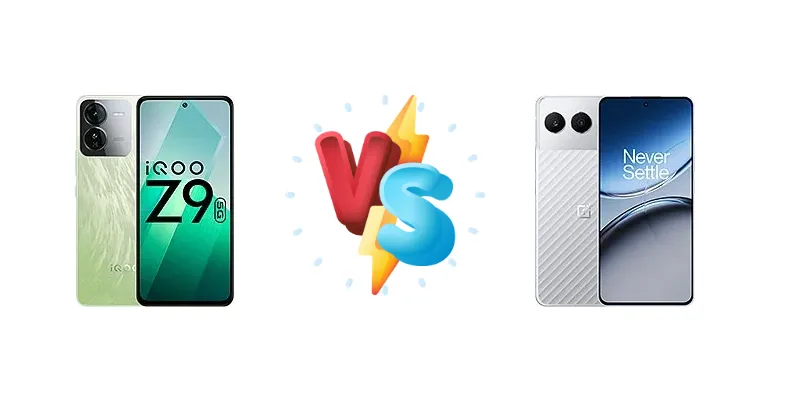
The mid-range smartphone market is fiercely competitive, and the OnePlus Nord 4 and vivo iQOO Z9 represent compelling options. The Nord 4 arrives as a refinement of OnePlus’s established formula, while the iQOO Z9 aims to disrupt with aggressive pricing and a focus on core performance. This comparison dissects their key differences to determine which device delivers the best value for your money.
🏆 Quick Verdict
For most users, the OnePlus Nord 4 emerges as the stronger contender. Its Snapdragon 7+ Gen 3 chipset offers a noticeable performance edge, complemented by significantly faster 100W charging and a brighter display. While the iQOO Z9 provides excellent value, the Nord 4’s overall refinement justifies the price difference.
| Network |
|---|
| 2G bands | GSM 850 / 900 / 1800 / 1900 | GSM 850 / 900 / 1800 / 1900 |
| 3G bands | HSDPA 850 / 900 / 2100 | HSDPA 800 / 850 / 900 / 1700(AWS) / 1800 / 1900 / 2100 - International |
| 4G bands | 1, 3, 5, 8, 28, 38, 40, 41 | 1, 2, 3, 4, 5, 7, 8, 12, 17, 18, 19, 20, 26, 28, 38, 39, 40, 41, 66 - International |
| 5G bands | 1, 3, 5, 8, 28, 40, 77, 78 SA/NSA | 1, 2, 3, 5, 7, 8, 12, 20, 28, 38, 40, 41, 66, 77, 78 SA/NSA - International |
| Speed | HSPA, LTE, 5G | HSPA, LTE, 5G |
| Technology | GSM / HSPA / LTE / 5G | GSM / HSPA / LTE / 5G |
| Launch |
|---|
| Announced | 2024, March 12 | 2024, July 16 |
| Status | Available. Released 2024, March 13 | Available. Released 2024, August 08 |
| Body |
|---|
| Build | Glass front, plastic back, plastic frame | Glass front, aluminum back, aluminum frame |
| Dimensions | 163.2 x 75.8 x 7.8 mm (6.43 x 2.98 x 0.31 in) | 162.6 x 75 x 8 mm (6.40 x 2.95 x 0.31 in) |
| SIM | Nano-SIM + Nano-SIM | Nano-SIM + Nano-SIM |
| Weight | 188 g (6.63 oz) | 199.5 g (7.05 oz) |
| Display |
|---|
| Protection | Dragontrail Star 2 Plus | - |
| Resolution | 1080 x 2400 pixels, 20:9 ratio (~395 ppi density) | 1240 x 2772 pixels, 20:9 ratio (~450 ppi density) |
| Size | 6.67 inches, 107.4 cm2 (~86.8% screen-to-body ratio) | 6.74 inches, 109.7 cm2 (~90.0% screen-to-body ratio) |
| Type | AMOLED, 120Hz, HDR, 1800 nits (peak) | Fluid AMOLED, 1B colors, 120Hz, HDR10+, 2150 nits (peak) |
| Platform |
|---|
| CPU | Octa-core (2x2.8 GHz Cortex-A715 & 6x Cortex-A510) | Octa-core (1x2.8 GHz Cortex-X4 & 4x2.6 GHz Cortex-A720 & 3x1.9 GHz Cortex-A520) |
| Chipset | Mediatek Dimensity 7200 (4 nm) | Qualcomm SM7675 Snapdragon 7+ Gen 3 (4 nm) |
| GPU | Mali-G610 MC4 | Adreno 732 |
| OS | Android 14, Funtouch 14 | Android 14, up to 4 major Android upgrades, OxygenOS 15 |
| Memory |
|---|
| Card slot | microSDXC (uses shared SIM slot) | No |
| Internal | 128GB 8GB RAM, 256GB 8GB RAM | 128GB 8GB RAM, 256GB 8GB RAM, 256GB 12GB RAM, 512GB 16GB RAM |
| Main Camera |
|---|
| Dual | 50 MP, f/1.8, 26mm (wide), 1/1.95", 0.8µm, PDAF, OIS
Auxiliary lens | 50 MP, f/1.8, 25mm (wide), 1/1.95", 0.8µm, PDAF, OIS
8 MP, f/2.2, 112˚ (ultrawide), 1/4.0", 1.12µm |
| Features | LED flash, panorama, HDR | Dual-LED flash, HDR, panorama |
| Video | 4K@30fps, 1080p@30/60fps, gyro-EIS, HDR | 4K@30/60fps, 1080p@30/60/120fps, gyro-EIS |
| Selfie camera |
|---|
| Features | - | Panorama |
| Single | 16 MP, f/2.0, (wide), 1/3.0", 1.0µm | 16 MP, f/2.4, 24mm (wide), 1.0µm |
| Video | 1080p@30fps | 1080p@30fps |
| Sound |
|---|
| 35mm jack | No | No |
| Loudspeaker | Yes, with stereo speakers | Yes, with stereo speakers |
| Comms |
|---|
| Bluetooth | 5.3, A2DP, LE | 5.4, A2DP, LE, aptX HD, LHDC |
| Infrared port | - | Yes |
| NFC | No | Yes |
| Positioning | GPS, GALILEO, GLONASS, QZSS, BDS | GPS, GALILEO, GLONASS, BDS, QZSS |
| Radio | No | No |
| USB | USB Type-C 2.0, OTG | USB Type-C 2.0 |
| WLAN | Wi-Fi 802.11 a/b/g/n/ac/6, dual-band, Wi-Fi Direct | Wi-Fi 802.11 a/b/g/n/ac/6, dual-band, Wi-Fi Direct |
| Features |
|---|
| Sensors | Fingerprint (under display, optical), accelerometer, gyro, proximity, compass | Fingerprint (under display, optical), accelerometer, gyro, proximity, compass |
| Battery |
|---|
| Charging | 44W wired, 50% in 30 min | 100W wired, PPS, 100% in 28 min |
| Type | Li-Ion 5000 mAh | 5500 mAh |
| Misc |
|---|
| Colors | Brushed Green, Graphene Blue | Obsidian Midnight, Mercurial Silver, Oasis Green |
| Models | I2302, I2218 | CPH2663, CPH2661 |
| Price | About 220 EUR | € 410.27 / £ 423.17 |
| SAR | 0.98 W/kg (head) 0.94 W/kg (body) | 1.18 W/kg (head) 1.06 W/kg (body) |
vivo iQOO Z9
- Faster Snapdragon 7+ Gen 3 chipset for superior performance
- 100W SuperVOOC charging for incredibly quick top-ups
- Brighter display (1163 nits) for excellent outdoor visibility
- Potentially higher price point than the iQOO Z9
- Software experience may not appeal to all users (OxygenOS)
OnePlus Nord 4
- More affordable price point, offering excellent value
- Decent performance for everyday tasks and light gaming
- 44W charging is still reasonably fast
- Slower chipset compared to the Snapdragon 7+ Gen 3
- Likely dimmer display, impacting outdoor usability
Display Comparison
The OnePlus Nord 4 boasts a significant advantage with its measured peak brightness of 1163 nits, ensuring excellent visibility outdoors. While the iQOO Z9’s display specifications are not provided, it’s likely to be lower, potentially impacting usability in bright conditions. The Nord 4’s panel likely benefits from the Snapdragon 7+ Gen 3’s ISP for improved color accuracy and dynamic range. The absence of LTPO technology in either device suggests both will rely on adaptive refresh rate switching to conserve battery, but the Nord 4’s brighter panel will be more impactful for media consumption.
Camera Comparison
Without detailed camera specifications for the iQOO Z9, a direct comparison is limited. However, the Snapdragon 7+ Gen 3’s ISP in the Nord 4 offers advanced image processing capabilities, including improved noise reduction and dynamic range. The Nord 4 likely benefits from more sophisticated computational photography algorithms. The focus should be on the main sensor performance; a larger sensor size (not specified for either) generally captures more light and detail. Ignoring the typical 2MP macro lenses found on both devices, the quality of the primary camera and its associated image processing will be the deciding factor.
Performance
The core difference lies in the chipsets: the OnePlus Nord 4 utilizes the Qualcomm SM7675 Snapdragon 7+ Gen 3 (4nm), featuring a Cortex-X4 prime core clocked at 2.8 GHz, while the iQOO Z9 employs the MediaTek Dimensity 7200 (4nm) with Cortex-A715 cores at 2.8 GHz. The Snapdragon 7+ Gen 3’s Cortex-X4 core provides a substantial architectural advantage over the A715, translating to faster single-core performance and improved responsiveness. Both chips are built on a 4nm process, offering good efficiency, but Qualcomm’s Adreno GPU typically outperforms MediaTek’s Mali equivalent, making the Nord 4 the better choice for gaming. The Nord 4’s LPDDR5x RAM further enhances performance, offering faster data transfer speeds compared to the iQOO Z9’s likely LPDDR4x or LPDDR5 configuration.
Battery Life
The OnePlus Nord 4’s 100W wired charging with PPS support is a game-changer, achieving a full charge in just 28 minutes. This significantly surpasses the iQOO Z9’s 44W charging, which takes 30 minutes to reach 50%. While the iQOO Z9’s battery capacity isn’t specified, the Nord 4’s active use score of 14:41h demonstrates excellent battery life. The faster charging of the Nord 4 mitigates any potential disadvantage from a slightly smaller battery capacity, offering greater convenience and reducing downtime.
Buying Guide
Buy the vivo iQOO Z9 if you prioritize maximizing value and are comfortable with slightly slower charging speeds. It’s ideal for everyday users who need a reliable phone for communication, social media, and light gaming. Buy the OnePlus Nord 4 if you demand a smoother, more responsive experience, particularly for gaming and multitasking, and value the convenience of incredibly fast charging and a brighter, more visible display in sunlight.
Frequently Asked Questions
❓ Does the Snapdragon 7+ Gen 3 in the OnePlus Nord 4 handle demanding games like Genshin Impact well?
Yes, the Snapdragon 7+ Gen 3 is a capable chipset for gaming. While it won't match flagship performance, it can comfortably run Genshin Impact at medium to high settings with stable frame rates. The Adreno GPU provides a significant advantage over the iQOO Z9’s Mali GPU in this regard.
❓ How does the 44W charging on the iQOO Z9 compare to typical fast charging standards?
44W charging is considered a standard fast charging speed, but it's significantly slower than the OnePlus Nord 4’s 100W charging. Expect a full charge to take around 1.5 to 2 hours with the iQOO Z9, while the Nord 4 can achieve a full charge in under 30 minutes.
❓ Is the lack of detailed camera specs on the iQOO Z9 a major concern?
It is a concern. Without knowing the sensor size, aperture, and image processing capabilities, it's difficult to assess the iQOO Z9’s camera performance. Generally, the Snapdragon 7+ Gen 3’s ISP in the Nord 4 offers a more advanced camera experience.
❓ Will the Dimensity 7200 in the iQOO Z9 throttle under sustained load, like during long gaming sessions?
While the Dimensity 7200 is a 4nm chip and therefore relatively efficient, it's likely to throttle more noticeably than the Snapdragon 7+ Gen 3 under prolonged heavy load. Qualcomm’s thermal management solutions are generally more effective.