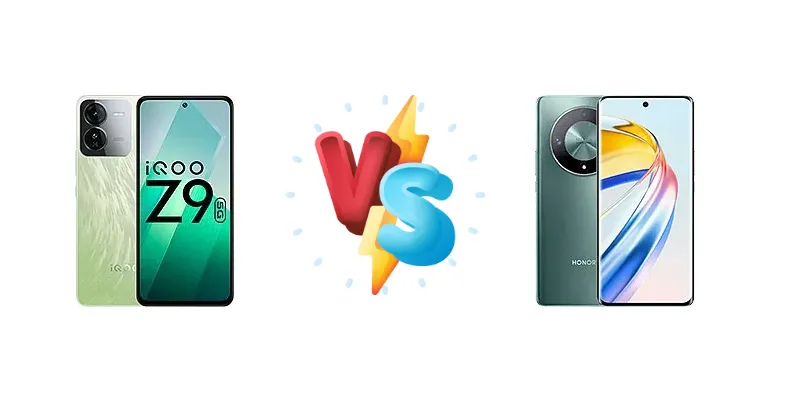
The iQOO Z9 and Honor X9b represent compelling options in the increasingly competitive mid-range smartphone market. Both leverage 4nm chipsets for efficiency, but diverge in their processor choices and charging implementations. This comparison dissects these differences to determine which device delivers the best experience for various user needs.
🏆 Quick Verdict
For users prioritizing raw performance and faster charging, the iQOO Z9 emerges as the winner. Its Dimensity 7200 chipset offers a noticeable edge in CPU and GPU capabilities. However, the Honor X9b’s Snapdragon 6 Gen 1 provides a more balanced experience with reverse wireless charging, making it a strong contender for those valuing convenience and efficiency.
| Network |
|---|
| 2G bands | GSM 850 / 900 / 1800 / 1900 | GSM 850 / 900 / 1800 / 1900 |
| 3G bands | HSDPA 850 / 900 / 2100 | HSDPA 850 / 900 / 1900 / 2100 |
| 4G bands | 1, 3, 5, 8, 28, 38, 40, 41 | 1, 2, 3, 4, 5, 7, 8, 20, 28, 32, 38, 40, 41 |
| 5G bands | 1, 3, 5, 8, 28, 40, 77, 78 SA/NSA | 1, 3, 7, 8, 20, 28, 38, 40, 41, 77, 78 SA/NSA |
| Speed | HSPA, LTE, 5G | HSPA, LTE, 5G |
| Technology | GSM / HSPA / LTE / 5G | GSM / HSPA / LTE / 5G |
| Launch |
|---|
| Announced | 2024, March 12 | 2023, October 18 |
| Status | Available. Released 2024, March 13 | Available. Released 2023, October |
| Body |
|---|
| Build | Glass front, plastic back, plastic frame | - |
| Dimensions | 163.2 x 75.8 x 7.8 mm (6.43 x 2.98 x 0.31 in) | 163.6 x 75.5 x 8 mm (6.44 x 2.97 x 0.31 in) |
| SIM | Nano-SIM + Nano-SIM | Nano-SIM + Nano-SIM |
| Weight | 188 g (6.63 oz) | 185 g (6.53 oz) |
| Display |
|---|
| Protection | Dragontrail Star 2 Plus | - |
| Resolution | 1080 x 2400 pixels, 20:9 ratio (~395 ppi density) | 1220 x 2652 pixels, 19.5:9 ratio (~431 ppi density) |
| Size | 6.67 inches, 107.4 cm2 (~86.8% screen-to-body ratio) | 6.78 inches, 112.6 cm2 (~91.2% screen-to-body ratio) |
| Type | AMOLED, 120Hz, HDR, 1800 nits (peak) | AMOLED, 1B colors, 120Hz, 1200 nits (peak) |
| Platform |
|---|
| CPU | Octa-core (2x2.8 GHz Cortex-A715 & 6x Cortex-A510) | Octa-core (4x2.2 GHz Cortex-A78 & 4x1.8 GHz Cortex-A55) |
| Chipset | Mediatek Dimensity 7200 (4 nm) | Qualcomm SM6450 Snapdragon 6 Gen 1 (4 nm) |
| GPU | Mali-G610 MC4 | Adreno 710 |
| OS | Android 14, Funtouch 14 | Android 13, Magic OS 7.2 |
| Memory |
|---|
| Card slot | microSDXC (uses shared SIM slot) | No |
| Internal | 128GB 8GB RAM, 256GB 8GB RAM | 256GB 8GB RAM, 256GB 12GB RAM, 512GB 8GB RAM, 512GB 12GB RAM |
| Main Camera |
|---|
| Dual | 50 MP, f/1.8, 26mm (wide), 1/1.95", 0.8µm, PDAF, OIS
Auxiliary lens | - |
| Features | LED flash, panorama, HDR | LED flash, panorama, HDR |
| Triple | - | 108 MP, f/1.8, (wide), 1/1.67", PDAF
5 MP, f/2.2, (ultrawide)
2 MP (macro) |
| Video | 4K@30fps, 1080p@30/60fps, gyro-EIS, HDR | 4K@30fps, 1080p@30fps |
| Selfie camera |
|---|
| Single | 16 MP, f/2.0, (wide), 1/3.0", 1.0µm | 16 MP, f/2.5, (wide) |
| Video | 1080p@30fps | 1080p@30fps |
| Sound |
|---|
| 35mm jack | No | No |
| Loudspeaker | Yes, with stereo speakers | Yes |
| Comms |
|---|
| Bluetooth | 5.3, A2DP, LE | 5.1, A2DP, LE |
| Infrared port | - | Yes |
| NFC | No | Yes (market/region dependent) |
| Positioning | GPS, GALILEO, GLONASS, QZSS, BDS | GPS, GLONASS, GALILEO, BDS |
| Radio | No | No |
| USB | USB Type-C 2.0, OTG | USB Type-C 2.0, OTG |
| WLAN | Wi-Fi 802.11 a/b/g/n/ac/6, dual-band, Wi-Fi Direct | Wi-Fi 802.11 a/b/g/n/ac, dual-band, Wi-Fi Direct |
| Features |
|---|
| Sensors | Fingerprint (under display, optical), accelerometer, gyro, proximity, compass | Fingerprint (under display, optical), accelerometer, gyro, proximity, compass |
| Battery |
|---|
| Charging | 44W wired, 50% in 30 min | 35W wired
Reverse wired |
| Type | Li-Ion 5000 mAh | Li-Po 5800 mAh |
| Misc |
|---|
| Colors | Brushed Green, Graphene Blue | Sunrise Orange, Midnight Black, Emerald Green |
| Models | I2302, I2218 | ALI-NX1 |
| Price | About 220 EUR | About 970 EUR |
| SAR | 0.98 W/kg (head) 0.94 W/kg (body) | - |
vivo iQOO Z9
- Faster 44W charging significantly reduces downtime.
- More powerful Dimensity 7200 chipset for better performance.
- Likely superior multi-core performance for multitasking.
- Lacks reverse wireless charging.
- No information on display quality.
Honor X9b
- Reverse wired charging for added convenience.
- Snapdragon 6 Gen 1 offers good power efficiency.
- Potentially more refined display experience (speculative).
- Slower 35W charging.
- Less powerful CPU and GPU compared to the iQOO Z9.
Display Comparison
Neither device's display specifications are provided, so a direct comparison is limited. However, given the price bracket, we can assume both utilize LCD or AMOLED panels with FHD+ resolution. The absence of details like refresh rate or peak brightness makes it difficult to assess visual quality. Honor typically focuses on display quality, so it's reasonable to expect a slightly more refined display experience on the X9b, but this is speculative without concrete data.
Camera Comparison
Without specific camera sensor details, a definitive comparison is challenging. However, the market segment suggests both phones will feature a multi-camera setup with a primary sensor, ultrawide, and potentially a macro lens. The absence of OIS information suggests neither phone prioritizes advanced stabilization. Image processing will likely differ, with vivo often leaning towards vibrant, saturated colors, while Honor tends towards more natural tones. The quality of the primary sensor will be the most significant factor, and without that data, it's impossible to declare a clear winner.
Performance
The iQOO Z9’s Mediatek Dimensity 7200, built on a 4nm process, features a more powerful CPU configuration with 2x2.8 GHz Cortex-A715 cores and 6x Cortex-A510 cores. This contrasts with the Honor X9b’s Qualcomm Snapdragon 6 Gen 1, which utilizes 4x2.2 GHz Cortex-A78 cores and 4x1.8 GHz Cortex-A55 cores. The Dimensity 7200’s higher clock speeds and newer core architecture suggest superior multi-core performance, benefiting demanding applications and multitasking. While the Snapdragon 6 Gen 1 is efficient, the iQOO Z9 is likely to offer a smoother experience in graphically intensive games and resource-heavy apps. The 4nm fabrication process in both chips contributes to improved thermal management compared to older nodes.
Battery Life
The iQOO Z9 boasts 44W wired charging, capable of reaching 50% charge in 30 minutes, offering a significantly faster charging experience. The Honor X9b, with 35W wired charging, is slower, but compensates with the addition of reverse wired charging – a feature absent on the iQOO Z9. This allows the X9b to function as a power bank for other devices. While battery capacity isn't specified, the faster charging of the iQOO Z9 will minimize downtime, while the X9b’s reverse charging adds a layer of utility.
Buying Guide
Buy the vivo iQOO Z9 if you need a phone for demanding tasks like mobile gaming or video editing, and value the fastest possible charging speeds. Buy the Honor X9b if you prioritize a more balanced experience with added convenience features like reverse wireless charging, and prefer a chipset known for its power efficiency in everyday tasks.
Frequently Asked Questions
❓ Will the Dimensity 7200 in the iQOO Z9 overheat during prolonged gaming sessions?
The Dimensity 7200 is a 4nm chipset, which inherently offers better thermal efficiency than older nodes. While sustained gaming will generate heat, the iQOO Z9 should manage temperatures effectively, preventing significant throttling. However, sustained peak performance will still lead to some heat generation, as with any smartphone.
❓ Is the reverse wired charging on the Honor X9b useful for more than just emergencies?
Yes, the reverse wired charging on the Honor X9b is surprisingly versatile. It can be used to top up accessories like wireless earbuds or smartwatches, or even provide a slow charge to another phone in a pinch. While not a replacement for a dedicated power bank, it adds a convenient layer of functionality for users who frequently travel or rely on multiple devices.
❓ Does the Snapdragon 6 Gen 1 in the Honor X9b support advanced features like 5G?
Yes, the Snapdragon 6 Gen 1 does support 5G connectivity. This allows the Honor X9b to take advantage of faster network speeds where available, providing a smoother experience for streaming, downloading, and online gaming.