
iQOO Z9 Turbo+ vs Xiaomi 14T Pro: A Deep Dive into the Dimensity 9300+ Powerhouses
| Phones Images | |||||
|---|---|---|---|---|---|
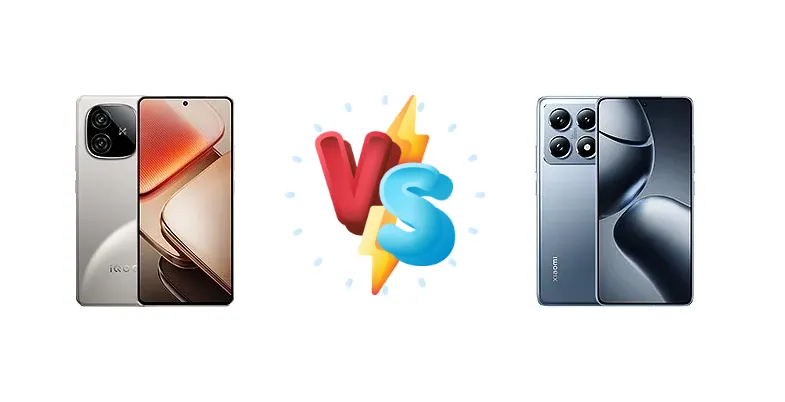
|
🏆 Quick Verdict
For the average user prioritizing convenience and rapid replenishment, the Xiaomi 14T Pro is the clear winner. Its 120W charging, capable of a full charge in just 19 minutes, significantly outperforms the iQOO Z9 Turbo+'s 80W system. While both share the same processor, the Xiaomi’s superior charging and longer active use battery life make it the more practical choice.
| PHONES | ||
|---|---|---|
| Phone Names | vivo iQOO Z9 Turbo+ | Xiaomi 14T Pro |
| Network | ||
|---|---|---|
| 2G bands | GSM 850 / 900 / 1800 / 1900 | GSM 850 / 900 / 1800 / 1900 |
| 3G bands | HSDPA 850 / 900 / 2100 | HSDPA 800 / 850 / 900 / 1700(AWS) / 1900 / 2100 |
| 4G bands | 1, 3, 5, 8, 28, 34, 38, 39, 40, 41 | 1, 2, 3, 4, 5, 7, 8, 12, 13, 17, 18, 19, 20, 25, 26, 28, 32, 38, 39, 40, 41, 42, 48, 66 |
| 5G bands | 1, 3, 5, 8, 28, 38, 40, 41, 77, 78 SA/NSA | 1, 2, 3, 5, 7, 8, 12, 20, 25, 26, 28, 38, 40, 41, 48, 66, 75, 77, 78 SA/NSA |
| Speed | HSPA, LTE, 5G | HSPA, LTE, 5G |
| Technology | GSM / CDMA / HSPA / LTE / 5G | GSM / HSPA / LTE / 5G |
| Launch | ||
|---|---|---|
| Announced | 2024, September 24 | 2024, September 26 |
| Status | Available. Released 2024, September 24 | Available. Released 2024, September 26 |
| Body | ||
|---|---|---|
| Build | Glass front, plastic back, plastic frame | Glass front (Gorilla Glass 5), aluminum frame, glass back (Panda X) |
| Dimensions | 163.7 x 75.9 x 8 mm (6.44 x 2.99 x 0.31 in) | 160.4 x 75.1 x 8.4 mm (6.31 x 2.96 x 0.33 in) |
| SIM | Nano-SIM + Nano-SIM | · Nano-SIM + eSIM· eSIM + eSIM· Nano-SIM + Nano-SIM |
| Weight | 196 g (6.91 oz) | 209 g (7.37 oz) |
| Display | ||
|---|---|---|
| Protection | - | Corning Gorilla Glass 5 |
| Resolution | 1260 x 2800 pixels, 20:9 ratio (~453 ppi density) | 1220 x 2712 pixels, 20:9 ratio (~446 ppi density) |
| Size | 6.78 inches, 111.0 cm2 (~89.3% screen-to-body ratio) | 6.67 inches, 107.4 cm2 (~89.1% screen-to-body ratio) |
| Type | AMOLED, 1B colors, 144Hz, HDR, 4500 nits (peak) | AMOLED, 68B colors, 144Hz, 3840Hz PWM, Dolby Vision, HDR10+, 1600 nits (HBM), 4000 nits (peak) |
| Platform | ||
|---|---|---|
| CPU | Octa-core (1x3.4 GHz Cortex-X4 & 3x2.85 GHz Cortex-X4 & 4x2.0 GHz Cortex-A720) | Octa-core (1x3.4 GHz Cortex-X4 & 3x2.85 GHz Cortex-X4 & 4x2.0 GHz Cortex-A720) |
| Chipset | Mediatek Dimensity 9300+ (4 nm) | Mediatek Dimensity 9300+ (4 nm) |
| GPU | Immortalis-G720 MC12 | Immortalis-G720 MC12 |
| OS | Android 14, OriginOS 4 | Android 14, HyperOS |
| Memory | ||
|---|---|---|
| Card slot | Unspecified | No |
| Internal | 256GB 12GB RAM, 256GB 16GB RAM, 512GB 12GB RAM, 512GB 16GB RAM | 256GB 12GB RAM, 512GB 12GB RAM, 512GB 16GB RAM, 1TB 12GB RAM |
| Main Camera | ||
|---|---|---|
| Dual | 50 MP, f/1.8, (wide), 1/1.95", 0.8µm, PDAF, OIS 8 MP, f/2.2, (ultrawide) | - |
| Features | LED flash, panorama, HDR | Leica lens, Ultra HDR, LED flash, HDR, panorama |
| Triple | - | 50 MP, f/1.6, 23mm (wide), 1/1.31", 1.2µm, PDAF, OIS 50 MP, f/2.0, 60mm (telephoto), 1/2.88", 0.61µm, PDAF, 2.6x optical zoom 12 MP, f/2.2, 15mm (ultrawide), 1/3.06", 1.12µm |
| Video | 4K@30/60fps, 1080p, gyro-EIS, OIS | 8K@24/30fps, 4K@24/30/60fps, 1080p@30/60/120/240/960fps, gyro-EIS, 10-bit Rec. 2020, HDR10+ |
| Selfie camera | ||
|---|---|---|
| Features | - | HDR |
| Single | 16 MP, f/2.5, (wide), 1/3.0", 1.0µm | 32 MP, f/2.0, 25mm (wide), 1/3.44", 0.64µm |
| Video | 1080p@30fps, gyro-EIS | 4K@30fps, 1080p@30/60fps, HDR10+ |
| Sound | ||
|---|---|---|
| 35mm jack | No | No |
| Loudspeaker | Yes, with stereo speakers | Yes, with stereo speakers |
| Comms | ||
|---|---|---|
| Bluetooth | 5.4, A2DP, LE, aptX HD, aptX Adaptive, aptX Lossless | 5.4, A2DP, LE, LHDC |
| Infrared port | Yes | Yes |
| NFC | Yes | Yes (market/region dependent) |
| Positioning | GPS (L1+L5), BDS (B1I+B1C+B2a+B2b), GALILEO (E1+E5a+E5b), QZSS (L1+L5), GLONASS, NavIC (L5) | GPS (L1+L5), BDS (B1I+B1C+B2a+B2b), GALILEO (E1+E5a+E5b), QZSS (L1+L5), NavIC (L5), GLONASS |
| Radio | No | No |
| USB | USB Type-C 2.0, OTG | USB Type-C 2.0, OTG |
| WLAN | Wi-Fi 802.11 a/b/g/n/ac/6/7, dual-band | Wi-Fi 802.11 a/b/g/n/ac/6e/7, dual-band, Wi-Fi Direct |
| Features | ||
|---|---|---|
| Sensors | Fingerprint (under display, optical), accelerometer, gyro, proximity, compass | Fingerprint (under display, optical), accelerometer, gyro, proximity, compass |
| Battery | ||
|---|---|---|
| Charging | 80W wired 7.5W reverse wired | 120W wired, PD3.0, QC4, 100% in 19 min 50W wireless, 100% in 45 min |
| Type | Si/C Li-Ion 6400 mAh | Li-Po 5000 mAh |
| Misc | ||
|---|---|---|
| Colors | Black, White, Titanium | Titan Gray, Titan Blue, Titan Black |
| Models | V2417A | 2407FPN8EG |
| Price | About 280 EUR | $ 550.00 / £ 498.00 / € 539.99 |
| SAR EU | - | 0.99 W/kg (head) 1.00 W/kg (body) |
vivo iQOO Z9 Turbo+
- Potentially superior sustained gaming performance due to aggressive cooling.
- Competitive price point for the Dimensity 9300+ chipset.
- 80W charging is still relatively fast.
- Slower charging speed compared to the Xiaomi 14T Pro.
- Lack of detailed specifications hinders a comprehensive assessment.
Xiaomi 14T Pro
- Incredibly fast 120W wired charging (19 minutes to full).
- 50W wireless charging for added convenience.
- Longer battery life (12:32h active use).
- May prioritize thermal balance over sustained peak performance.
- Potentially higher price compared to the iQOO Z9 Turbo+.
Display Comparison
While both devices likely employ high-refresh-rate AMOLED panels, the Xiaomi 14T Pro boasts a measured peak brightness of 1228 nits, suggesting superior outdoor visibility compared to the iQOO Z9 Turbo+. The absence of specific display details for the iQOO Z9 Turbo+ suggests a more standard implementation, potentially lacking the advanced features like LTPO found in higher-end Xiaomi models. This brightness difference will be noticeable when viewing HDR content or under direct sunlight.
Camera Comparison
The provided data lacks specific camera details for both devices. Given the market positioning, it's reasonable to expect both phones to feature multi-camera systems with a primary sensor. However, without sensor size or aperture information, a direct comparison is impossible. The Xiaomi 14T Pro, being positioned slightly higher, may offer more advanced image processing algorithms and potentially a larger main sensor for improved low-light performance. The inclusion of a 2MP macro camera on either device is likely a marketing feature with limited practical benefit.
Performance
Both the iQOO Z9 Turbo+ and Xiaomi 14T Pro are powered by the MediaTek Dimensity 9300+ (4nm), featuring an octa-core configuration with a 1x3.4 GHz Cortex-X4 prime core, 3x2.85 GHz Cortex-X4 performance cores, and 4x2.0 GHz Cortex-A720 efficiency cores. This identical chipset configuration promises comparable CPU performance. However, thermal management will be crucial. The iQOO’s ‘Turbo’ branding hints at a more aggressive cooling solution, potentially allowing for sustained peak performance during extended gaming sessions, while the Xiaomi may prioritize thermal balance. Both devices likely utilize LPDDR5x RAM, ensuring fast memory access.
Battery Life
The Xiaomi 14T Pro’s active use score of 12:32h demonstrates a clear advantage in battery endurance. While the iQOO Z9 Turbo+'s battery capacity is unknown, the Xiaomi’s combination of efficient chipset and optimized software delivers longer runtimes. Crucially, the Xiaomi 14T Pro’s 120W wired charging, completing a full charge in just 19 minutes, is a game-changer. This is significantly faster than the iQOO Z9 Turbo+'s 80W charging. The Xiaomi also offers 50W wireless charging, a feature absent on the iQOO, adding another layer of convenience.
Buying Guide
Buy the vivo iQOO Z9 Turbo+ if you prioritize a more focused gaming experience and are comfortable with slightly slower charging. Its aggressive thermal design (implied by the 'Turbo' branding) suggests a sustained performance edge in demanding titles. Buy the Xiaomi 14T Pro if you value all-day battery life, incredibly fast charging, and a more balanced feature set, making it ideal for power users and those constantly on the go.