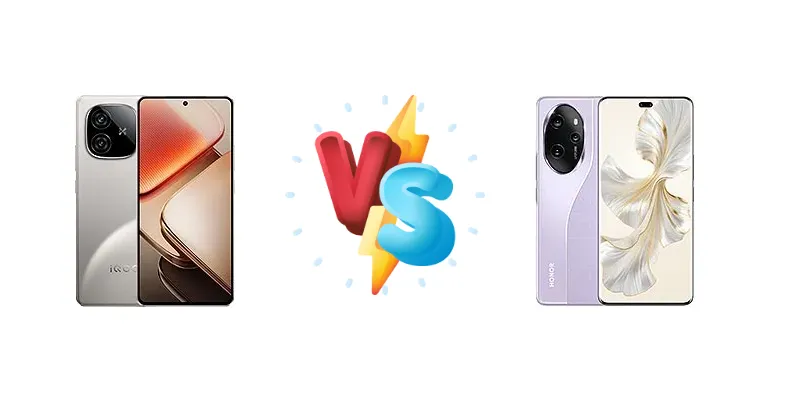
The iQOO Z9 Turbo+ and Honor 100 Pro represent compelling options in the increasingly competitive flagship smartphone space. The iQOO focuses on raw processing power with the latest MediaTek Dimensity 9300+, while the Honor 100 Pro leverages the established Snapdragon 8 Gen 2. This comparison dissects their key differences, focusing on performance, charging speeds, and overall user experience to determine which device delivers the best value.
🏆 Quick Verdict
For users prioritizing peak CPU performance and rapid gaming, the iQOO Z9 Turbo+ with its Dimensity 9300+ is the clear winner. However, the Honor 100 Pro counters with significantly faster and more versatile charging – including wireless – making it the better choice for those who value convenience and all-day usability.
| Network |
|---|
| 2G bands | GSM 850 / 900 / 1800 / 1900 | GSM 850 / 900 / 1800 / 1900 |
| 3G bands | HSDPA 850 / 900 / 2100 | HSDPA 800 / 850 / 900 / 1700(AWS) / 1900 / 2100 |
| 4G bands | 1, 3, 5, 8, 28, 34, 38, 39, 40, 41 | LTE |
| 5G bands | 1, 3, 5, 8, 28, 38, 40, 41, 77, 78 SA/NSA | SA/NSA |
| Speed | HSPA, LTE, 5G | HSPA, LTE, 5G |
| Technology | GSM / CDMA / HSPA / LTE / 5G | GSM / CDMA / HSPA / CDMA2000 / LTE / 5G |
| Launch |
|---|
| Announced | 2024, September 24 | 2023, November 23 |
| Status | Available. Released 2024, September 24 | Available. Released 2023, November 23 |
| Body |
|---|
| Build | Glass front, plastic back, plastic frame | - |
| Dimensions | 163.7 x 75.9 x 8 mm (6.44 x 2.99 x 0.31 in) | 163.7 x 74.7 x 8.2 mm or 8.5 mm |
| SIM | Nano-SIM + Nano-SIM | Nano-SIM + Nano-SIM |
| Weight | 196 g (6.91 oz) | 195 g (6.88 oz) |
| Display |
|---|
| Resolution | 1260 x 2800 pixels, 20:9 ratio (~453 ppi density) | 1224 x 2700 pixels (~437 ppi density) |
| Size | 6.78 inches, 111.0 cm2 (~89.3% screen-to-body ratio) | 6.78 inches, 111.5 cm2 (~91.2% screen-to-body ratio) |
| Type | AMOLED, 1B colors, 144Hz, HDR, 4500 nits (peak) | OLED, 1B colors, 120Hz, HDR, 2600 nits (peak) |
| Platform |
|---|
| CPU | Octa-core (1x3.4 GHz Cortex-X4 & 3x2.85 GHz Cortex-X4 & 4x2.0 GHz Cortex-A720) | Octa-core (1x3.2 GHz Cortex-X3 & 2x2.8 GHz Cortex-A715 & 2x2.8 GHz Cortex-A710 & 3x2.0 GHz Cortex-A510) |
| Chipset | Mediatek Dimensity 9300+ (4 nm) | Qualcomm SM8550-AB Snapdragon 8 Gen 2 (4 nm) |
| GPU | Immortalis-G720 MC12 | Adreno 740 |
| OS | Android 14, OriginOS 4 | Android 13, MagicOS 7.2 |
| Memory |
|---|
| Card slot | Unspecified | No |
| Internal | 256GB 12GB RAM, 256GB 16GB RAM, 512GB 12GB RAM, 512GB 16GB RAM | 256GB 12GB RAM, 256GB 16GB RAM, 512GB 16GB RAM, 1TB 16GB RAM |
| Main Camera |
|---|
| Dual | 50 MP, f/1.8, (wide), 1/1.95", 0.8µm, PDAF, OIS
8 MP, f/2.2, (ultrawide) | - |
| Features | LED flash, panorama, HDR | LED flash, HDR, panorama |
| Triple | - | 50 MP, f/2.0, 27mm (wide), 1/1.56", 1.0µm, PDAF, OIS
32 MP, f/2.4, (telephoto), PDAF, OIS, 2.5x optical zoom
12 MP, f/2.2, 112˚ (ultrawide), AF |
| Video | 4K@30/60fps, 1080p, gyro-EIS, OIS | 4K@30fps, 1080p@30/60fps, gyro-EIS, OIS |
| Selfie camera |
|---|
| Dual | - | 50 MP, f/2.0
2 MP, f/2.4, (depth) |
| Features | - | HDR |
| Single | 16 MP, f/2.5, (wide), 1/3.0", 1.0µm | - |
| Video | 1080p@30fps, gyro-EIS | 4K@30fps, 1080p@30fps, gyro-EIS |
| Sound |
|---|
| 35mm jack | No | No |
| Loudspeaker | Yes, with stereo speakers | Yes, with stereo speakers |
| Comms |
|---|
| Bluetooth | 5.4, A2DP, LE, aptX HD, aptX Adaptive, aptX Lossless | 5.3, A2DP, LE, aptX HD |
| Infrared port | Yes | - |
| NFC | Yes | Yes |
| Positioning | GPS (L1+L5), BDS (B1I+B1C+B2a+B2b), GALILEO (E1+E5a+E5b), QZSS (L1+L5), GLONASS, NavIC (L5) | GPS, GALILEO, GLONASS, BDS, QZSS |
| Radio | No | No |
| USB | USB Type-C 2.0, OTG | USB Type-C 2.0, OTG |
| WLAN | Wi-Fi 802.11 a/b/g/n/ac/6/7, dual-band | Wi-Fi 802.11 a/b/g/n/ac/6, dual-band, Wi-Fi Direct |
| Features |
|---|
| Sensors | Fingerprint (under display, optical), accelerometer, gyro, proximity, compass | Fingerprint (under display, optical), accelerometer, gyro, compass, ultrasound proximity |
| Battery |
|---|
| Charging | 80W wired
7.5W reverse wired | 100W wired, 50% in 10 min
66W wireless, 100% in 42 min
5W reverse wired
Reverse wireless |
| Type | Si/C Li-Ion 6400 mAh | Li-Po 5000 mAh |
| Misc |
|---|
| Colors | Black, White, Titanium | Black, Silver, Blue, Violet |
| Models | V2417A | MAA-AN10 |
| Price | About 280 EUR | About 440 EUR |
vivo iQOO Z9 Turbo+
- Potentially higher peak CPU performance with Dimensity 9300+
- Aggressive thermal design likely optimized for gaming
- Competitive price point (expected)
- Lacks wireless charging
- Potentially higher thermal throttling under sustained load
- Camera system may be less refined than the Honor 100 Pro
Honor 100 Pro
- 100W wired and 66W wireless charging for ultimate convenience
- Mature Snapdragon 8 Gen 2 platform with optimized software
- Potentially superior camera performance
- Slightly lower peak CPU performance compared to Dimensity 9300+
- May be more expensive than the iQOO Z9 Turbo+
- Thermal management may not be as aggressive as the iQOO
Display Comparison
While both devices likely feature high-refresh-rate AMOLED displays (data not provided), the core difference lies in their processing power. The iQOO Z9 Turbo+’s Dimensity 9300+ will benefit from a smoother experience when pushing high frame rates in demanding games. The Honor 100 Pro’s Snapdragon 8 Gen 2, while still incredibly capable, may exhibit slightly more frame drops in the most intensive scenarios. Without specific display specs, it's difficult to assess color accuracy or peak brightness, but both brands typically deliver vibrant and sharp visuals.
Camera Comparison
Without detailed camera specifications, a direct comparison is challenging. However, the market positioning suggests the Honor 100 Pro may prioritize camera capabilities more heavily. Honor often emphasizes camera features in its 'Pro' line. The Snapdragon 8 Gen 2’s ISP (Image Signal Processor) is well-regarded for its image processing capabilities. The iQOO Z9 Turbo+, while likely equipped with a capable camera system, may focus more on performance than photographic excellence. We can assume both phones will offer a variety of shooting modes, but the Honor 100 Pro is likely to deliver more refined image quality, particularly in low-light conditions.
Performance
The iQOO Z9 Turbo+’s Mediatek Dimensity 9300+ (4nm) boasts a unique CPU configuration with a 1x3.4 GHz Cortex-X4 prime core, alongside three additional Cortex-X4 cores, suggesting a focus on sustained peak performance. This contrasts with the Honor 100 Pro’s Snapdragon 8 Gen 2 (4nm) which utilizes a more traditional 1x3.2 GHz Cortex-X3 core. The Dimensity 9300+'s architecture suggests a potential advantage in multi-threaded workloads and gaming. Both utilize 4nm fabrication, offering good thermal efficiency, but the iQOO’s CPU configuration may generate more heat under sustained load. The Honor 100 Pro likely benefits from Qualcomm’s mature software optimizations for the Snapdragon 8 Gen 2.
Battery Life
The Honor 100 Pro significantly outpaces the iQOO Z9 Turbo+ in charging technology. Its 100W wired charging can reach 50% in just 10 minutes, and a full charge in a reasonable timeframe. The addition of 66W wireless charging, completing a full charge in 42 minutes, provides unparalleled convenience. The iQOO Z9 Turbo+’s 80W wired charging is fast, but lacks the versatility of wireless charging. While battery capacity isn’t specified, the Honor 100 Pro’s charging speed effectively mitigates any potential capacity disadvantage, offering a more flexible and user-friendly charging experience.
Buying Guide
Buy the vivo iQOO Z9 Turbo+ if you are a hardcore mobile gamer who demands the absolute highest CPU performance and are willing to trade off wireless charging convenience. Buy the Honor 100 Pro if you prioritize a balanced experience with faster, more flexible charging options (wired and wireless), and a more refined software experience, even if it means slightly lower peak CPU scores.
Frequently Asked Questions
❓ Will the Dimensity 9300+ in the iQOO Z9 Turbo+ overheat during prolonged gaming sessions?
The Dimensity 9300+'s CPU configuration, while powerful, may generate more heat than the Snapdragon 8 Gen 2. However, iQOO typically employs aggressive cooling solutions. Expect some thermal throttling during extended gaming, but the phone is likely designed to manage heat effectively, maintaining playable frame rates.
❓ How does the 66W wireless charging on the Honor 100 Pro compare to traditional wired charging?
While 66W wireless charging isn't as fast as 100W wired charging, it offers unparalleled convenience. The Honor 100 Pro can fully charge wirelessly in approximately 42 minutes, which is still significantly faster than many other wireless charging solutions. This eliminates the need for cables and reduces wear and tear on the charging port.
❓ Does the Honor 100 Pro support reverse wireless charging for accessories like earbuds?
Yes, the Honor 100 Pro supports reverse wireless charging, allowing you to wirelessly charge compatible accessories like earbuds or smartwatches. While the 5W output is relatively slow, it's a convenient feature for topping up smaller devices on the go.
❓ Is the iQOO Z9 Turbo+ a good choice for users who frequently record video?
While the iQOO Z9 Turbo+ excels in processing power, its video recording capabilities are less certain without detailed camera specs. The Snapdragon 8 Gen 2 in the Honor 100 Pro is generally considered superior for video recording due to its advanced ISP and video codecs.