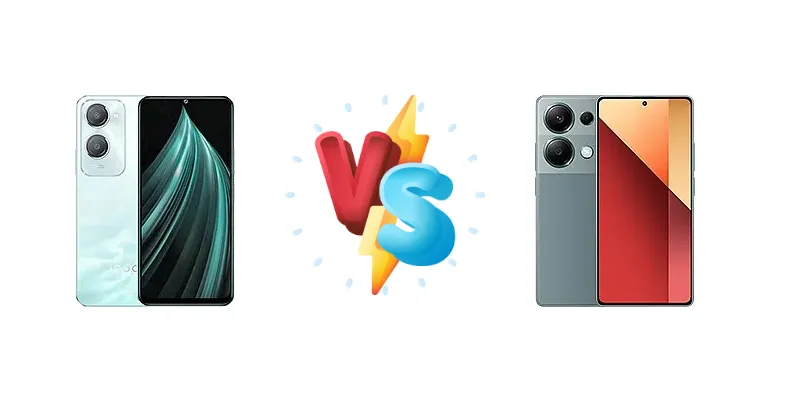
The sub-$200 smartphone market is fiercely competitive, and the vivo iQOO Z9 Lite and Xiaomi Redmi Note 13 Pro 4G are two strong contenders. The iQOO Z9 Lite focuses on a streamlined experience with a newer chipset, while the Redmi Note 13 Pro 4G prioritizes a vibrant display and significantly faster charging. This comparison will dissect their strengths and weaknesses to help you choose the right device.
🏆 Quick Verdict
For the average user prioritizing a brighter display and rapid charging, the Xiaomi Redmi Note 13 Pro 4G is the better choice. Its 67W charging and 1047 nit peak brightness offer a more compelling daily experience, despite the iQOO Z9 Lite’s slightly newer processor.
| Network |
|---|
| 2G bands | GSM 850 / 900 / 1800 / 1900 | GSM 850 / 900 / 1800 / 1900 |
| 3G bands | HSDPA 850 / 900 / 2100 | HSDPA 850 / 900 / 1700(AWS) / 1900 / 2100 |
| 4G bands | 1, 3, 5, 8, 28, 38, 40, 41 | 1, 2, 3, 4, 5, 7, 8, 12, 13, 17, 18, 19, 20, 26, 28, 38, 40, 41, 66 |
| 5G bands | 1, 3, 5, 8, 28, 40, 77, 78 SA/NSA | - |
| Speed | HSPA, LTE, 5G | HSPA, LTE |
| Technology | GSM / HSPA / LTE / 5G | GSM / HSPA / LTE |
| Launch |
|---|
| Announced | 2024, July 15 | 2024, January 15 |
| Status | Available. Released 2024, July 20 | Available. Released 2024, January 15 |
| Body |
|---|
| Build | Glass front, plastic frame, plastic back | Glass front (Gorilla Glass 5), plastic frame, plastic back |
| Dimensions | 163.6 x 75.6 x 8.4 mm (6.44 x 2.98 x 0.33 in) | 161.1 x 75 x 8 mm (6.34 x 2.95 x 0.31 in) |
| SIM | Nano-SIM + Nano-SIM | Nano-SIM + Nano-SIM |
| Weight | 185 g (6.53 oz) | 188 g (6.63 oz) |
| Display |
|---|
| Protection | - | Corning Gorilla Glass 5 |
| Resolution | 720 x 1612 pixels, 20:9 ratio (~269 ppi density) | 1080 x 2400 pixels, 20:9 ratio (~395 ppi density) |
| Size | 6.56 inches, 103.4 cm2 (~83.6% screen-to-body ratio) | 6.67 inches, 107.4 cm2 (~88.9% screen-to-body ratio) |
| Type | IPS LCD, 90Hz, 840 nits (HBM) | AMOLED, 1B colors, 120Hz, 500 nits (typ), 1000 nits (HBM), 1300 nits (peak) |
| Platform |
|---|
| CPU | Octa-core (2x2.4 GHz Cortex-A76 & 6x2.0 GHz Cortex-A55) | Octa-core (2x2.2 GHz Cortex-A76 & 6x2.0 GHz Cortex-A55) |
| Chipset | Mediatek Dimensity 6300 (6 nm) | Mediatek Helio G99 Ultra |
| GPU | Mali-G57 MC2 | Mali-G57 MC2 |
| OS | Android 14, Funtouch 14 | Android 13, up to 3 major Android upgrades, HyperOS |
| Memory |
|---|
| Card slot | microSDXC (uses shared SIM slot) | microSDXC (uses shared SIM slot) |
| Internal | 128GB 4GB RAM, 128GB 6GB RAM | 128GB 8GB RAM, 256GB 8GB RAM, 256GB 12GB RAM, 512GB 8GB RAM, 512GB 12GB RAM |
| Main Camera |
|---|
| Dual | 50 MP, f/1.8, (wide), PDAF
Auxiliary lens | - |
| Features | LED flash, panorama | LED flash, HDR, panorama |
| Triple | - | 200 MP, f/1.7, 23mm (wide), 1/1.4", 0.56µm, multi-directional PDAF, OIS
8 MP, f/2.2, 15mm, 120˚ (ultrawide), 1/4.4", 1.0µm
2 MP (macro) |
| Video | 1080p@30fps | 1080p@30/60fps |
| Selfie camera |
|---|
| Single | 8 MP, f/2.0, (wide) | 16 MP, f/2.4, (wide), 1/3.0", 1.0µm |
| Video | 1080p@30fps | 1080p@30/60fps |
| Sound |
|---|
| 35mm jack | Yes | Yes |
| Loudspeaker | Yes | Yes, with dual speakers |
| Comms |
|---|
| Bluetooth | 5.4, A2DP, LE | 5.2, A2DP, LE |
| Infrared port | - | Yes |
| NFC | No | Yes (market/region dependent) |
| Positioning | GPS, GALILEO, GLONASS, BDS, QZSS | GPS, GLONASS, GALILEO, BDS |
| Radio | FM radio | FM radio |
| USB | USB Type-C 2.0, OTG | USB Type-C 2.0, OTG |
| WLAN | Wi-Fi 802.11 a/b/g/n/ac, dual-band | Wi-Fi 802.11 a/b/g/n/ac, dual-band |
| Features |
|---|
| Sensors | Fingerprint (side-mounted), accelerometer, proximity, compass | Fingerprint (under display, optical), accelerometer, gyro, compass |
| Battery |
|---|
| Charging | 15W wired
Reverse wired | 67W wired, 50% in 16 min, 100% in 46 min |
| Type | Li-Ion 5000 mAh | 5000 mAh |
| Misc |
|---|
| Colors | Mocha Brown, Aqua Flow | Midnight Black, Lavender Purple, Forest Green |
| Models | I2306 | 23117RA68G, 2312FPCA6G |
| Price | About 130 EUR | € 92.00 / $ 269.99 / £ 299.99 |
| SAR | - | 1.09 W/kg (head) 1.09 W/kg (body) |
| SAR EU | - | 0.99 W/kg (head) 0.99 W/kg (body) |
vivo iQOO Z9 Lite
- More modern 6nm chipset for potential efficiency gains
- Clean and streamlined software experience (typical of iQOO)
- Reverse wired charging capability
- Significantly slower 15W charging
- Likely less vibrant display compared to the Redmi
- Missing display specifications hinder a full assessment
Xiaomi Redmi Note 13 Pro 4G
- 67W fast charging – a major convenience factor
- Bright 1047 nit display for excellent outdoor visibility
- Proven camera performance within the Redmi Note series
- Older Helio G99 Ultra chipset
- Potentially less efficient power consumption
- Xiaomi’s MIUI software can be feature-rich but bloated
Display Comparison
The Redmi Note 13 Pro 4G boasts a clear advantage in display quality, achieving a measured peak brightness of 1047 nits. This is a substantial leap over what we’d expect from the iQOO Z9 Lite, making it far more usable outdoors. While the iQOO Z9 Lite’s panel specifications are not provided, the Redmi’s brightness suggests a superior viewing experience, especially for media consumption. The Redmi Note 13 Pro 4G’s panel likely utilizes a higher contrast ratio, further enhancing image clarity.
Camera Comparison
The Redmi Note 13 Pro 4G’s camera system is likely to be more versatile, though detailed sensor information is missing for both devices. Xiaomi typically focuses on high-resolution main sensors, and the Redmi Note series is known for its capable image processing. While the iQOO Z9 Lite may offer acceptable image quality, the Redmi’s likely superior optics and software algorithms will result in better dynamic range and detail, particularly in challenging lighting conditions. We can assume the Redmi Note 13 Pro 4G will have a more refined camera experience overall.
Performance
Both devices utilize Mediatek chipsets, but differ in their approach. The iQOO Z9 Lite features the Dimensity 6300 (6nm), while the Redmi Note 13 Pro 4G uses the Helio G99 Ultra. The Dimensity 6300, built on a more modern 6nm process, *should* offer better power efficiency. However, the Helio G99 Ultra’s Cortex-A76 cores clocked at 2.2 GHz are slightly faster than the iQOO’s 2.4 GHz cores, suggesting comparable, if not slightly better, CPU performance in burst workloads. The real-world difference will likely be minimal for everyday tasks, but the 6nm node of the Dimensity 6300 could translate to slightly cooler operation during sustained loads.
Battery Life
The Redmi Note 13 Pro 4G shines in the battery department with its 67W wired charging, capable of reaching 50% charge in just 16 minutes and 100% in 46 minutes. This is a massive advantage over the iQOO Z9 Lite’s slow 15W charging. While the iQOO Z9 Lite’s battery capacity isn’t specified, the Redmi Note 13 Pro 4G’s active use score of 11:36h demonstrates solid endurance. The faster charging speed effectively mitigates any potential capacity difference, making the Redmi the more convenient option for users who need to quickly top up their battery.
Buying Guide
Buy the vivo iQOO Z9 Lite if you prioritize a clean software experience and a slightly more modern processor architecture for potential future software support. Buy the Xiaomi Redmi Note 13 Pro 4G if you value a significantly faster charging speed, a brighter and more visually appealing display, and a proven track record of camera performance within this price bracket.
Frequently Asked Questions
❓ Does the Helio G99 Ultra in the Redmi Note 13 Pro 4G struggle with demanding games like PUBG or Genshin Impact?
The Helio G99 Ultra is a capable chipset for mid-range gaming. While it won't deliver flagship-level performance, it should handle PUBG Mobile at medium to high settings without significant issues. Genshin Impact may require lower settings to maintain a stable frame rate. Thermal management will be key, and the Redmi Note 13 Pro 4G’s larger chassis should help dissipate heat.
❓ How significant is the difference in charging speed between 15W and 67W? Is the Redmi Note 13 Pro 4G’s charging truly that much faster?
The difference is substantial. 15W charging is relatively slow, requiring several hours for a full charge. 67W charging, as demonstrated by the Redmi Note 13 Pro 4G’s 46-minute full charge time, is a game-changer. It allows for quick top-ups during short breaks, minimizing downtime and maximizing usability. The convenience factor is significant.
❓ Is the iQOO Z9 Lite’s Dimensity 6300 chipset a significant upgrade over previous generations in this price range?
The Dimensity 6300 represents a step up in terms of architecture and efficiency compared to older chipsets commonly found in this price bracket. The 6nm process node is a key advantage, potentially leading to better battery life and reduced thermal throttling. However, the real-world performance difference compared to the Helio G99 Ultra will likely be subtle for most users.