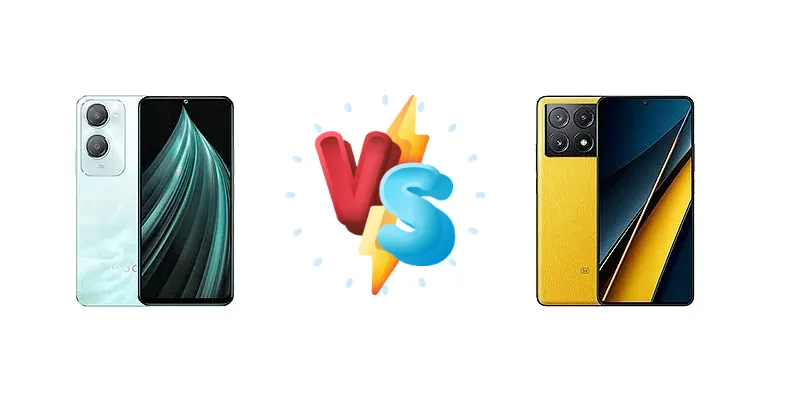
The sub-$300 smartphone market is fiercely competitive, and the vivo iQOO Z9 Lite and Xiaomi Poco X6 Pro are two contenders vying for the crown. The iQOO Z9 Lite focuses on efficient power delivery, while the Poco X6 Pro aims for raw performance with a more powerful chipset. This comparison dissects their key differences to determine which device delivers the best experience for your money.
🏆 Quick Verdict
For most users, the Xiaomi Poco X6 Pro is the clear winner. Its Dimensity 8300 Ultra chipset provides significantly superior performance, complemented by 67W fast charging and a brighter display. While the iQOO Z9 Lite offers respectable efficiency, it can't match the X6 Pro's overall capabilities.
| Network |
|---|
| 2G bands | GSM 850 / 900 / 1800 / 1900 | GSM 850 / 900 / 1800 / 1900 |
| 3G bands | HSDPA 850 / 900 / 2100 | HSDPA 850 / 900 / 1700(AWS) / 1900 / 2100 |
| 4G bands | 1, 3, 5, 8, 28, 38, 40, 41 | 1, 2, 3, 4, 5, 7, 8, 18, 19, 20, 28, 38, 40, 41, 48, 66 |
| 5G bands | 1, 3, 5, 8, 28, 40, 77, 78 SA/NSA | 1, 2, 3, 5, 7, 8, 20, 28, 38, 40, 41, 48, 77, 78 SA/NSA/Sub6 |
| Speed | HSPA, LTE, 5G | HSPA, LTE, 5G |
| Technology | GSM / HSPA / LTE / 5G | GSM / HSPA / LTE / 5G |
| Launch |
|---|
| Announced | 2024, July 15 | 2024, January 11 |
| Status | Available. Released 2024, July 20 | Available. Released 2024, January 12 |
| Body |
|---|
| Build | Glass front, plastic frame, plastic back | Glass front (Gorilla Glass 5), plastic frame, plastic back or silicone polymer back (eco leather) |
| Dimensions | 163.6 x 75.6 x 8.4 mm (6.44 x 2.98 x 0.33 in) | 160.5 x 74.3 x 8.3 mm (6.32 x 2.93 x 0.33 in) |
| SIM | Nano-SIM + Nano-SIM | Nano-SIM + Nano-SIM |
| Weight | 185 g (6.53 oz) | 186 g or 190 g (6.56 oz) |
| Display |
|---|
| Protection | - | Corning Gorilla Glass 5 |
| Resolution | 720 x 1612 pixels, 20:9 ratio (~269 ppi density) | 1220 x 2712 pixels, 20:9 ratio (~446 ppi density) |
| Size | 6.56 inches, 103.4 cm2 (~83.6% screen-to-body ratio) | 6.67 inches, 107.4 cm2 (~90.1% screen-to-body ratio) |
| Type | IPS LCD, 90Hz, 840 nits (HBM) | AMOLED, 68B colors, 120Hz, 1920Hz PWM, HDR10+, Dolby Vision, 500 nits (typ), 1200 nits (HBM), 1800 nits (peak) |
| Platform |
|---|
| CPU | Octa-core (2x2.4 GHz Cortex-A76 & 6x2.0 GHz Cortex-A55) | Octa-core (1x3.35 GHz Cortex-A715 & 3x3.20 GHz Cortex-A715 & 4x2.20 GHz Cortex-A510) |
| Chipset | Mediatek Dimensity 6300 (6 nm) | Mediatek Dimensity 8300 Ultra (4 nm) |
| GPU | Mali-G57 MC2 | Mali G615-MC6 |
| OS | Android 14, Funtouch 14 | Android 14, up to 3 major Android upgrades, HyperOS |
| Memory |
|---|
| Card slot | microSDXC (uses shared SIM slot) | No |
| Internal | 128GB 4GB RAM, 128GB 6GB RAM | 256GB 8GB RAM, 256GB 12GB RAM, 512GB 12GB RAM |
| Main Camera |
|---|
| Dual | 50 MP, f/1.8, (wide), PDAF
Auxiliary lens | - |
| Features | LED flash, panorama | LED flash, HDR, panorama |
| Triple | - | 64 MP, f/1.7, 25mm (wide), 1/2.0", 0.7µm, PDAF, OIS
8 MP, f/2.2, 120˚ (ultrawide), 1/4.0", 1.12µm
2 MP (macro) |
| Video | 1080p@30fps | 4K@24/30fps, 1080p@30/60fps, gyro-EIS |
| Selfie camera |
|---|
| Features | - | HDR, panorama |
| Single | 8 MP, f/2.0, (wide) | 16 MP, f/2.4, (wide), 1/3.06", 1.0µm |
| Video | 1080p@30fps | 1080p@30/60fps |
| Sound |
|---|
| 35mm jack | Yes | No |
| Loudspeaker | Yes | Yes, with dual speakers |
| Comms |
|---|
| Bluetooth | 5.4, A2DP, LE | 5.4, A2DP, LE, aptX HD |
| Infrared port | - | Yes |
| NFC | No | Yes (market/region dependent) |
| Positioning | GPS, GALILEO, GLONASS, BDS, QZSS | GPS, GALILEO, GLONASS, QZSS, BDS (B1I+B1c) |
| Radio | FM radio | No |
| USB | USB Type-C 2.0, OTG | USB Type-C 2.0, OTG |
| WLAN | Wi-Fi 802.11 a/b/g/n/ac, dual-band | Wi-Fi 802.11 a/b/g/n/ac/6, dual-band, Wi-Fi Direct |
| Features |
|---|
| Sensors | Fingerprint (side-mounted), accelerometer, proximity, compass | Fingerprint (under display, optical), accelerometer, gyro, compass |
| Battery |
|---|
| Charging | 15W wired
Reverse wired | 67W wired, QC2.0, PD3.0, 100% in 45 min |
| Type | Li-Ion 5000 mAh | 5000 mAh |
| Misc |
|---|
| Colors | Mocha Brown, Aqua Flow | Black, Yellow, Gray |
| Models | I2306 | 2311DRK48G, 2311DRK48I |
| Price | About 130 EUR | € 195.30 / $ 209.79 / £ 274.99 / ₹ 21,999 |
| SAR EU | - | 0.99 W/kg (head) 1.00 W/kg (body) |
vivo iQOO Z9 Lite
- Potentially better power efficiency with the Dimensity 6300.
- Reverse wired charging offers added convenience.
- Likely more affordable price point.
- Significantly weaker performance compared to the Poco X6 Pro.
- Slow 15W charging.
- Likely a less vibrant and dimmer display.
Xiaomi Poco X6 Pro
- Exceptional performance with the Dimensity 8300 Ultra.
- 67W fast charging with QC2.0 and PD3.0 support.
- Bright and vibrant display (1148 nits).
- Superior battery life (11:46h active use).
- Higher price compared to the iQOO Z9 Lite.
- Potentially more heat generation under heavy load.
Display Comparison
The Poco X6 Pro boasts a significantly brighter display, reaching a measured 1148 nits, making it far more usable outdoors under direct sunlight. The iQOO Z9 Lite’s display specifications are not provided, but given its price point, it likely falls considerably short of this peak brightness. This difference impacts visibility and overall viewing experience. While panel technology (LCD vs AMOLED) isn't specified for either, the X6 Pro’s brightness suggests a higher-quality panel. Bezels and color accuracy are also likely superior on the X6 Pro, given its more premium positioning.
Camera Comparison
Detailed camera specifications for both devices are limited. However, the Poco X6 Pro’s inclusion of 'Photo / Video' suggests a more robust camera system. While both phones likely feature multiple lenses, the X6 Pro’s higher price point implies a larger main sensor and potentially optical image stabilization (OIS). The iQOO Z9 Lite likely relies on software processing to compensate for a potentially smaller sensor. The presence of a 2MP macro camera on either device is largely irrelevant, offering minimal practical benefit.
Performance
The core difference lies in the chipsets: the iQOO Z9 Lite utilizes the Mediatek Dimensity 6300 (6nm), while the Poco X6 Pro features the Dimensity 8300 Ultra (4nm). The 8300 Ultra’s architecture – a 1x3.35 GHz Cortex-A715, 3x3.20 GHz Cortex-A715, and 4x2.20 GHz Cortex-A510 – is a substantial upgrade over the Z9 Lite’s 2x2.4 GHz Cortex-A76 & 6x2.0 GHz Cortex-A55. The 4nm process node of the 8300 Ultra also translates to better thermal efficiency, reducing throttling during sustained workloads like gaming. The X6 Pro will deliver a smoother, faster experience in demanding applications and games.
Battery Life
The Poco X6 Pro’s active use score of 11:46h demonstrates excellent battery life, likely due to the efficient Dimensity 8300 Ultra and intelligent power management. While the iQOO Z9 Lite’s battery capacity isn’t specified, its 15W charging is significantly slower than the X6 Pro’s 67W charging, which can reach 100% in just 45 minutes. This charging speed difference is a major convenience factor, especially for users who frequently need to top up their battery. The X6 Pro’s support for QC2.0 and PD3.0 further enhances its charging versatility.
Buying Guide
Buy the vivo iQOO Z9 Lite if you prioritize long-term efficiency and are primarily focused on everyday tasks and light gaming. Its Mediatek Dimensity 6300 is sufficient for basic use cases. Buy the Xiaomi Poco X6 Pro if you demand strong gaming performance, faster charging, and a brighter, more vibrant display. It’s the better choice for power users and mobile gamers.
Frequently Asked Questions
❓ Will the Poco X6 Pro’s Dimensity 8300 Ultra get noticeably hot during prolonged gaming sessions?
While the Dimensity 8300 Ultra is a powerful chip, its 4nm process node and the Poco X6 Pro’s thermal design should mitigate excessive heat. Some warmth is expected during extended gaming, but it’s unlikely to cause significant throttling or discomfort. The iQOO Z9 Lite, while cooler, will experience more performance drops under the same load.
❓ Is the 67W charging on the Poco X6 Pro compatible with all USB-C chargers?
The Poco X6 Pro supports USB Power Delivery (PD3.0) and Quick Charge (QC2.0). While it will charge with any USB-C charger, you’ll only achieve the full 67W speed with a charger that supports these protocols. Using a standard USB-C charger will result in slower charging times.
❓ Does the iQOO Z9 Lite have a headphone jack?
This information is not provided in the context data. However, based on iQOO’s recent trends and the price point of the Z9 Lite, it's likely the device *does not* include a 3.5mm headphone jack, requiring users to utilize USB-C headphones or a dongle.