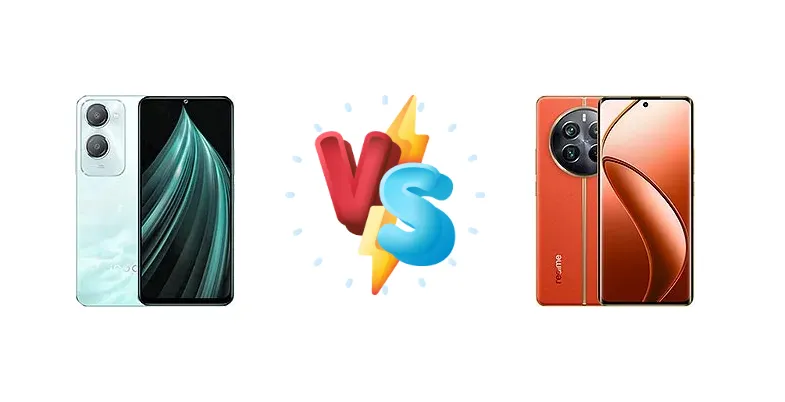
The mid-range smartphone market is fiercely competitive, and the Realme 12 Pro+ and vivo iQOO Z9 Lite represent compelling options for budget-conscious buyers. The Realme 12 Pro+ aims for a premium feel with its faster charging and brighter display, while the iQOO Z9 Lite focuses on efficient performance with its Dimensity 6300 chipset. This comparison dives deep into the specifications and real-world implications to determine which device offers the best value.
🏆 Quick Verdict
For the average user prioritizing fast charging and a vibrant display, the Realme 12 Pro+ is the stronger choice. Its 67W charging significantly reduces downtime, and the 802 nit peak brightness ensures excellent visibility. However, the iQOO Z9 Lite offers a compelling alternative for those prioritizing chipset efficiency.
| Network |
|---|
| 2G bands | GSM 850 / 900 / 1800 / 1900 | GSM 850 / 900 / 1800 / 1900 |
| 3G bands | HSDPA 850 / 900 / 2100 | HSDPA 850 / 900 / 2100 |
| 4G bands | 1, 3, 5, 8, 28, 38, 40, 41 | 1, 3, 5, 8, 28, 40, 41 |
| 5G bands | 1, 3, 5, 8, 28, 40, 77, 78 SA/NSA | 1, 3, 5, 8, 28, 40, 41, 77, 78 SA/NSA |
| Speed | HSPA, LTE, 5G | HSPA, LTE, 5G |
| Technology | GSM / HSPA / LTE / 5G | GSM / HSPA / LTE / 5G |
| Launch |
|---|
| Announced | 2024, July 15 | 2024, January 29 |
| Status | Available. Released 2024, July 20 | Available. Released 2024, January 29 |
| Body |
|---|
| Build | Glass front, plastic frame, plastic back | - |
| Dimensions | 163.6 x 75.6 x 8.4 mm (6.44 x 2.98 x 0.33 in) | 161.5 x 74 x 8.8 mm (6.36 x 2.91 x 0.35 in) |
| SIM | Nano-SIM + Nano-SIM | Nano-SIM + Nano-SIM |
| Weight | 185 g (6.53 oz) | 196 g (6.91 oz) |
| Display |
|---|
| Resolution | 720 x 1612 pixels, 20:9 ratio (~269 ppi density) | 1080 x 2412 pixels, 20:9 ratio (~394 ppi density) |
| Size | 6.56 inches, 103.4 cm2 (~83.6% screen-to-body ratio) | 6.7 inches, 108.0 cm2 (~90.4% screen-to-body ratio) |
| Type | IPS LCD, 90Hz, 840 nits (HBM) | AMOLED, 1B colors, 120Hz, 800 nits (HBM), 950 nits (peak) |
| Platform |
|---|
| CPU | Octa-core (2x2.4 GHz Cortex-A76 & 6x2.0 GHz Cortex-A55) | Octa-core (4x2.40 GHz Cortex-A78 & 4x1.95 GHz Cortex-A55) |
| Chipset | Mediatek Dimensity 6300 (6 nm) | Qualcomm SM7435-AB Snapdragon 7s Gen 2 (4 nm) |
| GPU | Mali-G57 MC2 | Adreno 710 |
| OS | Android 14, Funtouch 14 | Android 14, Realme UI 5.0 |
| Memory |
|---|
| Card slot | microSDXC (uses shared SIM slot) | No |
| Internal | 128GB 4GB RAM, 128GB 6GB RAM | 128GB 8GB RAM, 256GB 8GB RAM, 256GB 12GB RAM, 512GB 12GB RAM |
| Main Camera |
|---|
| Dual | 50 MP, f/1.8, (wide), PDAF
Auxiliary lens | - |
| Features | LED flash, panorama | LED flash, HDR, panorama |
| Triple | - | 50 MP, f/1.8, 24mm (wide), 1/1.56", 1.0µm, multi-directional PDAF, OIS
64 MP, f/2.8, 71mm, (periscope telephoto), 1/2.0", 0.7µm, PDAF, OIS, 3x optical zoom
8 MP, f/2.2, 16mm, 112˚ (ultrawide), 1/4.0", 1.12µm |
| Video | 1080p@30fps | 4K@30fps, 1080p@30/60/120fps, gyro-EIS |
| Selfie camera |
|---|
| Single | 8 MP, f/2.0, (wide) | 32 MP, f/2.4, 22mm (wide) |
| Video | 1080p@30fps | 1080p@30fps |
| Sound |
|---|
| 35mm jack | Yes | No |
| Loudspeaker | Yes | Yes, with stereo speakers |
| Comms |
|---|
| Bluetooth | 5.4, A2DP, LE | 5.2, A2DP, LE |
| NFC | No | Yes (market/region dependent) |
| Positioning | GPS, GALILEO, GLONASS, BDS, QZSS | GPS, GLONASS, GALILEO, BDS, QZSS |
| Radio | FM radio | No |
| USB | USB Type-C 2.0, OTG | USB Type-C 2.0 |
| WLAN | Wi-Fi 802.11 a/b/g/n/ac, dual-band | Wi-Fi 802.11 a/b/g/n/ac/6, dual-band |
| Features |
|---|
| Sensors | Fingerprint (side-mounted), accelerometer, proximity, compass | Fingerprint (under display, optical), accelerometer, gyro, proximity, compass |
| Battery |
|---|
| Charging | 15W wired
Reverse wired | 67W wired, 50% in 19 min |
| Type | Li-Ion 5000 mAh | 5000 mAh |
| Misc |
|---|
| Colors | Mocha Brown, Aqua Flow | Submarine Blue, Navigator Beige, Explorer Red |
| Models | I2306 | RMX3840, RMX3841 |
| Price | About 130 EUR | $ 465.00 / £ 299.00 / € 344.26 / ₹ 28,400 |
vivo iQOO Z9 Lite
- More efficient Dimensity 6300 chipset
- Potentially better value for money
- Reverse wired charging capability
- Significantly slower 15W charging
- Likely less powerful CPU/GPU
- Display brightness likely lower
Realme 12 Pro+
- Blazing-fast 67W charging
- Brighter 802 nit display
- More powerful Snapdragon 7s Gen 2 chipset
- Potentially lower battery life (despite good score)
- Higher price point
- No reverse wireless charging
Display Comparison
The Realme 12 Pro+ boasts a significantly brighter display, reaching a measured 802 nits, compared to an unstated value for the iQOO Z9 Lite. This brightness advantage translates to better outdoor visibility, especially under direct sunlight. While panel technology isn't specified for either, the Realme's higher peak brightness suggests a more advanced panel. Bezels are likely comparable given the price points, but the Realme's display is the clear winner for users who consume a lot of media or work outdoors.
Camera Comparison
Without detailed camera specifications for either device beyond the presence of a camera, a direct comparison is limited. However, the Realme 12 Pro+ is positioned as a more premium device, suggesting a potentially more capable camera system. The focus should be on the main sensor resolution and aperture, which are currently unknown. The iQOO Z9 Lite likely features a more basic camera setup geared towards casual photography. The absence of information on Optical Image Stabilization (OIS) for either device suggests it's unlikely to be present, limiting low-light performance.
Performance
The Realme 12 Pro+ utilizes the Qualcomm SM7435-AB Snapdragon 7s Gen 2 (4nm), featuring four Cortex-A78 cores clocked at 2.40 GHz. This contrasts with the iQOO Z9 Lite’s Mediatek Dimensity 6300 (6nm) and its two Cortex-A76 cores at 2.4 GHz. The Snapdragon 7s Gen 2’s 4nm process offers superior power efficiency and potentially better sustained performance under load, reducing thermal throttling during extended gaming sessions. While both CPUs have similar peak clock speeds, the architectural improvements in the Snapdragon 7s Gen 2, particularly the newer Cortex-A78 cores, provide a performance edge. The iQOO Z9 Lite's 6nm process aims to balance performance and efficiency, but likely falls behind in raw processing power.
Battery Life
The Realme 12 Pro+ shines with its 67W wired charging, capable of reaching 50% charge in just 19 minutes. This is a substantial advantage over the iQOO Z9 Lite’s slower 15W charging. While the iQOO Z9 Lite’s battery capacity is unstated, the Realme 12 Pro+’s active use score of 13:24h demonstrates solid battery life. The faster charging of the Realme 12 Pro+ mitigates any potential disadvantage from a slightly smaller battery capacity, offering a more convenient user experience.
Buying Guide
Buy the vivo iQOO Z9 Lite if you need a phone that prioritizes efficient all-day performance and are comfortable with slower charging speeds. It's ideal for users who primarily browse, use social media, and make calls. Buy the Realme 12 Pro+ if you prefer a brighter, more visually engaging display and value the convenience of incredibly fast 67W charging, making it a better fit for power users and those who frequently capture photos and videos.
Frequently Asked Questions
❓ Does the Mediatek Dimensity 6300 in the iQOO Z9 Lite struggle with demanding games like Genshin Impact?
While the Dimensity 6300 is a capable chipset for everyday tasks, demanding games like Genshin Impact may require reduced graphics settings to maintain a stable frame rate. The Snapdragon 7s Gen 2 in the Realme 12 Pro+ offers a more comfortable gaming experience with higher sustained performance.
❓ How much faster is the 67W charging on the Realme 12 Pro+ compared to the 15W charging on the iQOO Z9 Lite in real-world use?
The 67W charging on the Realme 12 Pro+ can take a phone from 0% to 50% in approximately 19 minutes. The iQOO Z9 Lite’s 15W charging will take significantly longer – likely over an hour to reach 50% – making the Realme 12 Pro+ much more convenient for users who need a quick power boost.
❓ Is the lack of OIS on either phone a significant drawback for photography?
The absence of Optical Image Stabilization (OIS) on both devices means that photos and videos taken in low-light conditions may exhibit more blur due to hand shake. Using a tripod or relying on well-lit environments is recommended for optimal results.