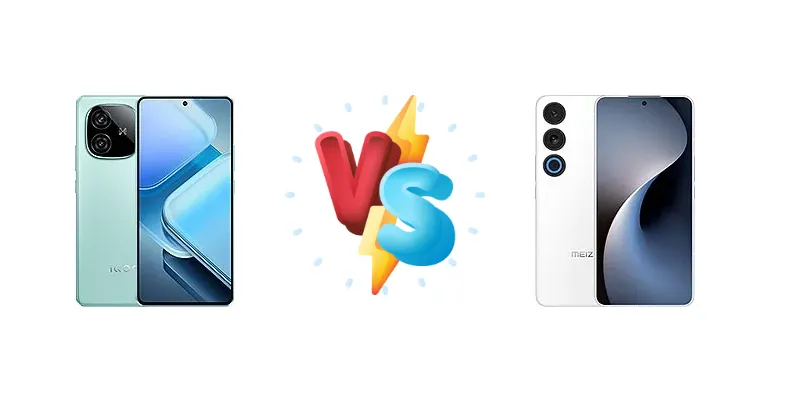
The iQOO Z9 and Meizu 21 Note represent compelling options in the increasingly competitive mid-range smartphone market. While both devices leverage Qualcomm's Snapdragon platform, they target different performance tiers. The iQOO Z9 focuses on delivering strong performance at an aggressive price point with the Snapdragon 7 Gen 3, while the Meizu 21 Note aims for near-flagship capabilities with the older, but still potent, Snapdragon 8 Gen 2. This comparison will dissect the key differences to help you determine which device best suits your needs.
🏆 Quick Verdict
For the average user prioritizing raw performance and future-proofing, the Meizu 21 Note is the clear winner. The Snapdragon 8 Gen 2 offers a substantial leap in CPU and GPU capabilities over the Snapdragon 7 Gen 3. However, the iQOO Z9 presents a compelling value proposition for budget-conscious gamers and everyday users who don't require the absolute highest performance.
| Network |
|---|
| 2G bands | GSM 850 / 900 / 1800 / 1900 | GSM 850 / 900 / 1800 / 1900 |
| 3G bands | HSDPA 850 / 900 / 2100 | HSDPA 850 / 900 / 2100 |
| 4G bands | 1, 3, 5, 8, 28, 34, 38, 39, 40, 41 | 1, 3, 4, 5, 8, 28, 34, 38, 39, 40, 41 |
| 5G bands | 1, 5, 8, 28, 38, 41, 77, 78 SA/NSA | 1, 3, 5, 8, 28, 38, 40, 41, 77, 78 SA/NSA |
| Speed | HSPA, LTE, 5G | HSPA, LTE, 5G |
| Technology | GSM / CDMA / HSPA / LTE / 5G | GSM / HSPA / LTE / 5G |
| Launch |
|---|
| Announced | 2024, April 24 | 2024, May 16 |
| Status | Available. Released 2024, April 29 | Available. Released 2024, May 21 |
| Body |
|---|
| Build | - | Glass front, aluminum frame, plastic back |
| Dimensions | 163.7 x 75.9 x 8 mm (6.44 x 2.99 x 0.31 in) | 162.4 x 76.9 x 8.2 mm (6.39 x 3.03 x 0.32 in) |
| SIM | Nano-SIM + Nano-SIM | Nano-SIM + Nano-SIM |
| Weight | 194.6 g (6.88 oz) | 205 g (7.23 oz) |
| Display |
|---|
| Resolution | 1260 x 2800 pixels, 20:9 ratio (~453 ppi density) | 1264 x 2780 pixels (~450 ppi density) |
| Size | 6.78 inches, 111.0 cm2 (~89.3% screen-to-body ratio) | 6.78 inches, 111.7 cm2 (~89.5% screen-to-body ratio) |
| Type | AMOLED, 1B colors, 144Hz, HDR, 4500 nits (peak) | LTPO OLED, 1B colors, 144Hz, HDR10+, 800 nits (typ), 1600 nits (HBM), 5000 nits (peak) |
| Platform |
|---|
| CPU | Octa-core (1x2.63 GHz Cortex-A715 & 4x2.4 GHz Cortex-A715 & 3x1.8 GHz Cortex-A510) | Octa-core (1x3.2 GHz Cortex-X3 & 2x2.8 GHz Cortex-A715 & 2x2.8 GHz Cortex-A710 & 3x2.0 GHz Cortex-A510) |
| Chipset | Qualcomm SM7550-AB Snapdragon 7 Gen 3 (4 nm) | Qualcomm SM8550-AB Snapdragon 8 Gen 2 (4 nm) |
| GPU | Adreno 720 | Adreno 740 |
| OS | Android 14, OriginOS 4 | Flyme OS |
| Memory |
|---|
| Card slot | No | No |
| Internal | 128GB 8GB RAM, 256GB 8GB RAM, 256GB 12GB RAM, 512GB 12GB RAM | 256GB 16GB RAM, 512GB 16GB RAM |
| Main Camera |
|---|
| Dual | 50 MP, f/1.8, (wide), 1/1.95", 0.8µm, PDAF
Auxiliary lens | 50 MP, f/1.7, 24mm (wide), 1/1.56", PDAF, OIS
13 MP, f/2.4, 16mm, 122˚ (ultrawide), AF |
| Features | LED flash, panorama, HDR | Ring-LED flash, panorama, HDR |
| Video | 4K@30fps, 1080p, gyro-EIS | 8K, 4K, 1080p; gyro-EIS |
| Selfie camera |
|---|
| Features | - | HDR |
| Single | 16 MP, f/2.5, (wide), 1/3.0", 1.0µm | 16 MP, f/2.5, (wide) |
| Video | 1080p@30fps | Yes |
| Sound |
|---|
| 35mm jack | No | No |
| Loudspeaker | Yes, with stereo speakers | Yes, with stereo speakers |
| Comms |
|---|
| Bluetooth | 5.4, A2DP, LE, aptX HD, aptX Adaptive, aptX Lossless | 5.3, A2DP, LE, aptX HD, LHDC |
| Infrared port | Yes | Yes |
| NFC | Yes | Yes |
| Positioning | GPS, GALILEO, GLONASS, QZSS, BDS (B1I+B1c) | GPS (L1+L5), GLONASS, GALILEO, BDS, QZSS, NavIC |
| Radio | No | No |
| USB | USB Type-C 2.0, OTG | USB Type-C 2.0, OTG |
| WLAN | Wi-Fi 802.11 a/b/g/n/ac/6, dual-band | Wi-Fi 802.11 а/b/g/n/ac/6e/7, tri-band |
| Features |
|---|
| Sensors | Fingerprint (under display, optical), accelerometer, gyro, proximity, compass | Fingerprint (under display, ultrasonic), accelerometer, gyro, proximity, compass |
| Battery |
|---|
| Charging | 80W wired
7.5W reverse wired | 65W wired, PD3 PPS, QC4+ |
| Type | 6000 mAh | 5500 mAh |
| Misc |
|---|
| Colors | Black, White, Green | Black, White |
| Models | V2361A | - |
| Price | About 190 EUR | About 330 EUR |
vivo iQOO Z9 (China)
- Faster 80W wired charging
- More affordable price point
- Solid performance for everyday tasks
- Less powerful Snapdragon 7 Gen 3 chipset
- Potentially lower-quality display
- Likely less advanced camera system
Meizu 21 Note
- Significantly more powerful Snapdragon 8 Gen 2 chipset
- Superior gaming performance
- Likely better display and camera quality
- Slower 65W wired charging
- Higher price tag
- May run slightly warmer under sustained load
Display Comparison
Neither device's display specifications are provided, so a direct comparison is limited. However, given the Meizu 21 Note's positioning, it likely features a higher-quality panel with potentially higher peak brightness and color accuracy. The iQOO Z9, targeting a lower price point, may utilize a more cost-effective display solution. The absence of LTPO technology in either device is a reasonable assumption given the price brackets, meaning refresh rate will likely be fixed rather than dynamically adjusted for power saving.
Camera Comparison
Without detailed camera specifications, a precise comparison is difficult. However, the Meizu 21 Note, being positioned higher, likely features a more sophisticated camera system with a larger main sensor and potentially optical image stabilization (OIS). The iQOO Z9 will likely rely on software processing to compensate for a potentially smaller sensor. The absence of information regarding lens apertures makes it impossible to assess low-light performance differences. It's safe to assume the Meizu 21 Note will offer a more versatile and higher-quality camera experience.
Performance
The core difference lies in the chipsets. The Meizu 21 Note’s Snapdragon 8 Gen 2 (4nm) boasts a significantly more powerful CPU configuration: 1x3.2 GHz Cortex-X3, 2x2.8 GHz Cortex-A715, 2x2.8 GHz Cortex-A710, and 3x2.0 GHz Cortex-A510. This contrasts with the iQOO Z9’s Snapdragon 7 Gen 3 (4nm) with 1x2.63 GHz Cortex-A715, 4x2.4 GHz Cortex-A715, and 3x1.8 GHz Cortex-A510. The Cortex-X3 prime core in the 8 Gen 2 provides a substantial performance advantage in single-threaded tasks and overall responsiveness. The 8 Gen 2’s Adreno 740 GPU also significantly outperforms the 7 Gen 3’s Adreno 670, translating to higher frame rates and better graphics fidelity in games. While both are built on a 4nm process, the architectural improvements and core count differences favor the 8 Gen 2 in both sustained performance and thermal efficiency.
Battery Life
The iQOO Z9’s 80W wired charging is a significant advantage over the Meizu 21 Note’s 65W charging, supporting PD3 PPS and QC4+. This means the iQOO Z9 will likely charge from 0-100% faster. While the Meizu 21 Note’s charging standards offer broader compatibility, the iQOO Z9’s higher wattage provides a quicker top-up. Battery capacity is not specified for either device, but the faster charging of the iQOO Z9 could offset a potentially smaller battery size for many users.
Buying Guide
Buy the vivo iQOO Z9 (China) if you need a capable all-rounder with fast 80W charging and prioritize value for money. It's ideal for everyday tasks, moderate gaming, and users who want a reliable phone without breaking the bank. Buy the Meizu 21 Note if you prefer a smoother, more responsive experience, demanding mobile gaming, and appreciate the benefits of a flagship-level chipset, even if it's a generation old. It's geared towards power users and those who want a phone that will remain performant for years to come.
Frequently Asked Questions
❓ Will the Snapdragon 7 Gen 3 in the iQOO Z9 struggle with demanding games like Genshin Impact?
While the Snapdragon 7 Gen 3 is a capable chipset, Genshin Impact and other graphically intensive games will likely require reduced graphics settings to maintain a stable frame rate. The Meizu 21 Note’s Snapdragon 8 Gen 2 will provide a significantly smoother experience at higher settings.
❓ Does the Meizu 21 Note's Snapdragon 8 Gen 2 tend to overheat during prolonged gaming sessions?
The Snapdragon 8 Gen 2 is known for its improved thermal efficiency compared to its predecessor. However, sustained gaming will inevitably generate heat. The Meizu 21 Note’s thermal management system will play a crucial role in preventing significant throttling, but some performance reduction is still possible during extended play.
❓ Is the 65W charging on the Meizu 21 Note slow compared to the iQOO Z9's 80W?
While 80W is faster on paper, 65W with PD3 PPS and QC4+ is still a very respectable charging speed. The difference in real-world charging times will likely be noticeable, but not dramatically so. Both phones offer relatively quick charging solutions.