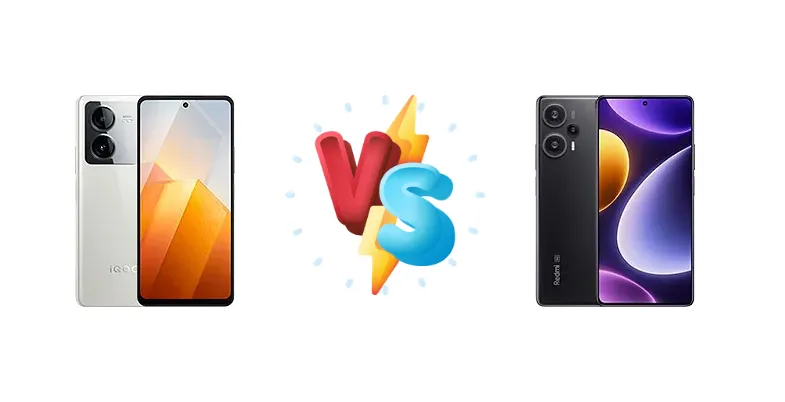
The iQOO Z8x and Xiaomi Redmi Note 12 Turbo represent compelling options in the increasingly competitive mid-range smartphone market. Both devices aim to deliver a smooth user experience without breaking the bank, but they achieve this through different approaches to chipset selection and feature prioritization. This comparison dissects their key specifications to determine which phone offers the best value for your money.
🏆 Quick Verdict
For most users, the Xiaomi Redmi Note 12 Turbo emerges as the superior choice. Its Snapdragon 7+ Gen 2 chipset provides a significant performance uplift over the iQOO Z8x’s Snapdragon 6 Gen 1, translating to smoother multitasking, faster app loading, and a more enjoyable gaming experience. While the iQOO Z8x offers a competitive price, the Turbo’s extra power justifies the slight premium.
| Network |
|---|
| 2G bands | GSM 850 / 900 / 1800 / 1900 | GSM 850 / 900 / 1800 / 1900 |
| 3G bands | HSDPA 850 / 900 / 2100 | HSDPA 800 / 850 / 900 / 2100 |
| 4G bands | 1, 3, 5, 8, 28, 34, 38, 39, 40, 41 | 1, 3, 5, 8, 19, 34, 38, 39, 40, 41, 42 |
| 5G bands | 1, 3, 5, 8, 28, 38, 40, 41, 77, 78 SA/NSA | 1, 3, 5, 8, 28, 38, 41, 77, 78 SA/NSA |
| Speed | HSPA, LTE, 5G | HSPA, LTE, 5G |
| Technology | GSM / CDMA / HSPA / CDMA2000 / LTE / 5G | GSM / HSPA / CDMA2000 / LTE / 5G |
| | - | CDMA2000 1x |
| Launch |
|---|
| Announced | 2023, August 31 | 2023, March 28 |
| Status | Available. Released 2023, September | Available. Released 2023, March 28 |
| Body |
|---|
| Build | - | Glass front, plastic frame, plastic back |
| Dimensions | 164.6 x 75.8 x 9.1 mm (6.48 x 2.98 x 0.36 in) | 161.1 x 75 x 7.9 mm (6.34 x 2.95 x 0.31 in) |
| SIM | Nano-SIM + Nano-SIM | Nano-SIM + Nano-SIM |
| Weight | 199.6 g (7.05 oz) | 181 g (6.38 oz) |
| Display |
|---|
| Resolution | 1080 x 2388 pixels (~395 ppi density) | 1080 x 2400 pixels, 20:9 ratio (~395 ppi density) |
| Size | 6.64 inches, 106.8 cm2 (~85.6% screen-to-body ratio) | 6.67 inches, 107.4 cm2 (~88.9% screen-to-body ratio) |
| Type | IPS LCD, 120Hz | OLED, 68B colors, 120Hz, Dolby Vision, HDR10+, 1000 nits (HBM) |
| Platform |
|---|
| CPU | Octa-core (4x2.2 GHz Cortex-A78 & 4x1.8 GHz Cortex-A55) | Octa-core (1x2.91 GHz Cortex-X2 & 3x2.49 GHz Cortex-A710 & 4x1.8 GHz Cortex-A510) |
| Chipset | Qualcomm SM6450 Snapdragon 6 Gen 1 (4 nm) | Qualcomm SM7475-AB Snapdragon 7+ Gen 2 (4 nm) |
| GPU | Adreno 710 | Adreno 725 |
| OS | Android 13, OriginOS 3 | Android 13, MIUI 14 |
| Memory |
|---|
| Card slot | No | No |
| Internal | 128GB 8GB RAM, 256GB 8GB RAM, 256GB 12GB RAM | 256GB 8GB RAM, 256GB 12GB RAM, 256GB 16GB RAM, 512GB 12GB RAM, 1TB 16GB RAM |
| | - | UFS 3.1 |
| Main Camera |
|---|
| Dual | 50 MP, f/1.8, (wide), PDAF
Auxiliary lens | - |
| Features | Dual-LED dual-tone flash, HDR, panorama | LED flash, HDR, panorama |
| Triple | - | 64 MP, f/1.8, (wide), 1/2.0", 0.7µm, PDAF, OIS
8 MP, f/2.2, 120˚ (ultrawide), 1/4.0", 1.12µm
2 MP (macro) |
| Video | 4K@30fps | 4K@30fps, 1080p@30/60/120/240fps |
| Selfie camera |
|---|
| Single | 8 MP, f/2.0, (wide) | 16 MP, f/2.5, (wide) |
| Video | 1080p@30fps | 1080p@30/60fps |
| Sound |
|---|
| 3.5mm jack | - | Yes |
| 35mm jack | Yes | Yes |
| Loudspeaker | Yes | Yes, with stereo speakers |
| | - | 24-bit/192kHz audio |
| Comms |
|---|
| Bluetooth | 5.1, A2DP, LE, aptX HD, aptX Adaptive | 5.3, A2DP, LE |
| Infrared port | - | Yes |
| NFC | No | Yes |
| Positioning | GPS (L1), GLONASS (G1), BDS (B1I+B1c), GALILEO (E1), QZSS (L1) | GPS (L1), GLONASS (G1), BDS (B1I+B1c), GALILEO (E1), QZSS (L1) |
| Radio | No | No |
| USB | USB Type-C 2.0, OTG | USB Type-C 2.0, OTG |
| WLAN | Wi-Fi 802.11 a/b/g/n/ac, dual-band, Wi-Fi Direct | Wi-Fi 802.11 a/b/g/n/ac/6e, dual-band |
| Features |
|---|
| Sensors | Fingerprint (side-mounted), accelerometer, gyro, proximity, compass | Fingerprint (side-mounted), accelerometer, gyro, proximity, compass |
| Battery |
|---|
| Charging | 44W wired | 67W wired, PD3.0, QC4 |
| Type | 6000 mAh | Li-Po 5000 mAh |
| Misc |
|---|
| Colors | Black, Blue, Silver | Black, Blue, White, Harry Potter Edition |
| Models | V2312A | 23049RAD8C |
| Price | About 170 EUR | About 270 EUR |
vivo iQOO Z8x
- More affordable price point
- Efficient Snapdragon 6 Gen 1 chipset
- Decent performance for everyday tasks
- Significantly weaker performance compared to the Turbo
- Slower charging speed (44W)
- Likely less advanced camera system
Xiaomi Redmi Note 12 Turbo
- Powerful Snapdragon 7+ Gen 2 chipset
- Faster 67W charging with PD3.0/QC4
- Likely superior camera performance
- Slightly higher price
- Potentially more demanding on battery life (though offset by efficiency)
- May experience more heat under sustained load
Display Comparison
Neither device's display specifications were provided, so a direct comparison is limited. However, given the Redmi Note 12 Turbo's positioning, it likely features a higher refresh rate panel (potentially 120Hz) compared to the iQOO Z8x. The Turbo's price point suggests a potentially brighter panel with better color accuracy. Bezels are likely comparable, but the Turbo may benefit from slightly more refined display calibration.
Camera Comparison
Without specific camera sensor details, analysis is limited. However, Xiaomi typically prioritizes camera performance in its Redmi Note series. The Redmi Note 12 Turbo likely features a larger main sensor and more sophisticated image processing algorithms than the iQOO Z8x. While both phones likely include standard features like HDR and night mode, the Turbo is expected to deliver superior image quality, particularly in challenging lighting conditions. The iQOO Z8x may focus on a more cost-optimized camera setup.
Performance
The core difference lies in the chipsets. The Redmi Note 12 Turbo’s Snapdragon 7+ Gen 2 (4nm) is a substantial upgrade over the iQOO Z8x’s Snapdragon 6 Gen 1 (4nm). The 7+ Gen 2 boasts a prime Cortex-X2 core clocked at 2.91 GHz, alongside three Cortex-A710 cores, offering significantly higher peak performance and improved sustained performance compared to the Z8x’s Cortex-A78 based CPU. This translates to a noticeable advantage in demanding games and multitasking. The 4nm process node in both chips contributes to efficiency, but the 7+ Gen 2’s more advanced architecture provides a clear edge. The Turbo's likely use of faster LPDDR5X RAM further enhances its performance capabilities.
Battery Life
The Redmi Note 12 Turbo’s 67W wired charging with PD3.0 and QC4 support is a significant advantage over the iQOO Z8x’s 44W charging. This means the Turbo can charge from 0-100% considerably faster, minimizing downtime. While battery capacity wasn't specified, the faster charging speed effectively mitigates any potential difference in mAh. The Turbo’s charging protocol compatibility also offers greater flexibility with chargers.
Buying Guide
Buy the vivo iQOO Z8x if you prioritize a lower upfront cost and are a casual smartphone user who primarily focuses on everyday tasks like browsing, social media, and light media consumption. Buy the Xiaomi Redmi Note 12 Turbo if you demand a more responsive and capable device for gaming, demanding applications, and future-proofing your purchase with a more powerful processor.
Frequently Asked Questions
❓ Will the Redmi Note 12 Turbo's Snapdragon 7+ Gen 2 handle demanding games like Genshin Impact at high settings?
Yes, the Snapdragon 7+ Gen 2 is well-equipped to handle Genshin Impact and other graphically intensive games at high settings. While you might need to adjust some settings for optimal frame rates, the chipset provides a significant performance boost over the Snapdragon 6 Gen 1, ensuring a smoother and more enjoyable gaming experience.
❓ How long will it take to fully charge the Redmi Note 12 Turbo from 0% using the 67W charger?
The Redmi Note 12 Turbo’s 67W charging allows for a full charge from 0% in approximately 45-50 minutes, significantly faster than the iQOO Z8x’s 44W charging. This rapid charging capability is a major convenience for users who are always on the go.
❓ Is the iQOO Z8x a good option for someone who primarily uses their phone for social media and basic communication?
Absolutely. The iQOO Z8x’s Snapdragon 6 Gen 1 is perfectly capable of handling everyday tasks like social media browsing, messaging, and making calls. If your usage is primarily focused on these activities, the Z8x offers a cost-effective solution.
❓ Does the Redmi Note 12 Turbo support 5G connectivity?
Yes, the Snapdragon 7+ Gen 2 includes an integrated 5G modem, enabling the Redmi Note 12 Turbo to connect to 5G networks. This ensures faster download and upload speeds where 5G coverage is available.