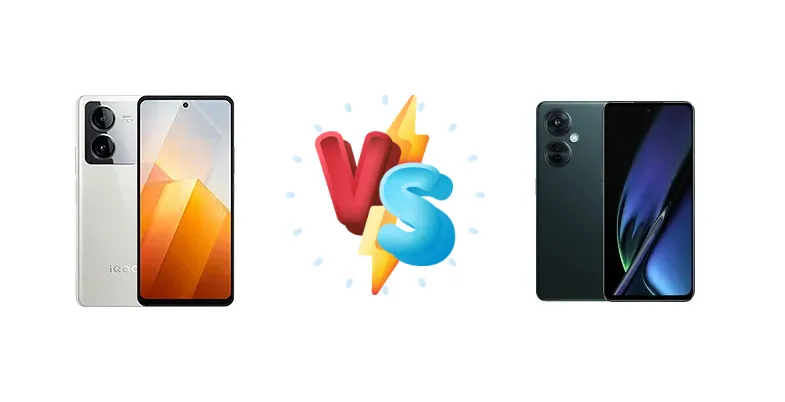
The iQOO Z8x and Oppo K11x represent compelling options in the increasingly competitive sub-$250 smartphone market. Both aim to deliver 5G connectivity and a smooth user experience, but they achieve this through different chipsets and prioritize different features. This comparison dissects their core specifications to determine which device offers the best value for your money.
🏆 Quick Verdict
For the average user prioritizing fast charging and a slightly broader 5G band support, the Oppo K11x is the better choice. However, the iQOO Z8x’s more efficient Snapdragon 6 Gen 1 offers a potential edge in sustained performance and thermal management, making it ideal for moderate gamers.
| Network |
|---|
| 2G bands | GSM 850 / 900 / 1800 / 1900 | GSM 850 / 900 / 1800 / 1900 |
| 3G bands | HSDPA 850 / 900 / 2100 | HSDPA 850 / 900 / 1700(AWS) / 2100 |
| 4G bands | 1, 3, 5, 8, 28, 34, 38, 39, 40, 41 | 1, 3, 4, 5, 8, 28, 34, 38, 39, 40, 41 |
| 5G bands | 1, 3, 5, 8, 28, 38, 40, 41, 77, 78 SA/NSA | 1, 5, 8, 28, 41, 77, 78 SA/NSA |
| Speed | HSPA, LTE, 5G | HSPA, LTE, 5G |
| Technology | GSM / CDMA / HSPA / CDMA2000 / LTE / 5G | GSM / HSPA / LTE / 5G |
| Launch |
|---|
| Announced | 2023, August 31 | 2023, May 25 |
| Status | Available. Released 2023, September | Available. Released 2023, May 25 |
| Body |
|---|
| Build | - | Glass front, plastic frame, plastic back |
| Dimensions | 164.6 x 75.8 x 9.1 mm (6.48 x 2.98 x 0.36 in) | 165.5 x 76 x 8.3 mm (6.52 x 2.99 x 0.33 in) |
| SIM | Nano-SIM + Nano-SIM | Nano-SIM + Nano-SIM |
| Weight | 199.6 g (7.05 oz) | 195 g (6.88 oz) |
| Display |
|---|
| Protection | - | Corning Gorilla Glass |
| Resolution | 1080 x 2388 pixels (~395 ppi density) | 1080 x 2400 pixels, 20:9 ratio (~392 ppi density) |
| Size | 6.64 inches, 106.8 cm2 (~85.6% screen-to-body ratio) | 6.72 inches, 109.0 cm2 (~86.7% screen-to-body ratio) |
| Type | IPS LCD, 120Hz | IPS LCD, 120Hz, 550 nits (typ), 680 nits (peak) |
| Platform |
|---|
| CPU | Octa-core (4x2.2 GHz Cortex-A78 & 4x1.8 GHz Cortex-A55) | Octa-core (2x2.2 GHz Kryo 660 Gold & 6x1.7 GHz Kryo 660 Silver) |
| Chipset | Qualcomm SM6450 Snapdragon 6 Gen 1 (4 nm) | Qualcomm SM6375 Snapdragon 695 5G (6 nm) |
| GPU | Adreno 710 | Adreno 619 |
| OS | Android 13, OriginOS 3 | Android 13, ColorOS 13.1 |
| Memory |
|---|
| Card slot | No | microSDXC (uses shared SIM slot) |
| Internal | 128GB 8GB RAM, 256GB 8GB RAM, 256GB 12GB RAM | 128GB 8GB RAM, 256GB 8GB RAM, 256GB 12GB RAM |
| Main Camera |
|---|
| Dual | 50 MP, f/1.8, (wide), PDAF
Auxiliary lens | 108 MP, f/1.8, 24mm (wide), 1/1.67", 0.64µm, PDAF
Auxiliary lens |
| Features | Dual-LED dual-tone flash, HDR, panorama | LED flash, HDR, panorama |
| Video | 4K@30fps | 1080p@30fps |
| Selfie camera |
|---|
| Features | - | HDR, panorama |
| Single | 8 MP, f/2.0, (wide) | 16 MP, f/2.4, (wide), 1.0µm |
| Video | 1080p@30fps | 1080p@30fps |
| Sound |
|---|
| 35mm jack | Yes | Yes |
| Loudspeaker | Yes | Yes, with stereo speakers |
| Comms |
|---|
| Bluetooth | 5.1, A2DP, LE, aptX HD, aptX Adaptive | 5.1, A2DP, LE, aptX HD |
| NFC | No | No |
| Positioning | GPS (L1), GLONASS (G1), BDS (B1I+B1c), GALILEO (E1), QZSS (L1) | GPS, GALILEO, GLONASS, BDS, QZSS |
| Radio | No | No |
| USB | USB Type-C 2.0, OTG | USB Type-C 2.0, OTG |
| WLAN | Wi-Fi 802.11 a/b/g/n/ac, dual-band, Wi-Fi Direct | Wi-Fi 802.11 a/b/g/n/ac, dual-band |
| Features |
|---|
| Sensors | Fingerprint (side-mounted), accelerometer, gyro, proximity, compass | Fingerprint (side-mounted), accelerometer, gyro, proximity, compass |
| Battery |
|---|
| Charging | 44W wired | 67W wired, 80% in 33 min |
| Type | 6000 mAh | Li-Po 5000 mAh |
| Misc |
|---|
| Colors | Black, Blue, Silver | Jade Black, Pearl Blue |
| Models | V2312A | - |
| Price | About 170 EUR | About 250 EUR |
vivo iQOO Z8x
- More efficient Snapdragon 6 Gen 1 chipset
- Potentially better sustained performance
- Newer chipset architecture for longer software support
- Slower 44W charging
- Likely less 5G band support compared to K11x
Oppo K11x
- Faster 67W charging with 33-minute 80% fill
- Potentially wider 5G band support
- May have a slightly better camera module due to higher system budget
- Less efficient Snapdragon 695 chipset
- Older chipset architecture
Display Comparison
Neither device boasts a standout display. Given the context data focuses on internals, we can infer both likely feature similar 6.67-inch LCD panels common in this price bracket. The key difference lies in the underlying efficiency of the chipsets powering them, which indirectly impacts display-on battery life. Without specific brightness or color gamut data, it’s safe to assume both offer adequate, but not exceptional, viewing experiences.
Camera Comparison
Without detailed camera specs, a direct comparison is difficult. However, given the price point, both phones likely feature a primary sensor around 50MP. The Oppo K11x’s 67W charging suggests a slightly higher overall system budget, potentially allowing for a marginally better camera module. Image processing will likely be the differentiating factor, with Oppo historically favoring more vibrant, saturated images, while iQOO tends towards a more natural look. The absence of information on OIS suggests neither phone will excel in low-light photography.
Performance
The core battleground is the chipset. The iQOO Z8x utilizes the Qualcomm SM6450 Snapdragon 6 Gen 1, fabricated on a more efficient 4nm process. This translates to better power efficiency and potentially lower thermal throttling during sustained loads. The Oppo K11x, however, employs the Snapdragon 695 5G (6nm). While the 695 features a Kryo 660 Gold prime core clocked at 2.2GHz, the Z8x’s Cortex-A78 cores, also at 2.2GHz, generally offer superior single-core performance. The 6nm process of the 695 is less efficient, meaning the Z8x will likely maintain peak performance for longer. The Z8x’s architecture is newer, suggesting better long-term software support.
Battery Life
The Oppo K11x’s 67W wired charging is a significant advantage, promising an 80% charge in just 33 minutes. The iQOO Z8x’s 44W charging is considerably slower. While battery capacity isn’t specified, the Snapdragon 6 Gen 1’s 4nm efficiency should offset the charging speed difference to some extent, providing comparable all-day battery life for typical usage. The K11x is the clear winner for users who frequently need to top up their battery quickly.
Buying Guide
Buy the vivo iQOO Z8x if you prioritize long-term performance consistency and a more modern chipset architecture, even if it means slightly slower charging. This phone suits users who engage in moderate gaming or multitasking. Buy the Oppo K11x if you value rapid charging speeds and wider 5G network compatibility, making it perfect for users who are frequently on the go and need a quick power boost.
Frequently Asked Questions
❓ Will the Snapdragon 695 in the Oppo K11x struggle with demanding games like PUBG Mobile?
The Snapdragon 695 is capable of running PUBG Mobile, but you'll likely need to lower graphics settings to maintain a stable frame rate. The iQOO Z8x’s Snapdragon 6 Gen 1 offers a more comfortable gaming experience, especially for sustained sessions, due to its superior thermal efficiency and newer architecture.
❓ How much faster is the 67W charging on the Oppo K11x compared to the 44W on the iQOO Z8x in real-world use?
The Oppo K11x can reach 80% charge in approximately 33 minutes, while the iQOO Z8x will take significantly longer – likely over an hour to reach the same level. This makes the K11x ideal for users who need a quick top-up before leaving the house.
❓ Does the Snapdragon 6 Gen 1 in the iQOO Z8x offer 5G connectivity?
Yes, the Snapdragon 6 Gen 1 supports 5G connectivity. However, the Oppo K11x, utilizing the Snapdragon 695, may support a wider range of 5G bands, potentially offering better compatibility with different carriers and networks depending on your region.